After the OC Test: Understanding Results and Next Steps
The Quiet Period
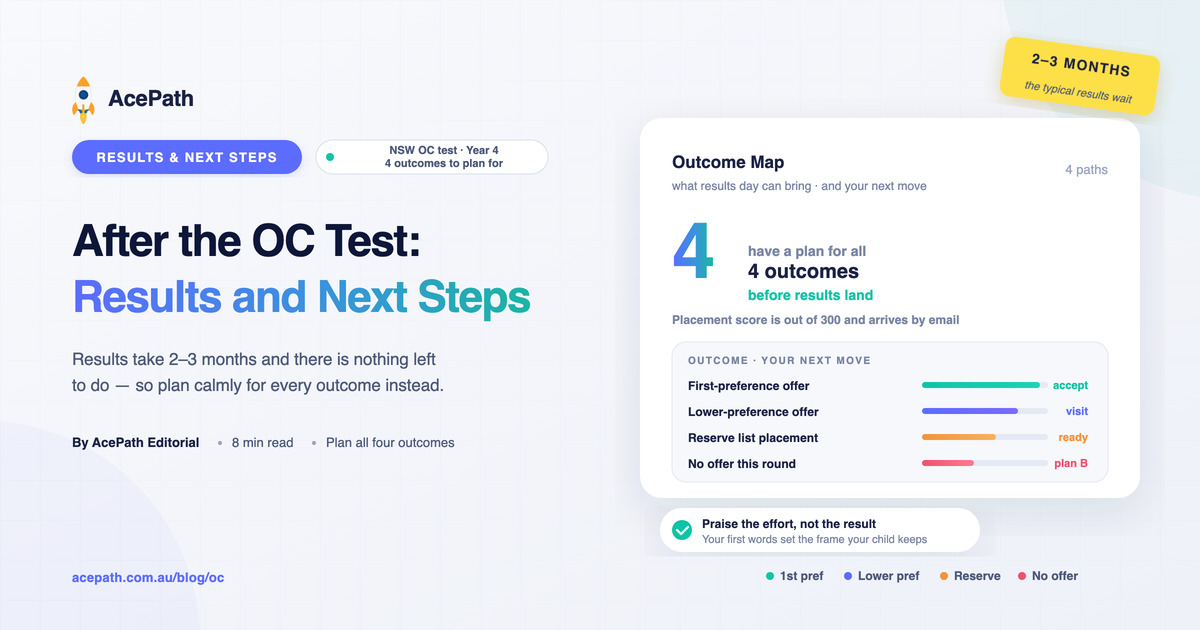
Test day passes quickly. Then comes the waiting — typically 2 to 3 months before results are released. This period is often harder on parents than the preparation was, precisely because there is nothing more to do. Here's how to handle it well, and how to prepare for the various outcomes.
Managing the Waiting Period
Resist Over-Discussion
It is tempting to revisit the test repeatedly — "how did you find the Maths section?", "do you think you got the Thinking Skills questions?" — but this rarely helps anyone. Your child has no control over the outcome now. Dwelling only raises anxiety.
Normalise Life
Return to regular routines as quickly as possible. If your child dropped activities during preparation, reintroduce them. Life is bigger than any one placement test, and modelling that helps your child keep perspective.
Plan for Multiple Outcomes
Privately (not with your child yet), start thinking about what happens if:
- Your child is offered their first-preference school
- Your child is offered a second or third or fourth preference
- Your child is placed on the reserve list
- Your child does not receive an offer
Having a calm plan for each scenario helps you respond steadily regardless of outcome.
When Results Are Released
What You'll Receive
Typically via email:
- Your child's overall placement score out of 300
- Sectional breakdown (sometimes provided — check the current year's process)
- Notification of whether an offer is made
- If an offer is made — which of your 4 preferred schools is offering the place
- Acceptance instructions and deadlines
How to Respond
Regardless of outcome, your first response to your child should emphasise effort, not result. Something like: "You worked so hard and gave it your best. I'm proud of you."
After that, have a factual conversation about next steps. Avoid bringing strong emotion (positive or negative) into the first discussion — your child will absorb whatever frame you set.
If Your Child Is Offered a Place
Review the Offer Carefully
Confirm which school has offered, when the offer must be accepted or declined, and what acceptance involves. Missing deadlines can cost you the place.
Visit the School Before Accepting
If possible, visit the school with your child — even briefly — before accepting. A school that looked attractive on paper may feel different in person. Schools also usually run welcome or induction events around this time.
Prepare for the Transition
OC is a different environment. The academic intensity, peer group, and pace may be more demanding than your child's current school. Support the transition with:
- Open conversations about expectations
- Connection with other new OC students if possible
- Emotional check-ins during the first term
If Your Child Is on the Reserve List
Understand What This Means
Reserve list placement indicates your child met the required standard but not enough of the specific school's places were available at the time of first-round offers. As other families decline offers, places may become available and are offered to reserve-list students in order.
Stay Responsive
Check email regularly. Reserve list offers can come weeks or even months after the initial round. Families who miss the communication window lose the opportunity.
Plan B Matters
Don't rely on a reserve offer coming through. Make arrangements for your child's Year 5 at another school, and treat any reserve offer as a bonus rather than a plan.
If Your Child Does Not Receive an Offer
Keep Perspective
This is the hardest outcome, but not the end of academic opportunity. Many students who do not receive OC offers perform strongly at their local school, receive Selective school offers in Year 7, and go on to excellent HSC results.
The OC program serves about 2,250 students across NSW. Many tens of thousands of students — most capable, bright children — do not end up in OC and still thrive.
Debrief With Your Child
After the initial emotional moment, have a clear conversation:
- "This doesn't change how capable you are"
- "The test is just one moment — it doesn't define you"
- "There are lots of good ways to have a great school experience"
Children often take the outcome as a personal judgement. Correct this framing gently and repeatedly.
Consider Selective in Year 7
If your child is academically capable, the Selective High School test in Year 6 is another major opportunity. Students who do not make OC often succeed in Selective — the two tests are independent, and extra years of growth can significantly shift results.
Focus on Current Schooling
Your child's Year 5 and 6 experience at their current school still matters. Encourage engagement, reading, and independent learning. Good habits at any school build strong foundations for later opportunities.
Should You Appeal?
The NSW Department of Education has a limited appeal process for placement decisions. Appeals are typically considered only for documented procedural errors, not for general dissatisfaction with the result. If you believe there was a genuine error (for example, a technical issue on test day that was not properly handled), consult the official appeal guidelines on the Department's website.
Plan the Longer Game
Whatever the result, use this period to plan the next 3 years:
- Build reading and thinking habits regardless of current school
- Maintain an interest in maths reasoning and logic puzzles
- If Selective High School is a target, begin preparation in Year 5
- Remember — a strong student grows into strong academic outcomes, regardless of which school they attend
Continue Building Skills
If your child is considering Selective in Year 7, now is a good time to keep momentum. Our Selective practice packs pick up from where OC preparation leaves off, continuing skill development through Year 5 and 6. The work you've already invested is not wasted — it builds directly into the next stage.
Start Practising Today
Try a free sample quiz to experience AcePath's exam-style practice tests.
Try Sample Quiz Register Free