Common OC Test Mistakes (and How to Avoid Them)
The Hidden Cost of Avoidable Errors
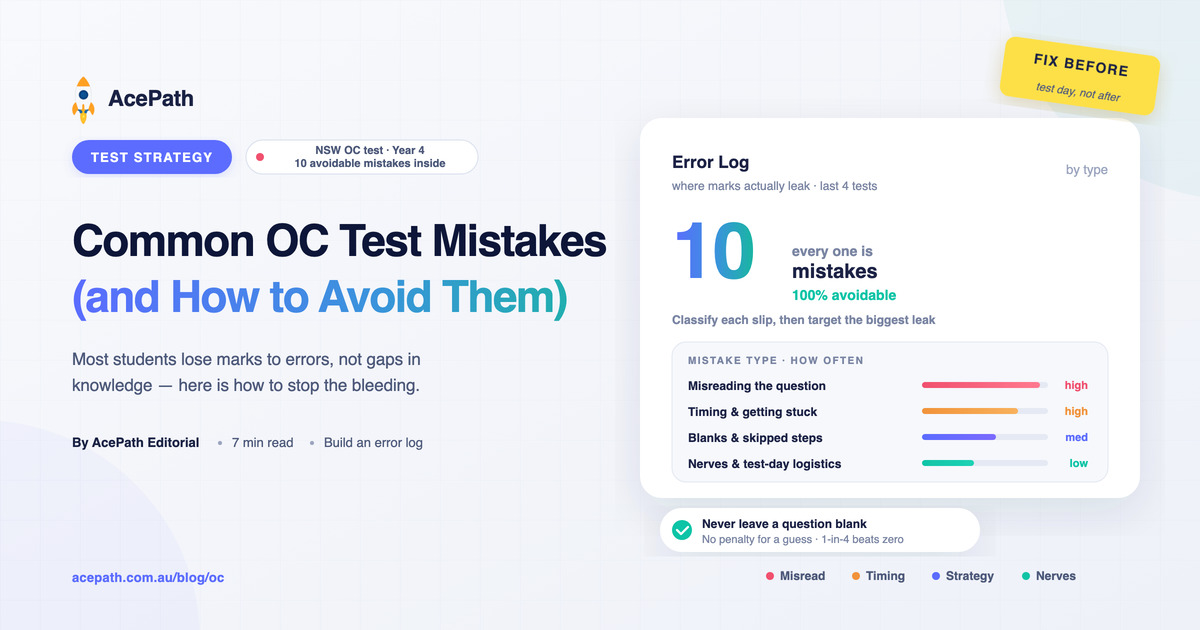
Many students who fall just short of an offer did not fail due to lack of knowledge — they lost marks to avoidable mistakes. Understanding these common errors and building habits to prevent them is often the highest-return preparation activity in the final months.
Mistake 1: Misreading the Question
The single most common cause of lost marks. Students read quickly, assume they know what is being asked, and answer the wrong question entirely.
Common examples:
- Missing a "NOT" or "EXCEPT" in the question
- Answering what "the author feels" when asked what "the character feels"
- Calculating perimeter when the question asks for area
How to fix: Teach your child to underline the exact question being asked. In practice, get them to verbalise: "The question is asking me for ___."
Mistake 2: Spending Too Long on One Question
Students sometimes invest 3–4 minutes on a single hard question, then run out of time for 5 easier ones at the end. That is a net loss of 4 marks to save 1 mark.
How to fix: Build a strict skip rule — if a question feels hard after 45 seconds, flag and move on. Return at the end if time allows.
Mistake 3: Leaving Questions Blank
There is no penalty for wrong answers. Every blank question is a guaranteed zero, while a guess has at least a 1-in-4 chance of being correct.
How to fix: Build a "never leave blank" habit. In the final 2 minutes, fill in any remaining questions, even randomly.
Mistake 4: Relying on Memory Instead of the Passage
In Reading, students sometimes answer questions based on what they remember from reading the passage, rather than going back to check. This leads to confident but wrong answers.
How to fix: For every Reading question, locate the relevant section in the passage before choosing. This takes a few extra seconds but dramatically improves accuracy.
Mistake 5: Poor Handling of Multi-Part Questions
Word problems with 2–3 steps often trip students up because they solve the first step correctly but stop there, or they skip a step.
How to fix: Teach your child to write down each step before calculating. "Step 1: find X. Step 2: use X to find Y. Step 3: calculate the final answer." This structure prevents lost steps.
Mistake 6: Panicking at Unfamiliar Questions
Even with strong preparation, some questions will feel unfamiliar. Students who panic spend too much time frozen or give up entirely. Those who stay calm often realise the question is solvable with what they know.
How to fix: Normalise unfamiliarity in practice. When a strange question appears, the response should be "OK, let me break this down" rather than "I can't do this."
Mistake 7: Over-preparing and Running Out of Energy
Some families do so much preparation that the student is exhausted by test day. Peak performance requires rest, not more practice.
How to fix: In the final week, reduce practice intensity. No new topics. Light review only. Focus on sleep, nutrition, and confidence.
Mistake 8: Not Practising Under Real Test Conditions
Students who have only done untimed, relaxed practice often collapse under real test pressure. Conditions matter.
How to fix: At least every 2 weeks, do a full-length timed practice test — same length, same format, same time pressure as the real exam. Do it at the same time of day as the real test if possible.
Mistake 9: Poor Test-Day Logistics
Late arrivals, forgotten Test Authority Letters, missed breakfast, uncomfortable clothing — all avoidable, all affect performance.
How to fix: Plan test-day logistics a week in advance. Dry-run the travel. Pack the night before. Keep everything simple.
Mistake 10: Obsessing Over Results Prematurely
Some students become so focused on "will I get in?" that the stress affects performance. Others obsess post-test, analysing every question.
How to fix: During preparation, focus on improvement, not outcome. After the test, move on — nothing can be changed now. Results come when they come.
Building an Error Log
An error log is one of the highest-value preparation tools. After each practice test:
- List every mistake
- Classify each mistake (misread, timing, strategy, skill gap)
- Note which type of mistake appears most often
- Target that weakness in the next week's practice
Patterns emerge quickly — most students make the same 2–3 types of mistakes repeatedly. Fixing those has the biggest score impact.
Identify Your Child's Mistake Patterns
Start with a free AcePath sample quiz to see where mistakes are happening. Our practice packs include detailed solutions that explain not just the correct answer but the reasoning, which is exactly what error-log practice requires.
Start Practising Today
Try a free sample quiz to experience AcePath's exam-style practice tests.
Try Sample Quiz Register Free