How OC Placement Scores Are Calculated (And What They Mean)
Why Score Mechanics Matter
Most parents focus on "passing" the OC test without understanding how scores actually work. That's a mistake. The OC test does not have a pass mark — it is a ranking assessment. Your child's score is compared against every other applicant, and places are allocated from the top down.
Knowing how the scoring system works helps you set realistic goals, choose appropriate school preferences, and avoid emotional responses to results that aren't helpful to your child.
From Raw Score to Placement Score
The OC placement score is not simply a count of correct answers. It goes through three stages:
Stage 1: Raw Score
Each of the three sections (Reading, Mathematical Reasoning, Thinking Skills) produces a raw score — the number of questions answered correctly. There are no penalties for wrong answers.
Stage 2: Scaled Score
Every correct response earns a mark: the Department says each individual response is worth 1 mark, and questions with several parts are worth more than 1. Because students sit different versions of the test on different days, results are then put on a common scale so they can be compared fairly across versions — no version gives an advantage.
Stage 3: Weighted Placement Score
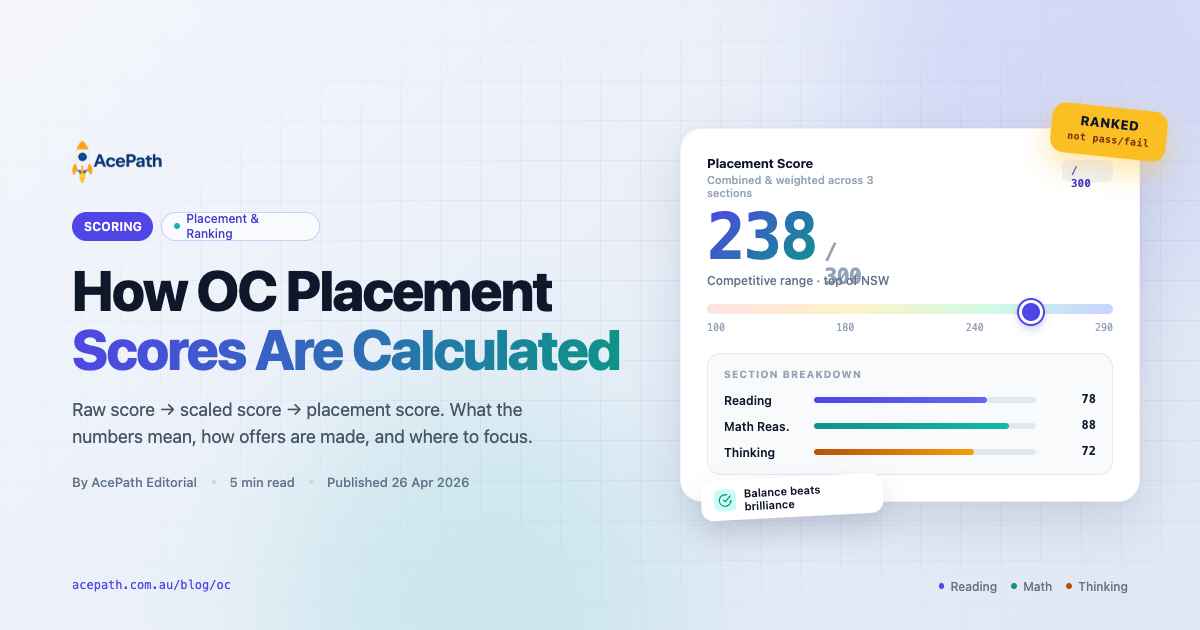
The three sections are weighted equally — a third each — and combined into a single placement score used to rank all applicants across NSW. Note that the NSW Department of Education does not release this number, or a placement rank, to families — you receive a Performance report showing which band your child fell into for each section (the report cites student wellbeing and privacy as the reason scores are no longer shared).
How the Placement Score Determines Offers
All applicants are ranked by placement score from highest to lowest. Offers then go out in this order, honouring each student's school preferences (up to 4 schools for OC — one more than the 3 allowed for selective high school).
This is why two students with the same score can have very different outcomes — if one chose popular schools and the other chose less competitive ones, their offers will differ even though their scores are equal.
The Role of School Preferences
Your 4 nominated schools act as a filter. If a student's score qualifies them for their first choice, that is the offer they receive. If their score is too low for first choice but high enough for second, they get second choice. And so on down to the fourth. The order never changes your odds at any single school — it only decides which offer you receive if your child qualifies for more than one.
Strategy matters:
- First choice — an aspirational school where entry is possible but not guaranteed
- Second choice — a realistic target based on expected score
- Third & fourth choices — safety options where entry is more likely
Nominating four highly competitive schools is a common mistake. If your child just misses the cutoff for all four, they receive no offer — even if a less competitive school would have accepted them. The fourth preference (unique to OC) is a useful safety slot — use it.
Why Scores Fluctuate Year to Year
The cutoff score for any given school changes every year based on:
- The difficulty of the test that year (harder tests = lower cutoffs)
- The number of applicants
- How applicants ranked that school
- The number of available places
This is why "last year's cutoff" is a rough guide, not a fixed target. Focus on maximising your child's score rather than hitting a specific number.
What the Numbers Online Actually Are
You will see specific figures quoted everywhere — "you need 220 for this school", "the cutoff was 248 last year". Be clear about what these are: unofficial estimates. The NSW Department of Education does not release placement scores or ranks, and it states there are no set minimum entry scores to receive an OC offer. The "cutoffs" circulated by coaching centres and forums are reverse-engineered guesses, not published numbers.
What you actually receive is the Performance report, which shows, for each of the three sections, which band your child fell into relative to everyone who sat the test that year — not a mark or a rank. Read in band terms, the honest picture is simpler: to be competitive for the most sought-after OC schools, children generally need to be in the top band across all three sections; less competitive schools accept a wider spread of bands.
So don't chase a specific number that doesn't officially exist. Chase consistent, well-rounded performance across all three sections.
Section Balance Matters
Because the three sections are weighted and combined, a weak section pulls down the total. A student who scores exceptionally in Maths but poorly in Reading may end up behind a more balanced student with moderate scores across all three.
This is why preparation should cover all three areas, with extra focus on the weakest. Identify weak areas early using a diagnostic sample quiz and build from there.
Practical Takeaways for Parents
- Don't fixate on pass/fail thinking — OC is a ranking, not a test to "pass"
- Balance sections — weak areas hurt more than strong areas help
- Choose school preferences strategically — mix aspirational, realistic, and safety choices
- Don't compare to last year's cutoffs — they change every year
- Focus on the process — consistent preparation, not score obsession
Start with a Clear Starting Point
Before setting score goals, establish a baseline. Take a free AcePath sample quiz to see where your child currently stands across Reading, Mathematical Reasoning, and Thinking Skills. Then use our structured practice packs to systematically improve — section by section, week by week.
Start Practising Today
Try a free sample quiz to experience AcePath's exam-style practice tests.
Try Sample Quiz Register Free