Mathematical Reasoning for OC: 7 Question Types You Must Know
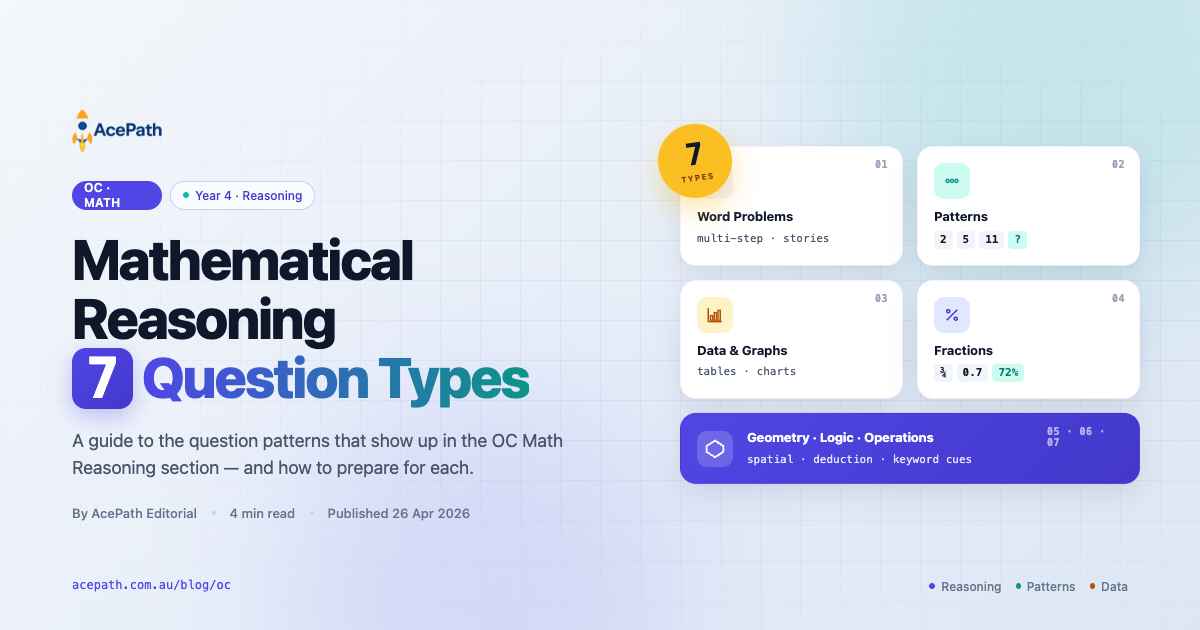
More Than Maths
The Mathematical Reasoning section is not a repeat of what your child does in Year 4 classroom maths. It assesses how well students apply mathematical thinking to unfamiliar problems. Calculation skills matter, but reasoning matters more.
Below are the 7 main question types you should prepare for, with strategies that work.
In the OC test the section has 35 multiple-choice questions in 40 minutes, each with five options, and calculators are not allowed (the Selective test also has 35 questions in 40 minutes). That is just over a minute per question, so recognising the question type quickly matters.
1. Multi-Step Word Problems
These wrap a mathematical problem inside a real-world story. Students need to extract the relevant numbers, identify what operation is required, and often perform several steps in sequence.
Example skill: "A bus leaves at 8:15 and takes 42 minutes. After a 10-minute stop, it continues for another 28 minutes. What time does it arrive?"
Strategy: Teach your child to underline key numbers and circle what is being asked. Write out each step before calculating.
2. Pattern and Sequence Questions
Students identify the rule in a number or shape sequence, then find missing terms or predict the next element.
Example skill: Finding what comes next in sequences like 2, 5, 11, 23, ?
Strategy: Look at differences between terms first (3, 6, 12 — doubling). Then check multiplications, additions, and combined operations.
3. Data Interpretation (Tables and Graphs)
Questions present bar charts, line graphs, pie charts, or tables and ask students to read, compare, or calculate with the data.
Example skill: "Looking at the graph, how much more did Sarah save in March than in January?"
Strategy: Always read axis labels and units first. Don't assume the scale. Practice with real data from news articles or sports statistics.
4. Fraction, Decimal, and Percentage Problems
These test understanding of equivalence, conversion, and comparison between different number forms.
Example skill: "Which is greater: 3/4, 0.7, or 72%?"
Strategy: Convert everything to the same form (usually decimals) for comparison. Memorise common equivalents: 1/4 = 0.25 = 25%, 1/2 = 0.5 = 50%, 3/4 = 0.75 = 75%.
5. Geometry and Spatial Measurement
Perimeter, area, volume, angles, and spatial relationships. Students may need to calculate or visualise 2D and 3D shapes.
Example skill: "A rectangle has area 24 cm² and width 4 cm. What is its perimeter?"
Strategy: Keep the core formulas front of mind — area of rectangle = length × width, area of triangle = ½ × base × height. Draw the shape if it is not given.
6. Logic and Deduction with Numbers
These combine maths with reasoning — constraints, elimination, and systematic checking.
Example skill: "Anna, Ben, and Chloe each picked a different card: 3, 5, or 8. Anna's number is even. Ben's is less than 5. What did Chloe pick?"
Strategy: Write down all possibilities, then eliminate systematically using the given constraints.
7. Worded Number Operations
Questions that test whether students recognise which operation applies to a given scenario.
Example skill: "Packets come in boxes of 6. A shop has 5 boxes and sells 11 packets. How many packets are left?"
Strategy: Teach keyword recognition — "in total" usually means add, "each" often means multiply or divide, "difference" means subtract. But read carefully, because the wording can be tricky.
The Common Thread: Read Before You Calculate
The biggest cause of wrong answers in Mathematical Reasoning is not calculation error — it is misreading the question. Teach your child to:
- Read the whole question first, without calculating
- Identify exactly what is being asked (what is the final answer looking for?)
- Note any key words or constraints
- Plan the steps mentally before writing anything down
How to Practise Effectively
- Identify weak question types using a diagnostic
- Do targeted practice — 10 questions of the same type in a row builds recognition
- Mix types in timed practice once skills are stronger
- Review mistakes by type — keep a list of which types need more work
Get a Starting Point
Try a free AcePath sample quiz to see which of these 7 types your child handles well and which need focus. Our Mathematical Reasoning practice packs are organised by question type so you can target the weak areas directly rather than grinding through mixed practice.
Start Practising Today
Try a free sample quiz to experience AcePath's exam-style practice tests.
Try Sample Quiz Register Free