Year 3 vs Year 4 OC Prep: When to Start and What to Do First
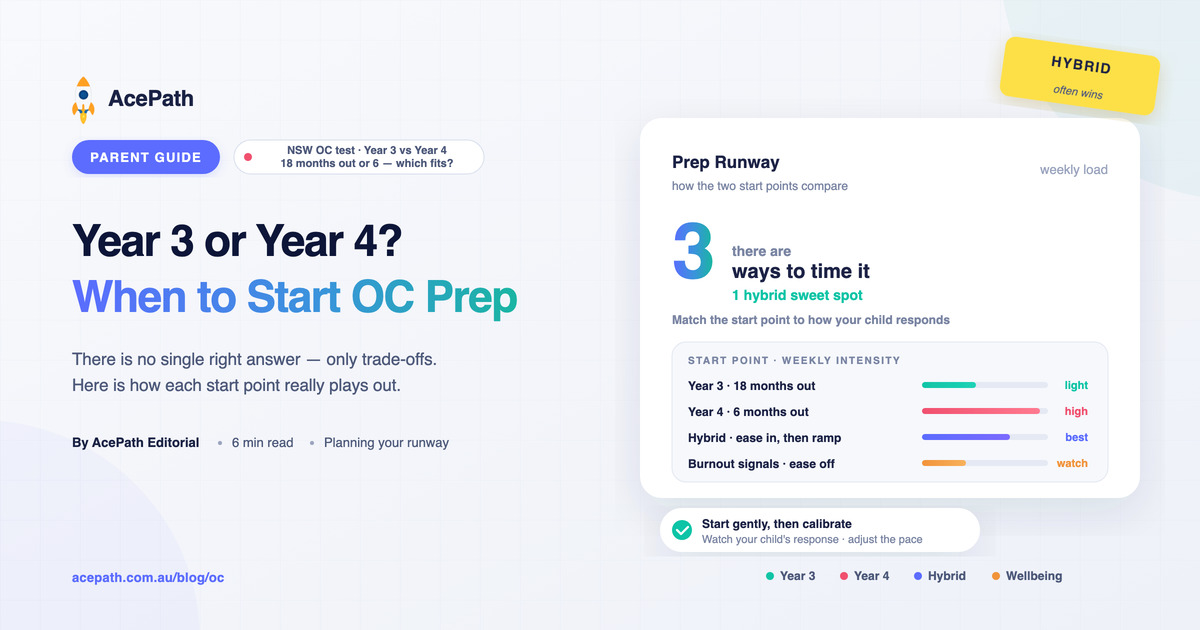
The Question Every OC Parent Asks
"When should we start?" There is no single right answer — but there are clear trade-offs. Starting earlier means less pressure per session and more time to build deep skills. Starting later keeps things more intense but focused.
Here is what each approach looks like in practice, and how to decide which fits your family.
Starting in Year 3 (About 18 Months Before the Test)
What It Looks Like
Light, casual preparation embedded into family life. 2 to 3 short sessions per week, maybe 20 minutes each. Focus on exposure and interest, not mastery.
Pros
- No pressure — your child builds skills without anxiety
- Habits form naturally — by Year 4, study is already part of routine
- More time for weak areas — you can identify gaps early and address them gradually
- Better quality practice — spaced learning sticks better than crammed learning
Cons
- Burnout risk — if Year 3 preparation is too intense, your child is already tired by Year 4
- Wasted effort — if you over-prepare on easy content, the real challenge later feels jarring
- Family time trade-off — more months committed to study
What to Do in Year 3
- Build strong reading habits — 20 to 30 minutes daily reading of varied materials
- Introduce maths reasoning puzzles — word problems, pattern games, logic books
- Play with thinking skills — visual puzzles, Sudoku, Rubik's cube, shape games
- Try a diagnostic quiz — get a baseline without expectations
- Focus on enjoyment — if your child resists, dial back. Forced learning backfires
Starting in Year 4 (About 6 Months Before the Test)
What It Looks Like
Structured, focused preparation with a clear schedule. 3 to 5 sessions per week, 30 to 45 minutes each. Goal is targeted improvement across all three test areas.
Pros
- More mature learner — Year 4 students have better stamina and focus
- Shorter commitment — less total time investment
- Higher urgency = higher engagement — some kids respond better when the goal feels real
- Less risk of over-preparation — unlikely to peak too early
Cons
- Less room for weak areas — major gaps are harder to fix in 6 months
- Higher weekly intensity — more pressure per session
- Stress builds as test approaches — less buffer if things slip
What to Do in Year 4
- Diagnostic first — identify strengths and weaknesses immediately
- Weekly structured plan — rotate through Reading, Maths Reasoning, Thinking Skills
- Start timed practice early — by month 3, most sessions should be timed
- Full-length practice tests every 2–3 weeks in the final 3 months
- Protect sleep and wellbeing — a tired Year 4 student underperforms regardless of how much they studied
A Hybrid Approach That Often Works Best
Many families find the sweet spot is light preparation in Year 3, intensifying in Year 4. This gets the benefits of early habit-building without the burnout risk of 18 months of heavy study.
Example hybrid plan:
- Year 3 Term 3 (Jul–Sep): Build reading habit, casual maths puzzles
- Year 3 Term 4 (Oct–Dec): Introduce short practice questions (10 mins, 3× per week)
- Year 4 Term 1 (Feb–Apr): Diagnostic test, identify weak areas, begin structured sessions
- Year 4 Term 1 → Term 2 (Mar–Apr): Full structured practice schedule, first timed tests
- Year 4 Term 2, weeks 1–2 (late Apr): Regular full-length practice, focus on endurance and timing
- Year 4 Term 2, week 3 (early May): Wind down. Light review only. Prioritise sleep, routine, and confidence
Signs You Should Ease Off
Regardless of timing, watch for signs that preparation is doing more harm than good:
- Your child resists study sessions consistently
- Sleep or appetite changes
- Increased anxiety about school in general, not just the OC test
- Dropping performance despite more practice
If any of these appear, reduce intensity. No placement test is worth a child's wellbeing.
Start Small and See What Works
The simplest way to decide timing is to start gently and watch your child's response. A free AcePath sample quiz gives you a realistic benchmark and takes only 5 minutes. Based on how your child engages with it, you can calibrate how much preparation makes sense.
From there, our structured practice packs give you a clear week-by-week path — whether you are starting 18 months out or 6 months out.
Start Practising Today
Try a free sample quiz to experience AcePath's exam-style practice tests.
Try Sample Quiz Register Free