Best Selective High Schools in NSW: How to Compare Them
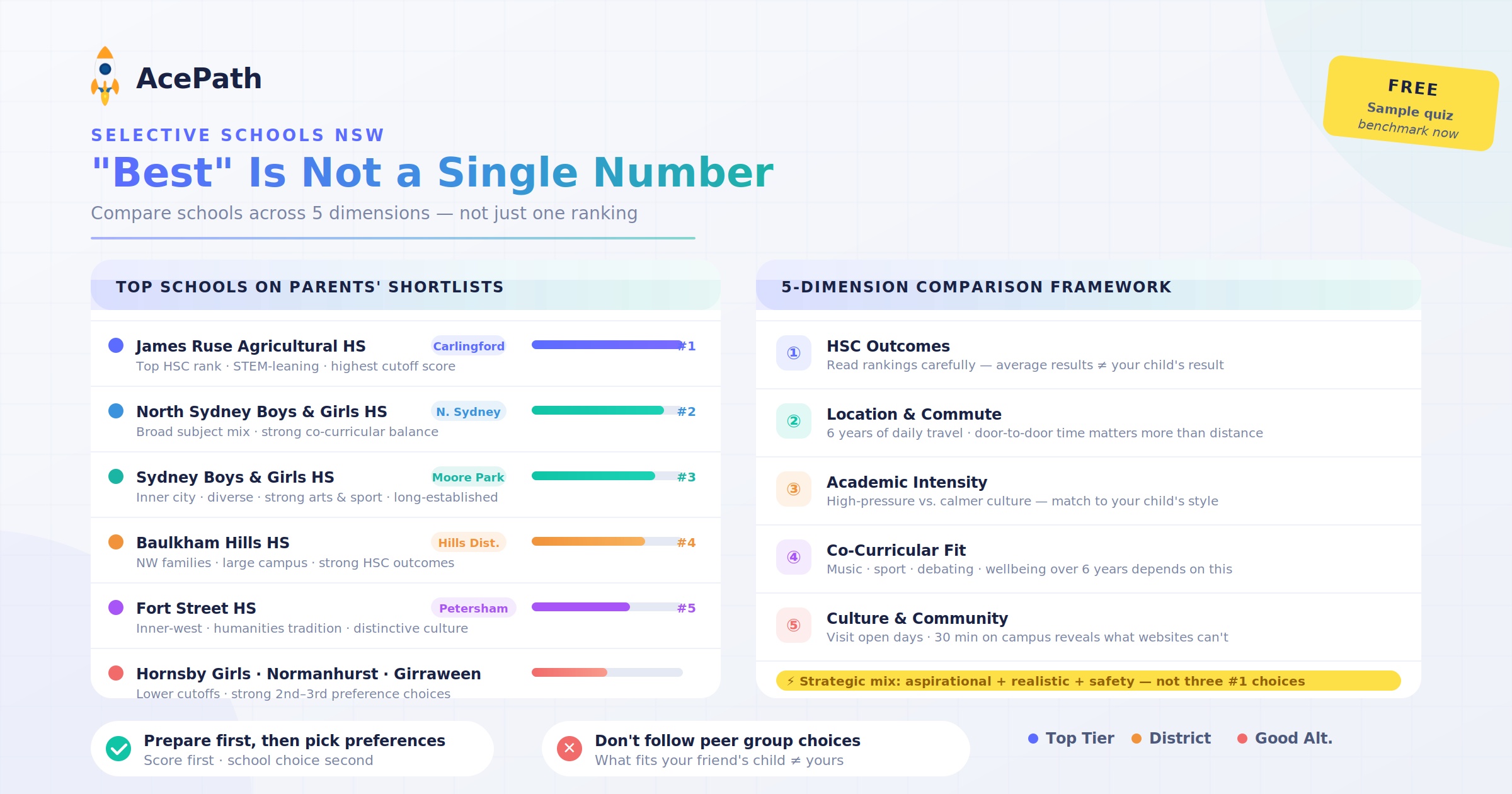
"Best" Is Not a Single Number
Parents often ask "which is the best Selective school?" and expect a ranked list. The honest answer is: the best school is the one that best fits your child. Two schools with nearly identical HSC rankings can feel completely different on the ground. A realistic comparison uses several dimensions, not just one number.
Here are the schools families most often ask about, and a practical framework for thinking about which fits.
The Schools Most Commonly on Parents' Shortlists
James Ruse Agricultural High School (Carlingford)
Ranked first in NSW on HSC outcomes for 27 consecutive years, from 1996 to 2022, and has placed second in the state since 2023. Highly academic, STEM-leaning, and known for a focused, high-achievement culture. Entry is among the most competitive in the state.
North Sydney Boys and North Sydney Girls High Schools
Strong HSC performance across a broad subject mix; North Sydney Boys has ranked first in NSW in 2023, 2024 and 2025, ending James Ruse's long run at the top. Well-balanced academic and co-curricular programs, and consistently among the most competitive schools to get into.
Sydney Boys and Sydney Girls High Schools
Located in Moore Park (inner city). Long-established Selective schools with strong academic results, diverse student bodies, and extensive sporting and arts programs. A common top-preference choice for eastern-suburbs families.
Baulkham Hills High School
Leading Selective school in the Hills district. Strong HSC outcomes and a large, well-resourced campus. A natural top choice for families in the north-west.
Hornsby Girls High School
Long record of strong academic performance with a focused, supportive culture. Popular with families in the upper North Shore.
Fort Street High School (Petersham)
Inner-west Selective with a strong humanities and academic tradition. Smaller footprint than some other top schools, with a distinctive cultural identity.
Normanhurst Boys and Girraween High Schools
Solid academic results with entry cutoffs below the very top tier. Often appear as strong second or third preference choices.
A Framework for Comparing Schools
1. HSC Outcomes (But Read Them Carefully)
Published HSC rankings tell you average performance, not how well the school would serve your child. A school ranked 1 that doesn't suit your child's learning style may produce a worse outcome than a school ranked 6 that fits well. Look at results, but don't let them be the only factor.
2. Location and Commute
Six years of daily travel adds up. A school 20 minutes away is very different from one that requires 75 minutes each way. Consider not just distance but realistic door-to-door travel time on a school morning.
3. Academic Intensity
All Selective schools are academically demanding, but the intensity varies. James Ruse is famously high-pressure. Others are equally strong academically with a calmer culture. Think about which environment your child will thrive in.
4. Co-Curricular Fit
If your child loves music, sport, debating, or a specific niche, compare what each school offers in that area. Strong academic results matter, but wellbeing over six years often depends on other activities.
5. Culture and Community
Open days reveal more than websites. Look at how students interact, how teachers engage, and how comfortable your child feels in the space. Culture is hard to quantify but easy to feel.
6. Strategic Preference Placement
Because offers are allocated by placement score and preference order, including a mix of aspirational, realistic, and safety schools matters more than nominating three top-tier schools.
Common Mistakes in School Comparisons
- Treating rankings as destiny — students at #6 can absolutely outperform students at #1 in their own HSC outcomes
- Ignoring fit — a high-pressure environment breaks some students and energises others
- Underweighting commute — tired children underperform academically, regardless of school brand
- Following peer group choices — what your friend's child chose isn't a good reason for your child
Visit Before You Rank
Before finalising your 3 preferences, attend open days for at least 2 shortlisted schools with your child. Thirty minutes on campus reveals things no research can.
Prepare First, Pick Second
No school preference matters until your child has a competitive placement score. Start with a free AcePath sample quiz to benchmark current performance, then our Selective practice packs build systematic preparation. Once you have a realistic sense of expected score, you can choose preferences with confidence.
Start Practising Today
Try a free sample quiz to experience AcePath's exam-style practice tests.
Try Sample Quiz Register Free