The NSW Selective Writing Test: 25% of the Score, Explained
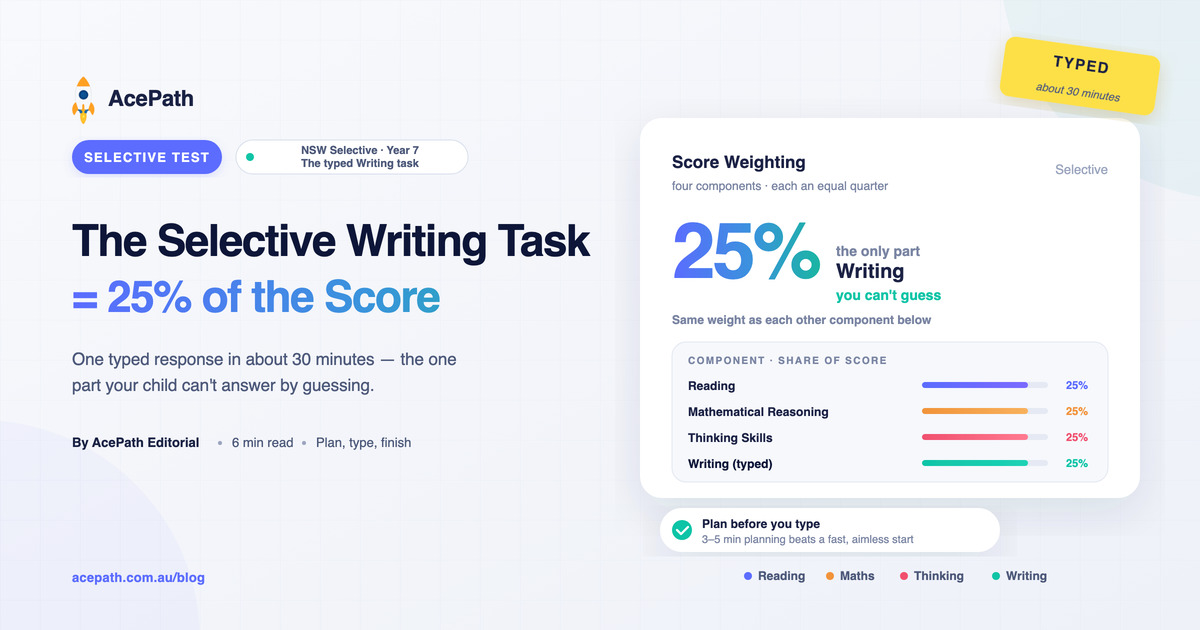
Writing is worth 25% of the NSW Selective High School Placement Test — the same weight as Reading, Mathematical Reasoning, and Thinking Skills — yet it is the one component you cannot answer by guessing, and the one most families under-prepare for. It is a single typed task of about 30 minutes, and how your child plans and paces those 30 minutes is often the difference between a place and the reserve list.
This guide explains exactly how the Writing task works, why a quarter of the total score rides on it, the mistakes that quietly cost marks, and a preparation routine that actually moves the needle. (Note: the OC placement test does not include Writing — it applies to the Year 7 Selective test only.)
Why Writing Is 25% of the Score
The Selective test has four components, and each one contributes an equal 25% to the total mark:
- Reading — multiple choice
- Mathematical Reasoning — multiple choice
- Thinking Skills — multiple choice
- Writing — one typed extended response
Three of the four components are multiple choice, where a lucky guess can still land a mark. Writing is different: every mark is earned from a blank screen. That makes it the highest-leverage component to train, because small, teachable improvements — a clearer structure, a stronger opening, finishing on time — translate directly into marks that competitors leave on the table.
It also means Writing is where preparation gaps show up most. A child who has drilled hundreds of multiple-choice questions but never practised a timed, typed response is walking into a quarter of the exam cold.
How the Writing Task Works
One typed task, about 30 minutes
Since the test moved fully computer-based, the Writing response is typed, not handwritten, and students have roughly 30 minutes. Crucially, that 30 minutes has to cover everything: reading the stimulus, planning, writing, and checking. Children who start typing immediately almost always run out of ideas halfway through; children who plan for a few minutes first tend to write faster and more clearly.
The stimulus
Students are given a stimulus to respond to — this may be an image, a quote, a short scenario, a single word or theme, or a combination. The stimulus is a springboard, not a cage: the marker wants to see how your child develops an idea from it, not a literal description of it.
The genre may or may not be specified
The task may name the genre to write in — narrative (a story), persuasive (an argument), or discursive (exploring a topic from several angles) — or it may leave the choice open. Because your child cannot be certain which will appear, they need to be comfortable in all three. A student who has only ever practised narratives is exposed if a persuasive prompt turns up on the day.
What Markers Are Actually Rewarding
Markers read for a consistent set of qualities. Aim your practice at these rather than at word count:
- Ideas and content — an interesting, developed response that genuinely engages with the stimulus
- Structure — a clear beginning, middle, and end; paragraphs that lead somewhere
- Language — precise, controlled vocabulary and sentence variety, used correctly
- Mechanics — accurate spelling, punctuation, and grammar under time pressure
One counter-intuitive truth: clarity beats sophistication. Reaching for big, half-understood words that create errors scores worse than writing clean, correct, confident sentences. The strongest responses write clearly first, then elevate only where the child is genuinely in control.
The Mistakes That Quietly Cost Marks
- No planning. Diving straight into typing burns the idea reserve early and produces a response that drifts.
- Ignoring the stimulus. A pre-memorised story bolted onto an unrelated prompt reads as exactly that, and markers notice.
- Running out of time. An unfinished piece with no ending loses structure marks no matter how strong the opening was.
- Over-reaching vocabulary. Misused "impressive" words create errors and break the flow.
- Never practising typed. Slow, hunt-and-peck typing eats minutes that should go to thinking and writing.
- Only practising one genre. Being fluent in narrative but lost in persuasive is a real risk on test day.
A Preparation Routine That Works
1. Start from the official baseline
Begin with the NSW Department of Education's official Selective sample materials so you know exactly what the real task looks and feels like. Everything else builds on that reference point.
2. Build a weekly rhythm, not a last-minute sprint
Alternate short, focused sessions: one week a timed narrative, the next a persuasive, then a discursive. Rotate the three genres so none becomes a blind spot. Consistency over months beats cramming in the final weeks.
3. Always practise typed and timed
Because the real task is typed on a screen in 30 minutes, practice must be too. Have your child type — not handwrite — every practice piece, with a visible timer, so planning and pacing become automatic rather than a shock on the day.
4. Teach a simple planning habit
Spend the first 3–5 minutes deciding the idea, the shape (beginning–middle–end or point–reasons–conclusion), and the ending before typing the first sentence. A child who knows how their piece finishes writes the middle far more efficiently.
5. Get real feedback
Writing improves through targeted feedback, not volume alone. Your child needs to know which specific habit to change next — a weak opening, thin paragraphs, comma errors — and then practise that one thing. This is where marked practice with clear, criteria-based comments matters most.
Frequently Asked Questions
Does the OC test include Writing?
No. The OC placement test has three multiple-choice sections — Reading, Mathematical Reasoning, and Thinking Skills. Writing applies only to the Year 7 Selective High School Placement Test.
How long is the Writing task?
About 30 minutes for one typed extended response, and that time includes reading the stimulus, planning, writing, and checking.
Is the Writing handwritten or typed?
Typed. The Selective test is fully computer-based, so your child should practise typing their responses on a keyboard, not handwriting them.
What genre will the task be?
It may specify narrative, persuasive, or discursive, or leave the genre open. Because it is not announced in advance, prepare across all three.
How much does Writing affect the final result?
A lot — it is 25% of the total mark, equal to each of the other three components. Learn how the placement score is calculated to see how the components combine.
What's the single most useful habit to build?
Planning before typing. Three to five minutes deciding the idea, structure, and ending makes the writing faster, clearer, and far more likely to finish.
Where to Confirm the Official Details
Test formats can be refined year to year, so confirm the current rules through official sources before you plan:
- The NSW Department of Education selective high schools pages at education.nsw.gov.au, including the official sample test materials
- Official communications sent to you after you apply
Turn the 25% You Can't Guess Into Marks You Can Earn
Writing rewards preparation more visibly than any other part of the Selective test. Build the habit of timed, typed practice with real feedback: try AcePath's free sample quiz to benchmark Reading, Mathematical Reasoning, and Thinking Skills, then use our Selective practice packs — including AI-assisted writing marking that shows your child exactly what to fix next — to make all four components exam-ready. Pair this with our Selective test success tips and Thinking Skills strategies for a complete plan.
Start Practising Today
Try a free sample quiz to experience AcePath's exam-style practice tests.
Try Sample Quiz Register Free