From OC to Selective: Preparing OC Students for Year 7 Entry
The Natural Next Step
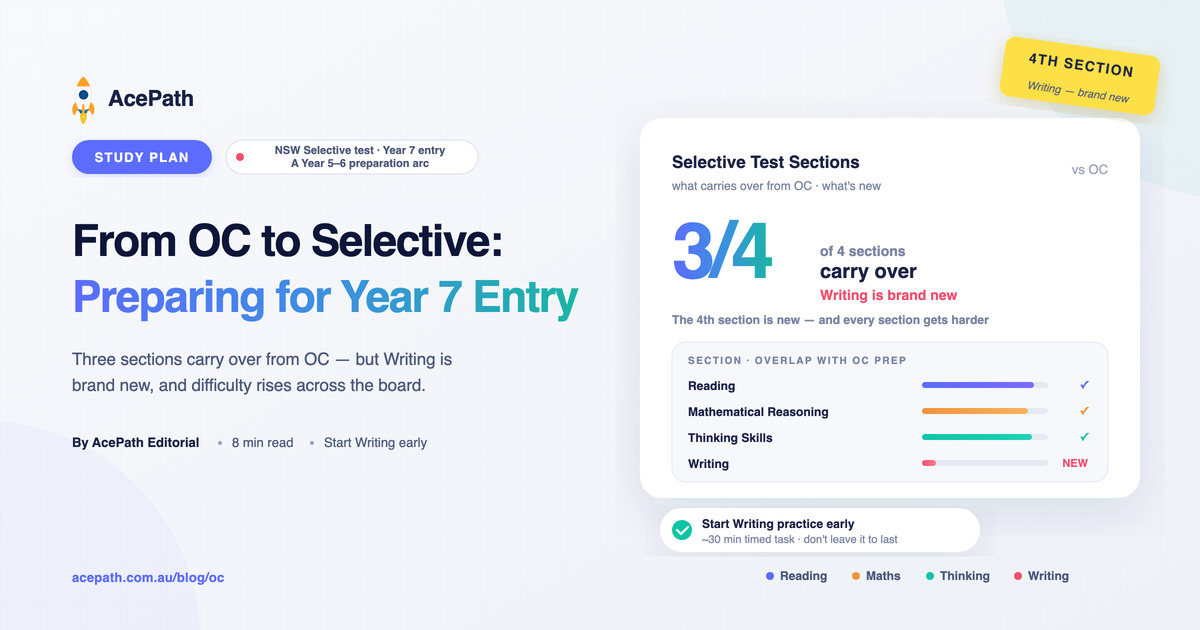
Most OC students eventually consider applying for Selective High School entry in Year 7. Three of the four Selective sections — Reading, Mathematical Reasoning, and Thinking Skills — overlap with OC, so OC students often have a strong foundation to build on. The Selective test adds a fourth section — Writing — which OC students have no prior exposure to. On top of that, difficulty across all sections rises. Selective is not simply "harder OC."
Here is how OC students should approach the transition.
What OC Students Already Have Going For Them
Established Study Habits
Students who came through OC preparation have learned how to study systematically. They know how to practice under time pressure, how to learn from mistakes, and how to maintain weekly routines. These meta-skills transfer directly.
Format Familiarity
The Cambridge-style format is shared between OC and Selective tests. Students who sat the OC test already know what computer-based multi-section testing feels like.
Peer Context
OC students are surrounded by peers preparing for Selective. This peer awareness is motivating and helps normalise the preparation process.
Foundation Skills
Core competencies developed during OC preparation — strong reading habits, confident maths reasoning, comfort with Thinking Skills — are exactly the foundation needed for Selective.
What Changes in the Selective Test
A New Section: Writing
The biggest structural change from OC is the addition of a Writing section — a timed written response (around 30 minutes) to a prompt or stimulus. OC students have no prior exposure to this. It is marked against a rubric covering written expression, structure, vocabulary, and grammar, and carries meaningful weight in the final placement score. Don't leave it until the last month.
Higher Difficulty Across the Board
Questions are calibrated for Year 6 students, so the content is more demanding. Maths problems may involve early algebraic thinking, negative numbers, and more complex geometry. Reading passages are longer and use more advanced vocabulary. Thinking Skills questions often combine multiple reasoning types in one question.
Greater Reading Stamina Required
Selective Reading passages are longer and more complex. Students need the endurance to read carefully for extended periods without losing focus.
Stronger Analytical Thinking
Questions increasingly require multi-step analysis. Instead of "what is the main idea," questions might ask "how does the author's use of imagery support their argument about X?" Students need to move beyond surface comprehension into analytical reading.
Time Pressure Is Tighter
The combination of harder questions and similar total time means students must work efficiently. Speed and accuracy together become more important.
A Year 5 / Year 6 Preparation Arc
First, know the key dates: the Selective High School Placement Test is held early in Term 2 of Year 6 — usually in early May — and applications open in October–November of Year 5. That means the bulk of preparation has to happen in Year 5. Once Year 6 begins, there is only about one term left before the test.
Year 5, First Half: Maintain and Extend
With OC preparation just behind them, don't try to peak early. This stage is about maintaining OC-level skills and gently pushing them further. Focus on:
- Reading more challenging material (young adult fiction, broadsheet-style children's news, analytical non-fiction)
- Extension maths — introducing pre-algebra concepts gently
- Harder Thinking Skills problems when OC-level questions feel easy
- Building vocabulary systematically
- Establishing a regular writing habit — untimed at first, focused on confidence and structure
Practice should feel challenging but not exhausting. 2–3 focused sessions per week is enough at this stage.
Year 5, Second Half: Structured Foundation
Start structured Selective preparation. Diagnostic test to establish baseline. Build weekly schedule rotating through all four sections — Reading, Maths Reasoning, Thinking Skills, and Writing. Begin with untimed practice to deepen understanding before adding time pressure. And don't forget the application itself — it opens in October–November of Year 5.
Year 6 Term 1: Build Intensity
Shift to timed practice. Introduce full-length Selective-format practice tests every 3–4 weeks. Start building an error log to identify patterns in weaknesses. Focus intensive practice on weak areas. Writing moves to fully timed tasks across a range of text types.
The Final 6–8 Weeks (Late Term 1 into Term 2)
Transition to weekly full-length timed practice. Reduce new learning; focus on consolidation, strategy, and confidence. Protect sleep and wellbeing. The test arrives early in Term 2 — usually the start of May.
Key Skill Areas to Develop Beyond OC Level
Reading
- Analytical reading — identifying author argument, evaluating evidence, recognising bias
- Vocabulary at depth — nuanced word meanings in context
- Cross-passage reasoning — comparing and contrasting multiple texts
- Poetry comprehension — imagery, tone, figurative language
Mathematical Reasoning
- Early algebra — solving for unknowns, understanding relationships
- Advanced problem-solving — multi-step problems with nested operations
- Proportional reasoning — ratios, rates, percentages in context
- Data analysis — interpreting complex graphs, drawing conclusions
- Geometric reasoning — angles, area/volume, spatial relationships
Thinking Skills
- Multi-layered reasoning — combining pattern + logic + spatial in one question
- Complex matrix patterns — 3×3 grids with intersecting rules
- 3D spatial visualisation — rotations in multiple axes
- Conditional logic — if/then/unless structures
Writing (New for OC Graduates)
OC students have no Writing section in their placement test experience, so this is genuinely new ground. Start building the skill early in Year 5:
- Structured responses — clear introduction, logically ordered body, purposeful conclusion
- Variety of text types — narrative, persuasive, discursive, descriptive, imaginative
- Timed practice — typically ~30 minutes per task, matching the Selective Writing section
- Vocabulary and sentence variety — aim for precision and range, not just length
- Feedback loop — self-review misses errors; a teacher, parent, or tutor catches patterns
Rest and Recovery Matter
OC students have been on a preparation journey for a year or more already. The months after the OC test and the first half of Year 5 should include genuine rest — school holidays without intensive study, a reduced weekly commitment, continued non-academic hobbies and sport. Burning out before the structured preparation phase even begins is a real risk.
The strongest Selective students are often those who reach the final sprint with energy, curiosity, and good habits — not those who pushed hardest at every stage.
Handle the Transition to High School Thinking
Selective preparation is also about cognitive maturity. Across Year 5 and Year 6, students should increasingly be expected to:
- Manage their own study schedules
- Identify their own weak areas
- Reflect on their own mistakes
- Articulate their own reasoning verbally
Parents should gradually step back from direct management of practice and step into a coaching role — asking good questions rather than directing content. This prepares students not just for the test, but for high school learning.
Start With Where They Are
Before jumping into Selective-specific material, take a diagnostic to see where your child currently stands at the Selective difficulty level. A free AcePath sample quiz can serve as an initial check. Then our Selective practice packs provide structured, year-long preparation that builds progressively from OC-level skills to full Selective readiness.
The work your child has already invested in OC preparation transfers directly. With the right next-stage plan, Selective success is a natural continuation of what they've already built.
Start Practising Today
Try a free sample quiz to experience AcePath's exam-style practice tests.
Try Sample Quiz Register Free