Mastering Thinking Skills: 5 Strategies for NSW OC and Selective Tests
Why Thinking Skills Often Decides the Outcome
Most NSW students have years of school exposure to Reading and Mathematics. Thinking Skills is different. It tests reasoning ability rather than learned knowledge, which is exactly why it catches unprepared students off-guard.
Because it sits outside the regular school curriculum, Thinking Skills is also the section where targeted practice delivers the biggest score improvements. Students who systematically work through question types can meaningfully move their results, often more than they can through extra maths or reading practice.
What Thinking Skills Actually Tests
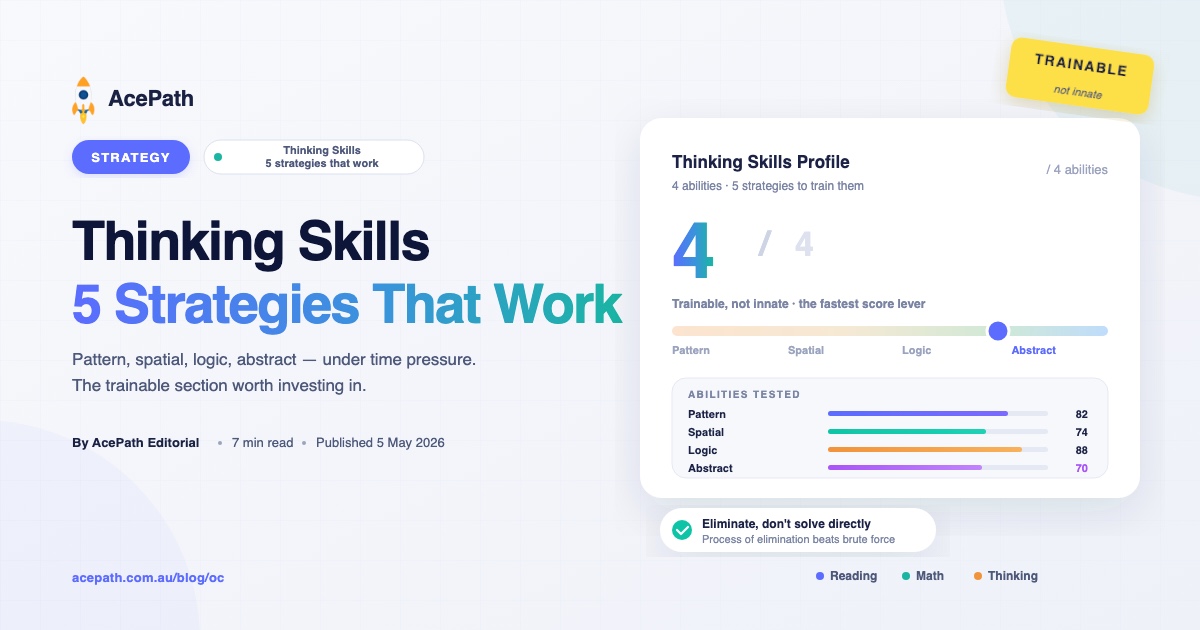
The Thinking Skills section assesses four broad abilities:
- Pattern recognition — identifying rules in sequences and matrices
- Spatial reasoning — mentally rotating, reflecting, and transforming shapes
- Logical deduction — drawing conclusions from given information
- Abstract reasoning — extracting rules from unfamiliar scenarios and applying them
The Cambridge-style format uses these abilities in combination. A single question may require recognising a pattern and applying a logical rule and visualising a spatial transformation — all under time pressure.
Strategy 1: Build a Visual Thinking Habit
Many Thinking Skills questions are visual. Students who try to solve them verbally — talking themselves through each step — often run out of time. The fastest solvers see the answer before they explain it.
How to build this:
- Practice with visual puzzles regularly — Sudoku, KenKen, shape rotation apps
- Play logic-based video games or apps that reward spatial reasoning
- When practising exam questions, look at the whole pattern before reading the options
- Cover the answer choices and try to predict the answer before looking
This habit rewires how your child approaches visual problems, moving them from slow verbal processing to faster visual intuition.
Strategy 2: Learn the Transformation Vocabulary
Spatial questions follow a small set of transformation rules. Recognising which rule is being applied saves enormous time.
The core transformations to know:
- Rotation — turning a shape by 90°, 180°, or 270°
- Reflection — flipping a shape horizontally or vertically (mirror image)
- Translation — moving a shape without rotating or flipping
- Scaling — making a shape larger or smaller proportionally
- Combining transformations — applying two or more changes in sequence
Create a one-page reference sheet showing each transformation with a simple example. Review it before every practice session until your child can name the transformation instantly on seeing it.
Strategy 3: Use Process of Elimination, Aggressively
Multiple-choice questions in Thinking Skills often have one clearly wrong answer, two plausible distractors, and one correct answer. Students who try to find the right answer directly often get pulled toward plausible-but-wrong options.
Instead, teach your child to eliminate what cannot be right:
- In pattern questions, check if each option follows the identified rule
- In logic questions, test each option against the given conditions
- In spatial questions, eliminate options with the wrong orientation first
- If you have narrowed it to two options, compare them feature by feature
Elimination is faster than direct solving for most students, and it reduces second-guessing.
Strategy 4: Manage the Time Trap
Thinking Skills questions vary wildly in difficulty. Some take 15 seconds. Others, if you try to solve them directly, can eat up 3 to 4 minutes. The students who run out of time are almost always those who refused to skip hard questions.
Time management rules to teach:
- Set a mental clock — if a question feels hard after 30 seconds, flag it and move on
- Come back to flagged questions after finishing the easy ones
- Never leave blank — there is no penalty for wrong answers, so always guess on flagged questions you cannot solve
- Count questions, not minutes — if there are 30 questions in 40 minutes, that is roughly 80 seconds per question on average
Practise this under real timed conditions. A child who has never felt time pressure before test day will not suddenly manage it well on the day.
Strategy 5: Review Mistakes Strategically
This is where most families waste the most time. Students do practice test after practice test without meaningfully learning from mistakes. The gap between someone who does 1,000 questions and someone who does 300 questions with deep review usually favours the second student.
A high-value review process:
- Classify the mistake — was it a misread, wrong strategy, timing issue, or genuine skill gap?
- Identify the pattern — are you making similar mistakes across questions? What question type is the weak spot?
- Do targeted practice — don't just do more mixed questions. Find 10 more questions of the same type and do them in a row
- Revisit after a week — true learning shows when the same question type appears in a different test a week later
AcePath's practice packs include detailed solutions for every question, explaining not just the correct answer but the reasoning process — which is exactly what Thinking Skills practice requires.
A Suggested Weekly Practice Routine
For students with 3 to 6 months before the test, this weekly routine works well:
- Monday: 20 minutes of pattern / matrix questions
- Wednesday: 20 minutes of spatial / shape questions
- Friday: 20 minutes of logic / deduction questions
- Saturday: one 40-minute full Thinking Skills practice section under timed conditions
- Sunday: 30 minutes reviewing the week's mistakes in detail
Total: around 2 hours per week. Consistent weekly practice beats 6-hour weekend marathons every time.
Start with a Diagnostic
Before diving into strategies, figure out where your child actually stands. A free AcePath sample quiz gives you an immediate snapshot of which question types are strengths and which need work.
Once you know the starting point, our Thinking Skills practice packs give you structured, leveled practice that builds skill progressively — without the burnout of unfocused drilling.
Thinking Skills rewards the students who treat it like a trainable skill, not an innate ability. It is absolutely learnable — and often the fastest path to a better overall placement score.
Start Practising Today
Try a free sample quiz to experience AcePath's exam-style practice tests.
Try Sample Quiz Register Free