Gender Parity in NSW Selective Schools and OC from 2027
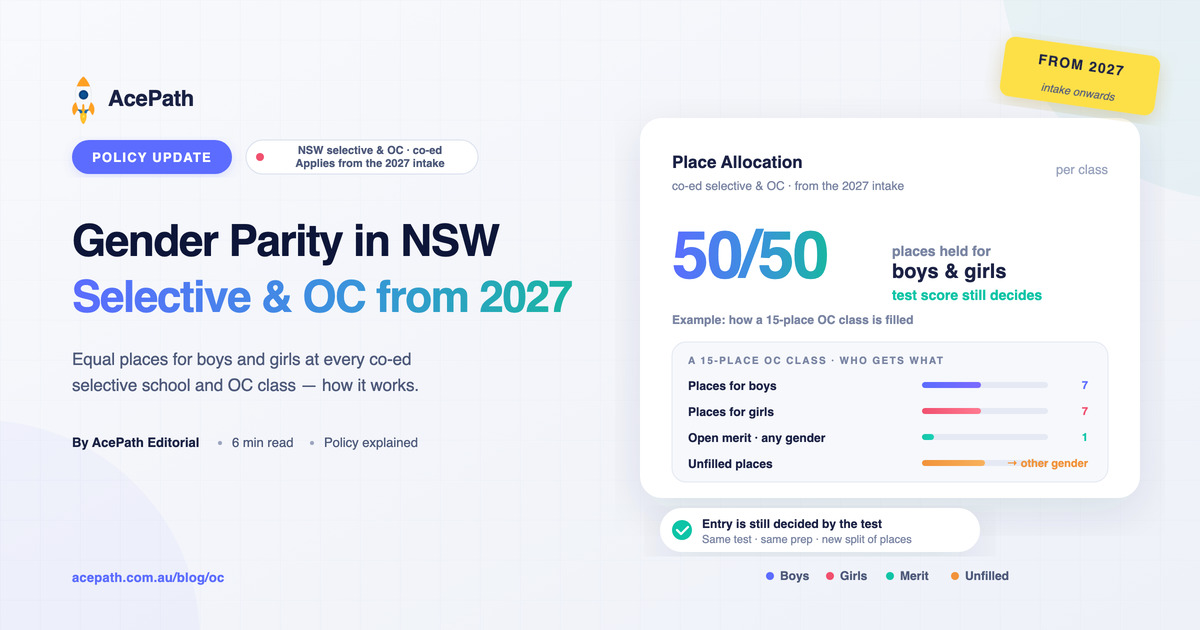
From the 2027 intake onwards, NSW will offer an equal number of places to boys and girls — a 50/50 gender balance — at every co-educational selective high school, partially selective high school, and Opportunity Class (OC). The first students placed under the new gender parity model are the ones who sat the placement tests in May 2026 — which means the change takes effect with the results families are receiving this year.
This guide explains what the gender balance model is, why the NSW Department of Education introduced it, exactly how the 50/50 split works, and what — if anything — you should do differently as a parent.
What Is Changing: The Model at a Glance
- Equal places for boys and girls at all co-educational selective high schools, partially selective high schools, and OC classes in public primary schools
- Applies from the 2027 intake — Year 5 OC entry in 2027 and Year 7 selective entry in 2027, tested in May 2026
- Entry is still decided by placement test performance — boys compete with boys and girls compete with girls for their halves of the places
- Odd-numbered classes: the leftover place is filled purely on academic merit, regardless of gender
- Unfilled places are not wasted: if not enough students of one gender qualify, the places are offered to qualifying students of the other gender
- Single-sex selective schools are unchanged — they already serve one gender
Why the Department Introduced the Gender Balance Rule
The Department's stated reason is a persistent imbalance: there are currently more boys than girls in selective education, and the trend has been driven by a decline in girls applying for — and, just as importantly, accepting — places in OC classes and co-educational selective high schools.
The numbers behind the announcement make the trend clear. The gender mix in selective high schools is currently about 58% boys to 42% girls, and in opportunity classes roughly 60/40. The gap has been widening: girls took 45% of Year 7 selective places in 2019, but only 41% in 2025.
By guaranteeing that half of the places at every co-ed setting are held for girls, the Department hopes to send a clear signal to families that these programs are for all high-potential students, and to break the cycle where fewer girls in a school leads to fewer girls applying to it.
The model sits alongside the existing Equity Placement Model, which continues to hold up to 20% of places for high-potential students from equity groups (10% for students from communities of low socio-educational advantage and 5% for Aboriginal and/or Torres Strait Islander students).
How the 50/50 Split Works
Even split, decided by test performance
Nothing changes about how your child is assessed. Selection is still based on performance in the placement test. What changes is how the ranked list converts into offers: at a co-ed school, the available places are divided equally, and boys and girls are offered places according to their test performance within their own half. At a selective school with 120 Year 7 places, for example, 60 go to the highest-scoring boys and 60 to the highest-scoring girls.
The odd place goes to merit
The Department's own example is an OC class with 15 Year 5 places: 7 places are allocated to boys and 7 to girls, and the remaining place is filled on academic merit regardless of gender — it simply goes to the highest-scoring remaining applicant.
Unfilled places flow to the other gender
If a school or OC class cannot fill its places for one gender with qualifying applicants, those places are offered to qualifying students of the other gender. No place is left empty for the sake of the quota.
Gender diverse students
Gender diverse applicants are considered for placement on academic merit. If a gender diverse student scores higher than the lowest eligible student of either gender, they are offered a place — even if that slightly changes the gender balance of the class.
Which Schools and Classes Are Affected
- Co-educational selective high schools — equal Year 7 places for boys and girls
- Partially selective high schools — the selective stream follows the same rule
- Opportunity Classes — every OC class in a NSW public primary school
- Single-sex selective high schools — no change; schools such as fully boys' or girls' selective schools already enrol one gender only
When It Starts: The 2027 Intake Is Already Under Way
The gender parity model applies from the 2027 intake, and that cycle has already happened on the testing side:
- Selective High School Placement Test (Year 7 entry 2027): sat 1–2 May 2026, with outcomes expected to be released on 19 August 2026
- OC Placement Test (Year 5 entry 2027): sat 8–9 May 2026, with outcomes expected to be released on 9 September 2026
In other words, if your child sat the test this year, their offer — or reserve-list position — will be one of the first decided under the new model. Families applying in the 2027 test cycle (for 2028 entry) will be fully within it as well.
What This Means for Your Child
Preparation does not change
The test itself — computer-based Reading, Mathematical Reasoning, and Thinking Skills, plus Writing for the selective test — is exactly the same for everyone, and performance on it is still what earns a place. The best preparation strategy is unchanged: consistent practice with realistic, exam-style questions.
For families of girls
The model guarantees that half the places at every co-ed selective school and OC class are available to girls. If you have hesitated to apply because a local selective setting seemed heavily male, the Department's explicit goal is to change that. An application costs nothing but time — and a strong test result now maps onto a guaranteed pool of places.
For families of boys
Boys still win places the same way they always have: by their test performance. Because boys have recently outnumbered girls in selective education, the mix of offers at some co-ed schools may look different from previous years, but the Department does not publish separate cut-off scores by gender, and unfilled girls' places still flow back to qualifying boys. The practical advice is the same as ever — aim for the strongest score possible and use all your school preferences wisely.
Frequently Asked Questions
Is this a gender quota?
Some media coverage has called it a gender quota; the Department's own terms are gender parity and a healthy gender balance. Mechanically it is a 50/50 split of places at co-ed settings: every student still earns their place through the placement test, the split changes how many places are open to each gender rather than what the test requires, and unfilled places flow back to the other gender instead of sitting empty.
When does the gender parity model start?
From the 2027 intake — students entering Year 5 OC classes or Year 7 selective schools in 2027, who sat their placement tests in May 2026. It applies to every intake after that.
Does it apply to single-sex selective schools?
No. It applies to co-educational selective high schools, partially selective high schools, and OC classes. Single-sex selective schools already enrol one gender.
Is entry still based on the placement test?
Yes. Performance in the placement test remains the basis of selection for both boys and girls. The model changes how the places are divided, not how students are assessed.
What happens if not enough girls (or boys) qualify at a school?
The unfilled places are offered to qualifying students of the other gender, so no place goes unused.
How are gender diverse students placed?
On academic merit. A gender diverse student who scores higher than the lowest eligible student of either gender is offered a place, even if this slightly changes the class's gender balance.
Where to Confirm the Official Details
Policy settings can be refined from year to year, so always confirm the current rules through official sources before making decisions:
- The NSW Department of Education's selective high schools and opportunity classes pages at education.nsw.gov.au, including the "fair access" section
- Official email communications sent to you after you apply
- Your child's current school
Give Your Child the Strongest Possible Score
Whatever the placement model looks like, one thing has not changed: the placement test decides who qualifies. Start with a free AcePath sample quiz to see where your child stands in Reading, Mathematical Reasoning, and Thinking Skills, then build an exam-ready routine with our OC and Selective practice test packs, which mirror the real computer-based format your child will face on test day.
Start Practising Today
Try a free sample quiz to experience AcePath's exam-style practice tests.
Try Sample Quiz Register Free