How Selective School Placement Scores Are Calculated
Why Understanding Scoring Matters
Many parents treat the Selective test as pass/fail: "Did my child get in or not?" That framing misses the mechanics. Selective placement is a ranking system. Your child competes against every other applicant, and offers are allocated top-down subject to preferences. Knowing how the score works helps you set realistic goals, choose preferences wisely, and interpret outcomes calmly.
From Raw Score to Placement Score
Stage 1: Raw Score
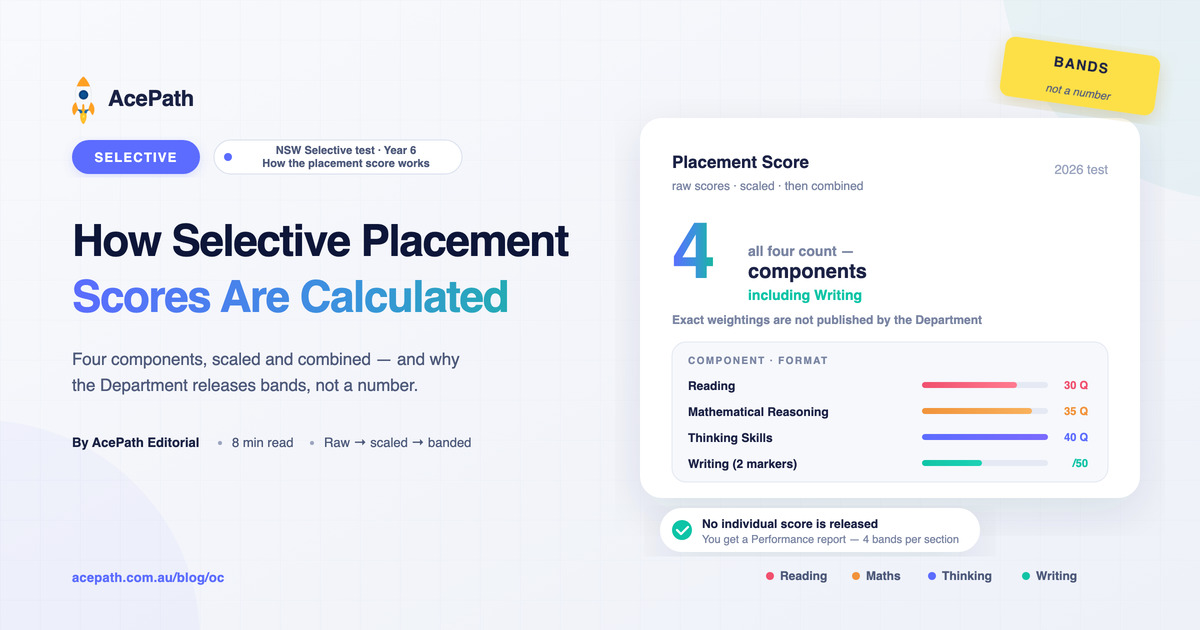
The Selective High School Placement Test has four components, each producing a raw score:
- Reading — 30 multiple-choice questions in 40 minutes
- Mathematical Reasoning — 35 multiple-choice questions in 40 minutes
- Thinking Skills — 40 multiple-choice questions in 40 minutes
- Writing — 1 extended writing task in 30 minutes
For Reading, Mathematical Reasoning and Thinking Skills, marks are awarded for correct answers only — there is no penalty for wrong or unanswered questions, so your child should always attempt every question rather than leave it blank. The Writing task is marked independently by two trained examiners, each awarding a score out of 25, giving a total out of 50. Writing assesses the creativity of ideas, the ability to write for a purpose and audience, use of language for effect, and grammar, punctuation, spelling and vocabulary.
Stage 2: Scaled Score
Raw scores are converted into scaled scores using psychometric analysis. Harder questions are worth more than easy ones, and scaling accounts for differences between test versions to ensure fairness. Two students with the same raw score on different test forms should receive similar scaled scores.
Stage 3: Weighted Placement Score
All four scaled components — Reading, Mathematical Reasoning, Thinking Skills and Writing — are combined using the Department's weightings into a single placement score. This is what ranks your child against the full applicant pool across NSW. Note that the NSW Department of Education does not publish the exact weighting of each component, and does not release individual placement scores or ranks — families receive a Performance report showing which band your child fell into for each section (top 10%, next 15%, next 25%, or lowest 50%).
How Offers Are Allocated
Once every student has a placement score, the process is straightforward:
- All applicants are ranked from highest to lowest placement score
- Offers go out in ranking order, honouring each student's 3 school preferences
- The highest-ranked student gets their first preference (if places remain)
- Students further down get whichever preference still has spots when their turn arrives
- Students whose score doesn't meet cutoffs at any of their 3 preferences go to the reserve list
Why Two Students with the Same Score Get Different Outcomes
Placement depends on both score and preferences. A student scoring 260 who preferences James Ruse, Baulkham Hills, and Hornsby Boys may get none — if 260 happens to be below each school's cutoff that year. A student scoring 255 who preferences Normanhurst Boys, Penrith, and Sefton may get their first preference.
This is not unfair — it's how ranking systems work when preferences are honoured. Strategic preference placement matters as much as score improvement.
How Component Weightings Work
Each of the four components contributes to the final placement score. The Department does not publish the exact weighting of each, and weightings can change with Department updates — but all four count, including Writing. A very weak component drags the total down disproportionately.
Practical implication: balanced performance across all four components usually beats exceptional performance in one and weak performance in another. A student strong in Reading, Maths and Thinking Skills but weak on Writing often loses more marks than they realise — Writing is a full component of the placement score, not an afterthought.
Why Cutoffs Move Each Year
Cutoffs are not set in advance — they emerge from that year's applicant pool. Factors that shift them:
- Test difficulty — harder tests produce lower raw scores across the board, which reduces cutoffs
- Number of applicants — more applicants with strong scores pushes cutoffs up
- School popularity — a surge of first preferences at a given school raises that school's cutoff
- Places available — changes to intake numbers shift cutoffs immediately
This is why "last year's cutoff was 248, so we need 248" is the wrong framing. Target consistent strong performance, not a specific number.
What the Numbers Online Actually Are
You will see specific figures quoted everywhere — "you need 260 for this school", "the cutoff was 248 last year". It is important to understand what these are: unofficial estimates. The NSW Department of Education does not release individual placement scores or ranks, and it states there are no set minimum entry scores to receive an offer. The "cutoffs" circulated by coaching centres and forums are reverse-engineered guesses, not published numbers.
What you actually receive is the Performance report, which shows, for each of the four components, which band your child fell into relative to everyone who sat the test that year:
- Top 10% of candidates
- Next 15% of candidates
- Next 25% of candidates
- Lowest 50% of candidates
Read in band terms, the realistic picture is simpler and more honest: to be competitive for the most sought-after fully selective schools, children generally need to be in the top band across most or all components. Less competitive schools and partially selective streams accept a wider spread of band results. Because no official number exists, the sensible goal is not "hit 260" — it is "place as high as possible in every band".
Preference Strategy Matters
Because offers are allocated by score + preferences, the three nominated schools should mix:
- Preference 1: aspirational — a school slightly above your realistic score target
- Preference 2: realistic — a school where your expected score is clearly competitive
- Preference 3: safety — a school where entry is highly likely based on expected performance
Nominating three elite schools is one of the most common placement mistakes. If your child narrowly misses each, they go to the reserve list — even though a less competitive school would have accepted them.
What the Score Doesn't Measure
The placement score measures performance on a specific four-component test on a specific day. It does not measure:
- Your child's intelligence or future success
- Their academic capability over time
- Qualities like creativity, persistence, or curiosity
- How they'll perform in high school and beyond
Many students who do not secure a Selective place go on to excellent HSC results and tertiary outcomes. The score is one data point, not destiny.
Practical Takeaways
- Balance sections — weak areas drag the total more than strong areas help
- Don't fixate on cutoff numbers — they move every year
- Prefer strategically — mix aspirational, realistic, and safety choices
- Never leave questions blank — no penalty for wrong answers
- Track progress across all four sections (Reading, Maths, Thinking Skills, Writing), not just favourites
Build a Realistic Baseline
Before setting score targets, know where your child currently stands. A free AcePath sample quiz gives you an immediate benchmark. From there, our Selective practice packs help you systematically improve across all four sections — the path to a strong, balanced placement score.
Start Practising Today
Try a free sample quiz to experience AcePath's exam-style practice tests.
Try Sample Quiz Register Free