What Is the Selective Reserve List? A Guide for NSW Parents
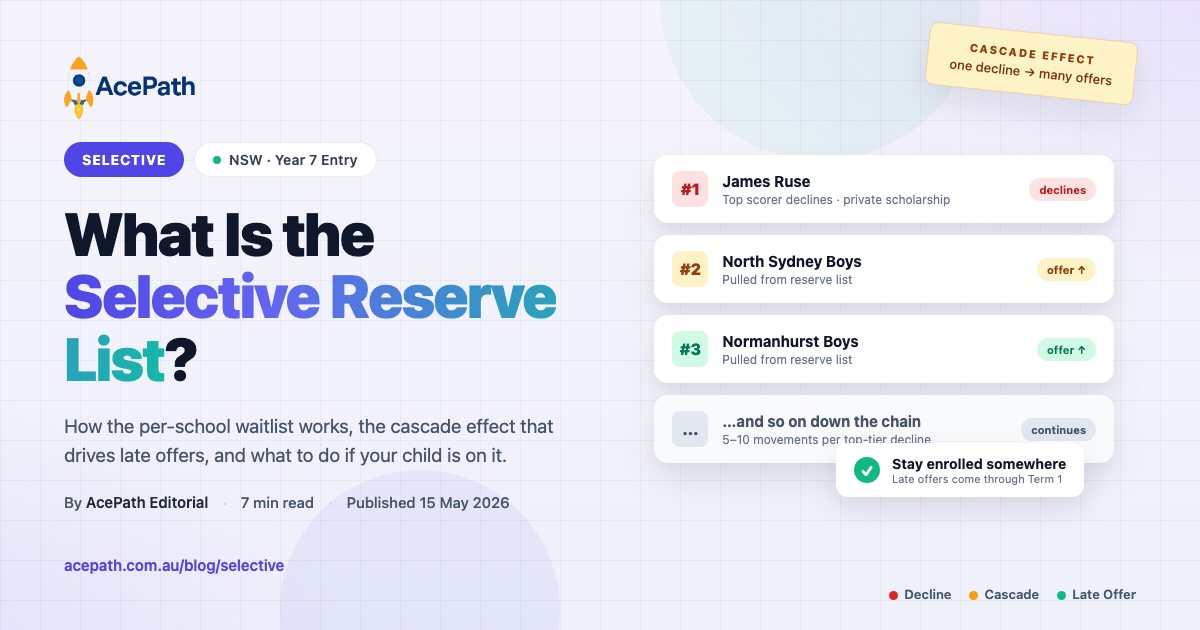
The Selective High School reserve list is a per-school ranked waitlist used by the NSW Department of Education. If a student who received a Year 7 selective offer declines, the next student on that school's reserve list is offered the vacated place — and one decline at the top can trigger a cascade of offers all the way down the system.
If your child sat the NSW Selective High School Placement Test, results day brings one of three outcomes — and the most confusing of the three is "reserve list". Is it a yes? A no? Worth waiting on? This guide explains exactly what the Selective reserve list is, how it differs from the OC version, and what you can realistically expect.
Quick Background: Selective High Schools in NSW
Selective high schools are public secondary schools where every (or some) student is selected on academic merit. There are roughly 48 fully and partially selective schools across NSW, including well-known names like James Ruse Agricultural High School, North Sydney Boys, North Sydney Girls, Sydney Boys High, Sydney Girls High, Baulkham Hills High, Normanhurst Boys, and Hornsby Girls — plus many more across metropolitan and regional NSW.
Each year, around 15,000+ students sit the Selective High School Placement Test in Year 6 for roughly 4,200 Year 7 places. Results give one of three outcomes:
- Offer — a confirmed Year 7 place at a specific selective school.
- Reserve list — a ranked waitlist for one or more selective schools.
- Not offered — no place at this round.
How the Selective Reserve List Works
The reserve list is per school, not state-wide — each selective school has its own ranked list of candidates who narrowly missed an offer there. When an offered student declines (because they took a higher-ranked selective, a private school scholarship, or moved away), the next student on that school's reserve list is offered the place.
The cascade effect
The biggest difference between the OC reserve list and the Selective reserve list is the cascade. When a top-scoring student declines James Ruse to take an academic scholarship at a private school, that opens a spot — but James Ruse fills it from its own reserve list, often pulling a student from North Sydney Boys, which then pulls from Normanhurst, which then pulls from Pennant Hills, and so on.
A single high-ranked decline can trigger five, ten, or more downstream movements. The result: even students in the middle of a reserve list can suddenly get a call.
Key Facts About the Selective Reserve List
- Released: the same day as main offers (usually early-to-mid Term 3).
- Active period: through Term 4 of Year 6 and well into Term 1 of Year 7 — sometimes longer if late vacancies appear.
- How offers are made: in strict rank order per school as places open up.
- How families are notified: via the online application portal and email.
- Appeals on position: the rank is fixed by test result, but a separate illness/misadventure appeal pathway exists for students whose performance was demonstrably affected.
- Multiple schools: a student can be on the reserve list for more than one school at the same time.
How Is It Different From the OC Reserve List?
- Year level: the OC reserve list is for Year 5 entry; the Selective reserve list is for Year 7 entry.
- Number of schools: roughly 80 OC classes statewide vs around 48 selective schools.
- Movement: OC reserve lists move modestly (around 10–20%); Selective reserve lists often move significantly more thanks to the cascade effect.
- Active period: OC reserve lists usually close at year end; Selective reserve lists routinely run into Term 1 of Year 7 and sometimes further.
- Alternative pathways: if no OC offer comes, the next big shot is the Selective test in Year 6; if no Selective Year 7 offer comes, several schools accept Year 8, 9, and 10 entry through separate tests when seats open up.
Scholarship cascades to private schools — Knox, Kings, Shore, PLC, MLC, Loreto, Pymble, SCEGGS, Trinity and many others — routinely pull top scorers out of the selective pool. The Selective reserve list tends to be more dynamic because the stakes and the options for Year 7 are bigger.
How Likely Is an Offer From the Selective Reserve List?
The honest answer is highly variable and depends mainly on which school you are on the reserve list for.
Top-tier selectives (e.g. James Ruse, North Sydney Boys/Girls, Baulkham Hills, Sydney Boys/Girls)
Movement is minimal. Students who win a place at these schools almost always accept. Reserve list movement is typically only a handful of names a year. Being deep on the reserve list at one of these schools is a long shot.
Mid-tier and regional selectives
Movement is much greater. Scholarship cascades, family relocations, and students opting for a closer co-ed selective all generate vacancies. It is not unusual for the first 30–50+ names on the reserve list at these schools to be called.
Partially selective schools
Partially selective schools — those that run both a selective stream and a regular intake — often have higher decline rates because students who win a spot in a fully selective school usually prefer it. Reserve list movement at partially selective schools is often substantial.
What Should You Do If Your Child Is on the Reserve List?
1. Accept the reserve position in the portal
You must formally accept the reserve placement to remain in the queue. Missing the deadline means you are out.
2. Stay on multiple reserve lists if eligible
Some students appear on the reserve list for more than one school. Do not withdraw from one just because another is preferred — wait it out.
3. Confirm your backup school
Enrol your child at your local high school, or the next-best option (independent, Catholic, or another public school), so they have a confirmed seat for Term 1. You can transfer later if a selective offer comes.
4. Watch for late offers
Late offers can come right up to, and after, the start of Year 7. Don't switch off the email after January — some families report receiving offers in Week 2 of Term 1.
5. Consider the illness/misadventure appeal
This is a separate process from the reserve list — for students whose test performance was clearly affected by something documented (illness on test day, family emergency, etc). A successful appeal can lead to a re-rank, which is different from the reserve list shuffle.
6. Look beyond Year 7 entry
If no offer comes for Year 7, several selective schools accept students into Year 8, Year 9, or Year 10 through separate placement tests when seats open up. The door does not close at Year 7.
Common Misconceptions
"Reserve list = my child failed."
False. Being on a Selective reserve list typically means your child scored in the top 10–15% of the state.
"If I accept my local school, I lose my reserve spot."
False. You can enrol locally and remain on the reserve list at the same time. If the offer comes, you transfer.
"All reserve lists move the same."
Very false. James Ruse moves a few names. A mid-tier selective might move 40+. Know your school.
"The list is finalised on results day."
False. The list continues to be drawn from for months.
"Reserve-list offers are second-class."
False. A student who enters via the reserve list has identical status to every other student at that school. No one knows or cares once Term 1 starts.
Frequently Asked Questions
What is the Selective High School reserve list?
The Selective reserve list is a per-school ranked waitlist of students who narrowly missed a direct Year 7 offer. If a student offered a place declines, the next student on that school's reserve list is offered the vacated spot.
What is the cascade effect?
When a top-scoring student declines a high-ranked selective school (often for a private school scholarship), the offer flows down: that school pulls from its reserve list, the next school pulls from its reserve list, and so on. One decline at the top can trigger several offers further down the system.
How long does the Selective reserve list stay active?
From results day (early-to-mid Term 3) through Term 4 of Year 6 and well into Term 1 of Year 7. Late offers can arrive after the school year starts.
How likely is a Selective reserve-list offer?
Highly variable by school. Top-tier fully selective schools see minimal movement; mid-tier, regional, and partially selective schools often see substantial movement. Position on the list, school decline rate, and the cascade effect all matter.
Can I appeal my child's reserve-list rank?
The rank itself is set by test score and is not appealable. A separate illness/misadventure appeal exists for students whose test performance was demonstrably affected by something documented on test day.
Should we enrol at a backup school while waiting?
Yes. Always secure a confirmed Term 1 seat at your local high school or another preferred option. If a Selective offer arrives — even after Term 1 begins — you can transfer.
Final Thoughts
The Selective High School reserve list is less of a "maybe" than most parents assume. The cascade effect means a significant number of reserve-listed students do eventually receive an offer — sometimes weeks, sometimes months after results day. Stay patient. Stay enrolled somewhere good. And keep an eye on the inbox.
Get Ready for the Placement Test
Whether your goal is a fully or partially selective school, the same Year 6 test decides the outcome. Start with a free AcePath sample quiz to see where your child currently sits across Reading, Mathematical Reasoning, Thinking Skills, and Writing. Our selective practice packs mirror the real test format and difficulty so your child walks in on test day knowing exactly what to expect.
Start Practising Today
Try a free sample quiz to experience AcePath's exam-style practice tests.
Try Sample Quiz Register Free