Reading Comprehension for OC Test: Passage Strategies That Work
Why Reading Is Often Underestimated
Many families assume reading is "the easy section" because their child already reads well. That is a common miscalculation. The OC Reading section tests deeper comprehension — inference, author intent, cross-passage comparison, and vocabulary in context — not just the ability to read words fluently.
Strong readers can still struggle here without targeted strategies.
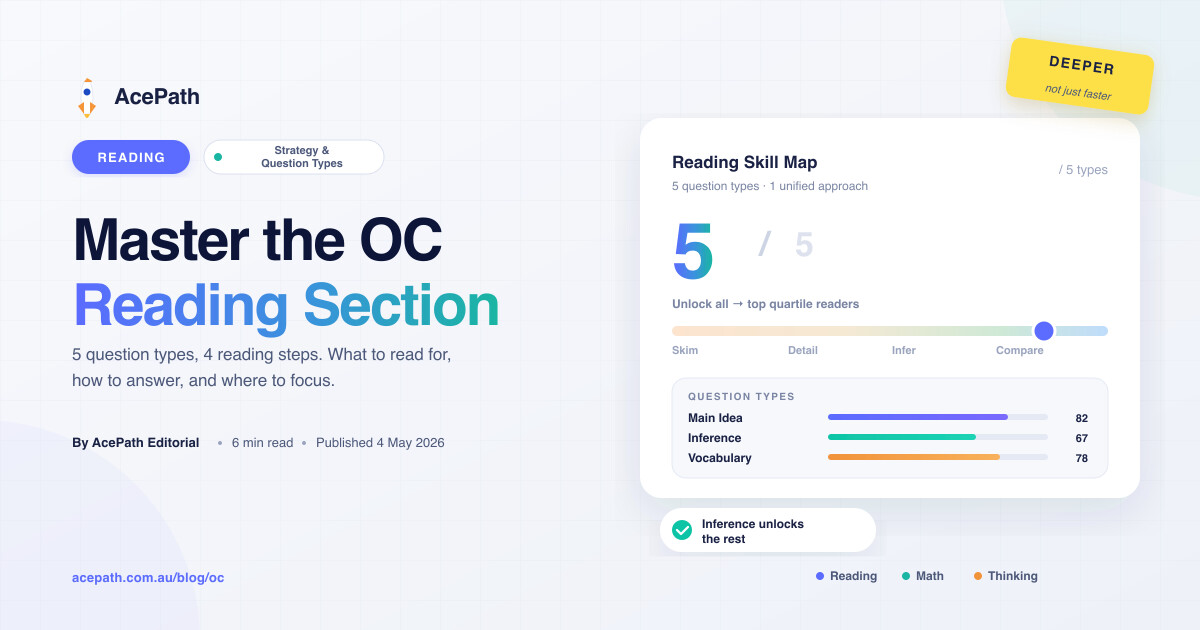
The 5 Main Question Types
1. Main Idea Questions
"What is this passage mainly about?" — testing whether students can see the forest, not just the trees.
Strategy: After reading, pause for 3 seconds and ask: "If I had to describe this passage in one sentence, what would I say?" That sentence is usually the answer.
2. Detail Questions
"According to the passage, what did Sarah find in the garden?" — testing whether students can locate specific information accurately.
Strategy: Scan rather than re-read. Find the keyword from the question in the passage, then read the surrounding sentences.
3. Inference Questions
"Why did the author choose to mention the weather?" or "What can we conclude about the character?" — asking students to read between the lines.
Strategy: The answer is suggested by the passage, not directly stated. Eliminate options that contradict the passage, then pick the one most strongly implied.
4. Vocabulary in Context
"In the sentence 'the weary traveller trudged home', the word 'trudged' most likely means..." — testing word meaning from surrounding text.
Strategy: Read the sentence and the one before and after. Look for tone clues (tired, happy, angry) and choose the option that matches.
5. Cross-Passage Comparison
Some questions compare two passages on the same topic. "How do the two authors differ in their view of X?"
Strategy: After reading each passage, note the author's position in one word — supportive, critical, neutral, curious. This makes comparison fast.
A 4-Step Approach to Any Passage
Step 1: Preview (10 seconds)
Read the title and the first sentence of each paragraph. This gives you a skeleton of the passage before you read.
Step 2: Active Read (90 seconds)
Read the full passage. While reading, ask: What is happening? Who is involved? What is the author's point? Mark unfamiliar words but don't stop to define them.
Step 3: Summarise Mentally (5 seconds)
In your head, say: "This passage is about ___, and the main point is ___." If you can't do this, quickly skim again.
Step 4: Answer the Questions (about 60–90 seconds per question)
For each question, go back to the passage. Never answer from memory alone, even if you're confident. Re-check the relevant section.
Managing Time in the Reading Section
Reading sections usually feel rushed. Key time-saving rules:
- Spend more time on the passage, less re-reading for each question
- Skip questions that feel hard — come back later
- Don't get stuck trying to understand every word
- Eliminate obviously wrong options first
Common Mistakes to Avoid
- Answering from prior knowledge — the answer must come from the passage, not what you already know
- Picking options that are "true" but not supported — the option needs to match the passage specifically
- Missing negative words — "NOT", "EXCEPT", "LEAST LIKELY" change the meaning completely
- Overthinking inference — stick to what the passage suggests, not elaborate theories
Building Reading Ability Outside Practice Tests
Comprehension improves through diverse, regular reading. Encourage your child to read:
- News articles for current events and formal writing style
- Science or history articles for informational text comprehension
- Fiction for character analysis and inference
- Poetry for tone, imagery, and figurative language
After reading, have short conversations: "What was that mainly about?" "Why did the character do that?" "What do you think the author wanted you to feel?" This builds the same skills the test measures.
Start with Targeted Practice
Try a free AcePath sample quiz with OC-style reading passages to see which question types feel hardest. Our Reading practice packs include passages across fiction, non-fiction, and informational texts, with detailed solutions that show how strong readers approach each question type.
Start Practising Today
Try a free sample quiz to experience AcePath's exam-style practice tests.
Try Sample Quiz Register Free