OC & Selective Prep Starter Plan for Year 3 and Year 5
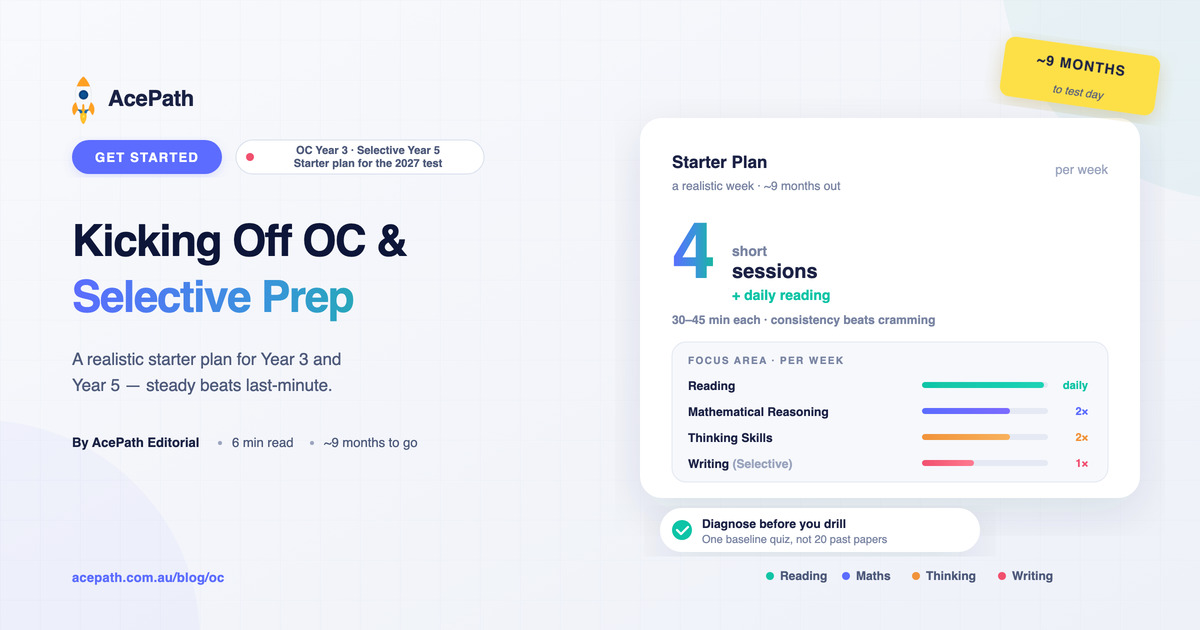
If your child is in Year 3 (OC) or Year 5 (Selective) right now, the next big test is roughly nine months away — in early May 2027 — and this term is the ideal time to start. Not with a frantic timetable and a stack of past papers, but with a calm, sustainable routine that builds the right habits early. This is a realistic starter plan: what to do this term, how much is enough, and the early mistakes to skip.
First, Get the Timeline Straight
Both the NSW Opportunity Class and Selective High School placement tests are sat in early May. A child in Year 3 today sits the OC test in Year 4; a child in Year 5 sits the Selective test in Year 6 — both in May 2027, for entry in 2028. Applications are expected to open around October–November 2026 and close around February 2027.
That gives you about nine months of runway. The full expected timelines are in our OC test dates 2028 and Selective test dates 2028 guides. The point of starting now is not to cram — it is to make preparation gentle and spread out, so it never has to become intense.
Set a Realistic Weekly Rhythm
The single biggest predictor of progress this early is consistency, not volume. Aim for three or four short sessions a week of 30 to 45 minutes each — enough to build momentum, short enough that your child stays willing. A calm 40 minutes on a Tuesday, done every week, beats a stressful three-hour marathon on a Sunday that everyone dreads.
Protect the routine, keep sessions at the same times, and stop while your child is still engaged rather than pushing to tears. Nine months of steady, positive practice compounds; nine months of resented drilling burns a child out before the test even appears on the horizon.
Diagnose Before You Drill
Before buying anything, find out where your child actually stands. A single baseline assessment across Reading, Mathematical Reasoning, and Thinking Skills will show you their genuine strengths and gaps — far more useful than guessing. Start with a free AcePath sample quiz, then aim your first term at the weakest strand rather than practising what your child is already good at.
Resist the urge to buy twenty practice papers on day one. Early on, targeted practice on real gaps is worth far more than volume.
What to Focus On This Term
Build the reading engine first
Reading is the quiet multiplier — it lifts comprehension, vocabulary, and even the wordy maths and thinking-skills questions. Make daily reading non-negotiable: 20 minutes of books your child enjoys, plus a habit of noticing and discussing new words. This is the highest-return thing you can do nine months out, and it never feels like test prep.
Keep mathematical reasoning practical
At this stage, focus on solid number sense and reasoning rather than exam tricks. Two short sessions a week on problem-solving — the kind where the answer needs a bit of thinking, not just recall — lays the groundwork the test rewards later.
Make thinking skills a game
Thinking Skills is usually the least familiar strand for families, so introduce it playfully: logic puzzles, patterns, and "what must be true?" questions. Two light sessions a week now means the Cambridge-style format feels routine long before test day.
For Selective families, start writing early
The Selective test includes a writing task; the OC test does not. If your child is in Year 5, add one short weekly writing session — a paragraph or a timed response — because writing improves slowly and steadily. Starting now, gently, avoids a stressful scramble in the final months.
A Simple First-Term Plan
A workable weekly shape for the term ahead:
- Every day: 20 minutes of reading for pleasure
- Session 1: Mathematical Reasoning — problem-solving
- Session 2: Thinking Skills — puzzles and logic
- Session 3: whichever strand the baseline flagged as weakest
- Session 4 (Selective only): a short writing task
Review every mistake together — understanding why an answer was wrong is where the real gains come from. Re-check the baseline every few months and shift focus as gaps close.
Early Mistakes to Avoid
- Over-scheduling from day one. Starting with two hours a day almost guarantees burnout. Begin small and let it grow.
- Drilling full past papers too early. Timed papers are a Term-1-2027 tool, not a July-2026 one. Build fundamentals first.
- Neglecting reading. It is easy to skip because it feels less like "study" — but it is the biggest lever you have.
- Comparing with other families. Other children's schedules tell you nothing about your child's best path.
- Forgetting the writing task (Selective). Left to the last term, it becomes a source of panic.
Frequently Asked Questions
Is nine months out too early to start?
No — it is close to ideal. Starting now lets preparation stay light and spread out. The alternative, cramming in the final months, is far more stressful and less effective.
How many hours a week should we do?
At this stage, roughly two to three hours total — three or four short sessions plus daily reading. Consistency matters far more than the number of hours.
Do we need a tutor to start?
Not necessarily. Many families begin well at home with a clear routine and good-quality practice. A baseline quiz will tell you whether a particular strand needs extra help.
How is OC prep different from Selective prep?
The OC test (Year 4) covers Reading, Mathematical Reasoning, and Thinking Skills. The Selective test (Year 6) covers the same three plus a writing task, so Selective families should build in regular writing practice from the start.
Start Small This Term
The families who find the final months calm are almost always the ones who started gently, months earlier. Take the first step this term: run a free AcePath sample quiz to find your child's starting point, then build a steady routine with our practice test packs, which mirror the real Cambridge-style format. Small, consistent, and early beats big, frantic, and late — every time.
Start Practising Today
Try a free sample quiz to experience AcePath's exam-style practice tests.
Try Sample Quiz Register Free