What Your Child's NAPLAN Result Says About OC & Selective
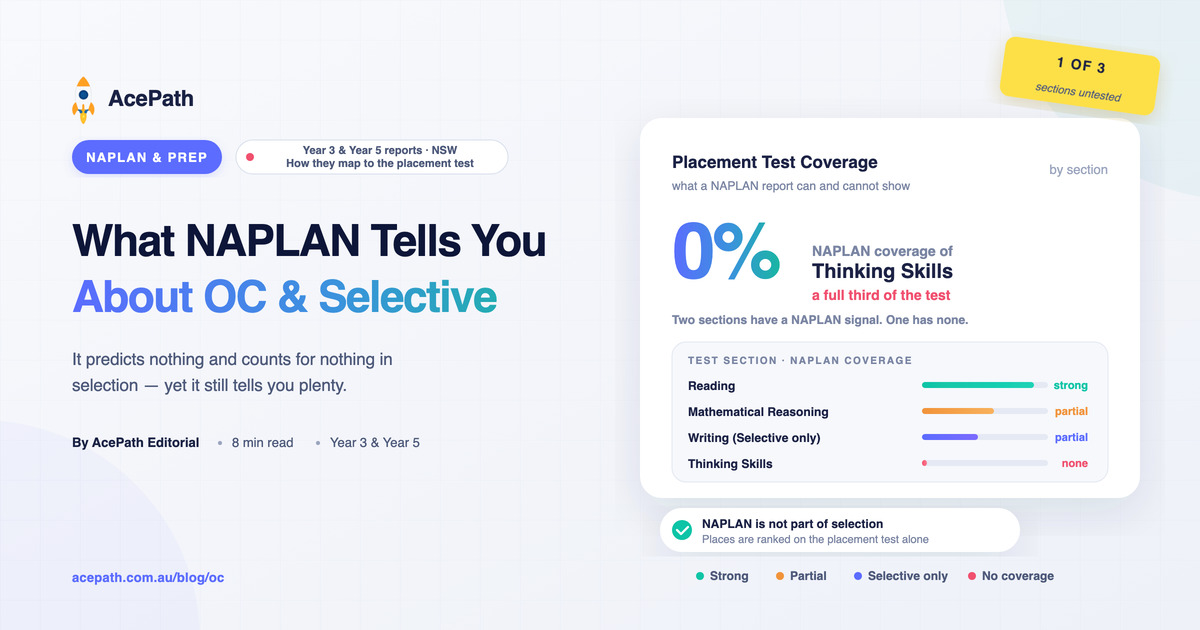
A NAPLAN result does not predict how your child will do in the OC or Selective placement test, and it plays no part in selection. The two assessments measure different things, against different benchmarks, for different purposes. But the report that landed in your inbox in July is still genuinely useful — if you read it for the right thing. Here is what a Year 3 or Year 5 NAPLAN result can tell you about placement-test readiness, what it cannot, and the one skill NAPLAN never tests at all.
Why These Two Tests Land in the Same Year
The overlap is not a coincidence of timing — it is structural. NAPLAN is sat in March of Years 3, 5, 7 and 9. The NSW placement tests are sat in early May of Years 4 and 6.
- Year 3 NAPLAN (March) is followed about 14 months later by the OC placement test (May of Year 4).
- Year 5 NAPLAN (March) is followed about 14 months later by the Selective placement test (May of Year 6).
So for both cohorts, the NAPLAN report arrives at almost exactly the moment preparation should be starting properly. That makes it the most convenient diagnostic most families will ever be handed for free — provided you do not ask it to do a job it was never designed for.
The Critical Difference: Expectations vs Competition
This is the single misunderstanding that causes the most disappointment, so it is worth being precise.
NAPLAN is measured against year-level expectations. ACARA reports every student against four proficiency levels — Exceeding, Strong, Developing, and Needs additional support — which panels of expert teachers set at, in ACARA's words, a "challenging but reasonable" level for that year group. "Exceeding" means your child has cleared a fixed bar. It is not a ranking.
The placement test is a competition. Places are allocated by rank against everyone else who applied — and the applicant pool is heavily self-selected. These are families who chose to apply, most of whom have prepared. Nothing about the placement test is measured against a year-level expectation.
The practical consequence: "Exceeding" in NAPLAN is a necessary signal, not a sufficient one. A large share of placement-test applicants sit in the Exceeding band. Clearing the national bar puts your child in the room; it says very little about where they will rank once inside it.
Mapping NAPLAN Domains Onto the Placement Test
NAPLAN reports five areas: reading, writing, spelling, grammar and punctuation, and numeracy. The placement tests assess Reading, Mathematical Reasoning and Thinking Skills — plus a writing task for Selective only. They line up like this:
| NAPLAN area | Placement test section | How well it transfers |
|---|---|---|
| Reading | Reading | Strong overlap. The closest match of any domain, though placement-test passages are denser and the question types — including cloze — are unfamiliar. |
| Numeracy | Mathematical Reasoning | Partial. Shared number sense, but placement-test items are multi-step reasoning problems, not curriculum recall. |
| Grammar, punctuation, spelling | (supports Reading and writing) | Indirect. Useful groundwork, not directly assessed as its own section. |
| Writing | Selective writing task only | Partial, and Selective only. The OC test has no writing component. |
| — nothing — | Thinking Skills | No coverage at all. See below. |
The Blind Spot: NAPLAN Never Tests Thinking Skills
This is the most important line in this article. A full third of the placement test has no NAPLAN equivalent whatsoever.
Thinking Skills assesses logical deduction, argument analysis, identifying assumptions and conclusions, and pattern reasoning — in the Cambridge-style format used by the NSW tests. It is not part of the Australian Curriculum in the way literacy and numeracy are, so NAPLAN does not touch it, and most primary classrooms do not teach it explicitly.
The result is a predictable trap: a child comes home with Exceeding in reading and numeracy, the family reasonably concludes preparation is well in hand, and the section nobody has a data point for is the one that decides the outcome. If you take one action after reading your child's NAPLAN report, make it this — get a baseline on Thinking Skills, because NAPLAN did not give you one. Our guide to Thinking Skills strategies explains what the section actually asks for.
What the 2026 National Results Suggest for Prep
ACARA released the 2026 national results on 5 August 2026. Two findings are directly relevant to the year levels that feed into OC and Selective:
- Year 3 numeracy was the weakest since the 2023 reset, with around 11% of students at Needs additional support. Year 3 is the pre-OC cohort.
- Year 5 reading trended down, by about 8.4 scale points. Year 5 is the pre-Selective cohort.
Read those as a nudge about where to aim attention, not as an alarm. On a scale running to 1,000, shifts of this size are classified as negligible by the testing authority's own definition, and several education researchers have made exactly that point about the 2026 figures. The national trend is a weak signal about your individual child. Your child's own report is the stronger one.
One Caveat Specific to 2026: The Writing Result
ACARA has explicitly flagged that 2026 writing results should be interpreted with extra care, because some students experienced connectivity disruptions during the online writing test. If your child's writing band looks out of step with everything you know about their writing, that is a documented possibility rather than a mystery.
Two related points worth knowing: Year 3 students always sit the writing test on paper, and results from 2023 onwards cannot be compared with results from 2008 to 2022, because the measurement scale changed.
How to Actually Read the Report
The individual student report puts three marks on a scale for each area:
- A black dot — your child's result.
- A black triangle — the national average for their year level.
- A light shaded rectangle — the range covering the middle 60% of students.
For placement-test purposes, the useful question is not "which band?" but "how far above the shaded rectangle?" A child sitting just above the national average is in a very different position from one sitting clear of the middle 60%, even though both may read as the same proficiency level.
Also compare across years where you can. Students in Years 5, 7 and 9 have now completed two cycles under the current arrangement, so 2024 and 2026 reports can be set side by side. And note ACARA's own framing: a child who achieves the same proficiency level in Year 3 and again in Year 5 may still be making real progress, because the bar rises each cycle.
Frequently Asked Questions
Does NAPLAN count towards OC or Selective selection?
No. Placement is determined by the placement test result, together with the Equity Placement Model and, from the 2027 intake, gender-balanced allocation. NAPLAN is not submitted, not considered, and plays no part in the process.
My child got Exceeding in everything. Are they ready for the OC test?
They are well positioned, but not assessed. Exceeding means clearing a national year-level bar; the placement test ranks your child against a self-selected, largely prepared applicant pool. Most importantly, Exceeding tells you nothing about Thinking Skills, which NAPLAN does not test.
My child was in the Developing band. Should we still apply?
That is a decision for you and your child's teacher, who has far better insight than any single test. ACARA is explicit that a NAPLAN result reflects performance on the day rather than a full measure of learning. A Developing band is a reason to look closely at the underlying skills, over 14 months of runway, rather than a verdict.
Is there a published NAPLAN score that predicts an OC offer?
No. The NSW Department of Education publishes no correlation between NAPLAN results and placement-test outcomes, and does not release raw placement scores or ranks at all. Any specific "NAPLAN band you need" figure you find online is invented.
Which NAPLAN area matters most for the placement test?
Reading — it is the closest match to a placement-test section, and it also drives performance in the wordy Mathematical Reasoning and Thinking Skills items. If one area needs work, reading is the highest-return place to start.
Turn the Report Into a Plan
Your child's NAPLAN report is a free, professionally marked snapshot of two of the three placement-test strands, delivered at almost exactly the right moment. Use it for that — then fill in the gap it leaves. Start with a free AcePath sample quiz to get the Thinking Skills baseline NAPLAN never gave you, and turn the whole picture into a routine with our practice test packs, which mirror the real Cambridge-style format. If you are just starting out, our Year 3 and Year 5 starter plan sets a realistic pace.
Start Practising Today
Try a free sample quiz to experience AcePath's exam-style practice tests.
Try Sample Quiz Register Free