OC and Selective Tests: 5 Changes Parents Still Miss
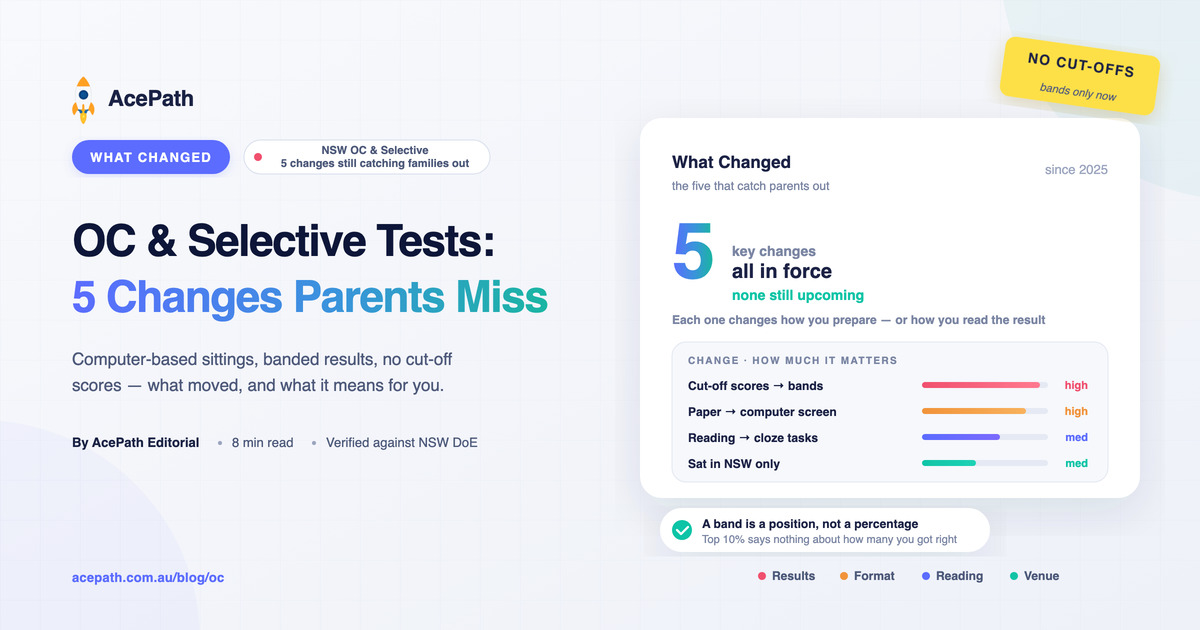
The OC and Selective placement tests are no longer the tests most parents think they are: they are sat on a computer, they are scored on the test alone, and the result comes back as a performance band rather than a score you can compare to a cut-off. Families still preparing against the old picture lose time on the wrong things and then misread the outcome when it arrives.
Here are the five changes that catch parents out, what each one actually means, and what it should change about how you prepare.
1. The Test Is on a Screen, Not on Paper
Both the OC and the Selective placement tests are computer-based. Students sit them on laptops provided by the Department, at a test centre allocated according to their primary school's location — in most cases a local public high school, not a large central venue.
This sounds administrative, but it changes the exam-room skills your child needs:
- You cannot annotate a passage, underline a key phrase, or scribble beside a diagram the way you can on paper.
- Long Reading passages have to be scrolled, so the whole text is never in front of you at once.
- Answers are selected from drop-downs and click targets, and changing one is a different physical action from erasing a circle.
- Rough working moves to the provided paper, away from the question — so students have to look up and down between two surfaces.
A child who has only ever practised on printed past papers is meeting the interface for the first time on the day. That is a poor time to discover it. See our guide to preparing for the computer-based test.
2. Placement Is Decided on the Test Alone
Entry to opportunity classes and selective high schools is based on performance in the placement test. Your child's classroom marks, their report, and their principal's view of them do not feed into the placement score.
Two practical consequences follow. The first is reassuring: a child at a school that marks more harshly than its neighbours is not disadvantaged. The second is less comfortable: a strong school report is not evidence that your child is on track for a place, because it measures something the test does not. The placement tests are designed to measure reasoning and problem-solving ability rather than how much of the Year 4 or Year 6 curriculum a child has covered.
The one structured exception is not school-based either. Under the Equity Placement Model, up to 20% of places at each school are reserved for students from recognised equity groups whose test results fall within 10% of the minimum score accepted from a general applicant at that school.
3. There Are No Cut-Off Scores Any More — Only Bands
This is the change that causes the most distress, because it lands at the worst moment: results day.
The performance report families receive does not contain an individual test score or a placement rank. The Department states plainly that scores and ranks are not available and cannot be provided. Instead, each component is reported as one of four bands showing where your child sat relative to everyone else who sat the test:
| Band | What it means |
|---|---|
| Top 10% | Your child's result was in the highest 10% of all candidates |
| Next 15% | Between the 10th and 25th percentile from the top |
| Next 25% | Between the 25th and 50th percentile from the top |
| Lowest 50% | In the bottom half of candidates |
The single most common misreading is treating a band as a percentage of questions answered correctly. It is not. "Top 10% in Reading" says nothing about how many Reading questions your child got right — it says that very few candidates did better. Because the tests are hard by design, the raw mark behind a top band is often lower than parents expect.
The published cut-off scores that circulate in parent groups and on coaching sites are historical. They cannot be used to check your child's result, because the number they would be compared against no longer exists. Reserve bands are a separate thing again, and are explained in our guide to reserve bands A to F.
4. The Reading Test Does Not Look Like the Old Papers
Reading is no longer a run of "what is the main idea" comprehension questions. The current test is built from a handful of separate tasks, each with its own text and its own question style, and two of the heaviest are cloze tasks — one where your child chooses a word for each gap in a passage, one where they choose whole sentences to slot back into a text.
These multi-part tasks are why the number of answers your child must give is far higher than the number of questions listed: 33 answers from 14 questions in the OC test, 38 from 17 in the Selective test. A single cloze task can be worth eight answers. Practice material that predates the redesign simply does not contain them, which is the clearest sign that a practice book is out of date. Our guide to cloze questions covers both types.
5. The Test Is Sat in NSW, and Nowhere Else
From 2026, the Selective High School Placement Test is held only in NSW. Families living overseas or interstate must bring their child back to NSW to sit it. There is no remote or interstate arrangement to fall back on, so travel and accommodation now belong in the planning from the start rather than as an afterthought once a test date is confirmed.
What Has Not Changed
Amid the changes, a few fundamentals are worth stating because parents often assume these moved too:
- The OC test still has three sections — Reading (40 minutes), Mathematical Reasoning (40 minutes) and Thinking Skills (30 minutes). There is no writing task in the OC test.
- The Selective test still has four — Reading (45 minutes), Mathematical Reasoning (40 minutes), Thinking Skills (40 minutes) and Writing (30 minutes), each carrying equal weight.
- You still nominate up to four OC schools in order of preference, and up to three selective high schools. Order decides which offer you receive if your child qualifies for more than one; it does not change the odds at any single school.
- Applications still open in November and close in February, with the test in May and outcomes released the following term. See how to apply for 2028 entry.
One further change is coming rather than already here: from 2027 entry, co-educational selective schools and opportunity classes allocate places equally between boys and girls. We cover what that does to the odds in our guide to gender parity.
Frequently Asked Questions
Can I find out my child's actual test score?
No. The Department does not release individual test scores or placement ranks, and states that they cannot be provided on request. The performance report's four bands are the only result information families receive.
Do my child's school reports or NAPLAN results affect placement?
No. Placement is based on performance in the placement test. School assessments, reports and NAPLAN results do not contribute to the placement score.
What score does my child need to get into a particular school?
There is no longer a published cut-off score to aim at. Any figure circulating for a specific school is historical and cannot be compared against the banded result your child will receive.
Does the test still use paper for working out?
Questions and answers are on the computer, and paper is provided for rough working. Practising entirely on printed papers leaves your child unpractised at moving between the two.
My child is overseas. Can they sit the test where we live?
No. From 2026 the Selective High School Placement Test is held only in NSW, and students overseas or interstate must return to NSW to sit it.
Prepare for the Test That Exists Now
Every change above points the same way: practise in the format your child will actually meet, and judge progress by reasoning rather than by a score out of a hundred. Start with a free AcePath sample quiz to see where your child stands across Reading, Mathematical Reasoning and Thinking Skills, then work through our OC and Selective practice packs, which are built around the current computer-based format and question types.
Start Practising Today
Try a free sample quiz to experience AcePath's exam-style practice tests.
Try Sample Quiz Register Free