What Is a Partially Selective High School in NSW?
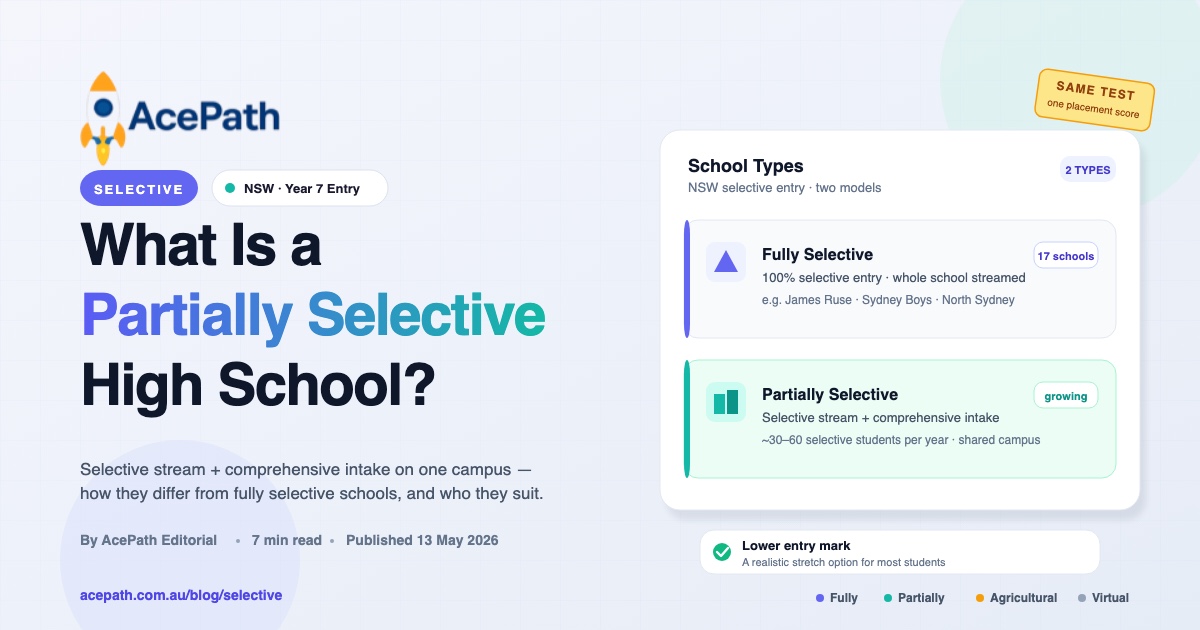
A partially selective high school in NSW is a public secondary school that runs both a selective entry stream and a regular comprehensive intake on the same campus. Selective students — admitted through the NSW Selective High School Placement Test — are placed in dedicated classes for core academic subjects, but share the broader school environment with local-area students.
If you have started researching NSW selective high schools, you have probably come across the term partially selective and wondered how it differs from a "fully selective" one. The distinction matters: it shapes who your child sits next to in class, what the school feels like day to day, and how competitive the entry mark is.
The Two Types of Selective High Schools in NSW
The NSW Department of Education runs selective entry across two different school models:
- Fully selective high schools — every student in the school has been admitted through the Selective High School Placement Test. The whole school is academically streamed. Examples include James Ruse Agricultural High School, North Sydney Boys, North Sydney Girls, and Sydney Boys High.
- Partially selective high schools — the school runs both a selective entry stream and a regular (comprehensive) intake. Selective students share the campus with local-area students, but are usually placed in dedicated selective classes for core subjects.
There is also a small number of agricultural selective schools (residential, agricultural focus) and the Aurora College virtual selective school for students in rural and regional NSW. Those sit slightly outside the fully/partially split, but follow the same placement test.
How a Partially Selective School Actually Works
In a partially selective high school, the selective stream is essentially a school-within-a-school for academic subjects. The typical pattern looks like this:
- Selective students are grouped together for English, Mathematics, Science, and often HSIE (Humanities) classes.
- Practical subjects — PE, Visual Arts, Music, Technology — are usually mixed with the comprehensive cohort.
- Lunch, sport, assemblies, electives, and extracurriculars are shared across the whole school.
- The selective intake is small — usually one or two Year 7 classes (around 30–60 students per year), versus several hundred in a fully selective school.
The selective stream uses the same placement test and the same entry rank as fully selective schools — it is not an "easier" path to a selective education. It is simply a different school environment.
Which NSW Schools Are Partially Selective?
The list changes occasionally as the Department of Education adds new selective streams to comprehensive schools. Long-standing partially selective high schools include Bonnyrigg High School, Macquarie Fields High School, Prairiewood High School, and Tempe High School. In recent years, selective streams have also been added at schools such as Chatswood High School, Elizabeth Macarthur High School, Karabar High School, and Leumeah High School to broaden access across regions.
Always check the current official list on the NSW Department of Education Selective High Schools page before listing preferences — the roster is updated each application cycle.
Partially vs Fully Selective: The Real Differences
1. Entry Mark
Fully selective schools — especially the top-ranked ones — usually demand a significantly higher placement test mark than partially selective schools. The minimum entry mark for a partially selective stream is typically lower than for a top-five fully selective school, which makes them a strong "reach but realistic" option for many families.
2. Peer Environment
In a fully selective school, every classmate, every conversation at recess, and every group project is with another high-achieving student. In a partially selective school, the selective cohort is academically dense, but the broader school community is mixed. Some students thrive on that diversity; others prefer the fully selective intensity.
3. School Culture
Partially selective schools tend to retain a more "normal high school" feel — wider extracurricular range, broader sports participation, and a less narrowly academic atmosphere. Fully selective schools are often more academically focused, with stronger competition culture and (usually) better HSC league-table results.
4. Location
Partially selective schools are spread more widely across NSW, including Western Sydney, the South West, the Hills, and regional centres. For families outside the inner city, a partially selective school can be a much shorter commute than the nearest fully selective option.
Pros and Cons for Your Child
Reasons to favour a partially selective school
- Lower entry mark — a more achievable target if your child is strong but not top-percentile.
- Better balance — selective-class academic challenge with normal-school social variety.
- Closer to home — often a shorter commute than the nearest fully selective school.
- Smaller selective cohort — teachers often know each selective student personally.
Reasons a fully selective school may suit better
- Maximum peer challenge — every classmate is a high achiever, in every subject.
- Stronger HSC track record — top-tier fully selective schools dominate the HSC league tables.
- Academic culture — heavy emphasis on enrichment, competitions, and accelerated programs.
- Specialist resources — many fully selective schools have invested deeply in gifted-and-talented programming over decades.
How to Apply
The application process is the same for fully and partially selective schools:
- Register online through the NSW Department of Education's Selective High School application portal in Year 5 (applications usually open in October–November).
- Select up to four preferences — you can freely mix fully and partially selective schools in one application.
- Sit the Selective High School Placement Test in Year 6 (typically around March–April). The test covers Reading, Mathematical Reasoning, Thinking Skills, and Writing.
- Receive placement offers later in the year, based on your child's placement score and the entry marks of your nominated schools.
A smart preference strategy often includes a stretch fully selective school, a realistic fully or partially selective school, and a safer partially selective option — giving your child the best chance of receiving an offer somewhere.
So, Is a Partially Selective School Worth Listing?
For most families, the answer is yes. A partially selective school gives your child a genuine selective education — strong peers in academic classes, accelerated pace, and stretching content — without the pressure-cooker intensity that some children find overwhelming at top fully selective schools. The lower entry mark also makes it a smart insurance preference for families aiming high but wanting realistic options.
The right choice depends on your child's personality, your family's commute tolerance, and how your child reacts to highly competitive environments. Visit open days at both fully and partially selective schools before locking in preferences.
Frequently Asked Questions
What is a partially selective high school?
A partially selective high school in NSW is a public school that runs both a selective entry stream and a regular comprehensive intake on the same campus. Selective students attend dedicated classes for core academic subjects (English, Mathematics, Science, HSIE), but share electives, sport, and extracurriculars with the rest of the school. Entry to the selective stream is via the NSW Selective High School Placement Test in Year 6.
What is the difference between fully selective and partially selective schools?
A fully selective school admits 100% of its students through the placement test, so every classmate is academically selected. A partially selective school admits only its selective stream — usually one or two classes per year (about 30–60 students per year level) — via the test, with the rest of the school made up of local-area comprehensive students.
Is the entry mark lower for partially selective schools?
Yes, typically. Top-tier fully selective schools such as James Ruse, North Sydney Boys, and Sydney Boys require very high placement scores. Partially selective schools usually have notably lower minimum entry marks, making them a strong realistic option for high-achieving students who may not score in the top percentile.
Which NSW schools are partially selective?
Long-standing partially selective high schools include Bonnyrigg High School, Macquarie Fields High School, Prairiewood High School, and Tempe High School. Newer additions include Chatswood High School, Elizabeth Macarthur High School, Karabar High School, and Leumeah High School. The roster is updated each application cycle — check the current list on the NSW Department of Education Selective High Schools page before listing preferences.
Do partially selective schools use the same test as fully selective schools?
Yes. Both fully and partially selective schools use the same NSW Selective High School Placement Test in Year 6. There is no separate test for partially selective entry — a single placement score is used to rank applicants across all selective schools.
How do you apply to a partially selective school?
Applications open in Year 5 (October–November) through the NSW Department of Education's online portal. You can list up to four preferences, freely mixing fully and partially selective schools. Your child sits the placement test in Year 6 (typically March–April), and offers are released later that year.
Get Ready for the Placement Test
Whether you are aiming for a fully or partially selective school, the same test decides the outcome. Start with a free AcePath sample quiz to see where your child currently sits across Reading, Mathematics, and Thinking Skills. Our selective practice packs mirror the real test format and difficulty so your child walks in on test day knowing exactly what to expect.
Start Practising Today
Try a free sample quiz to experience AcePath's exam-style practice tests.
Try Sample Quiz Register Free