James Ruse Agricultural High School: Selective Entry Guide
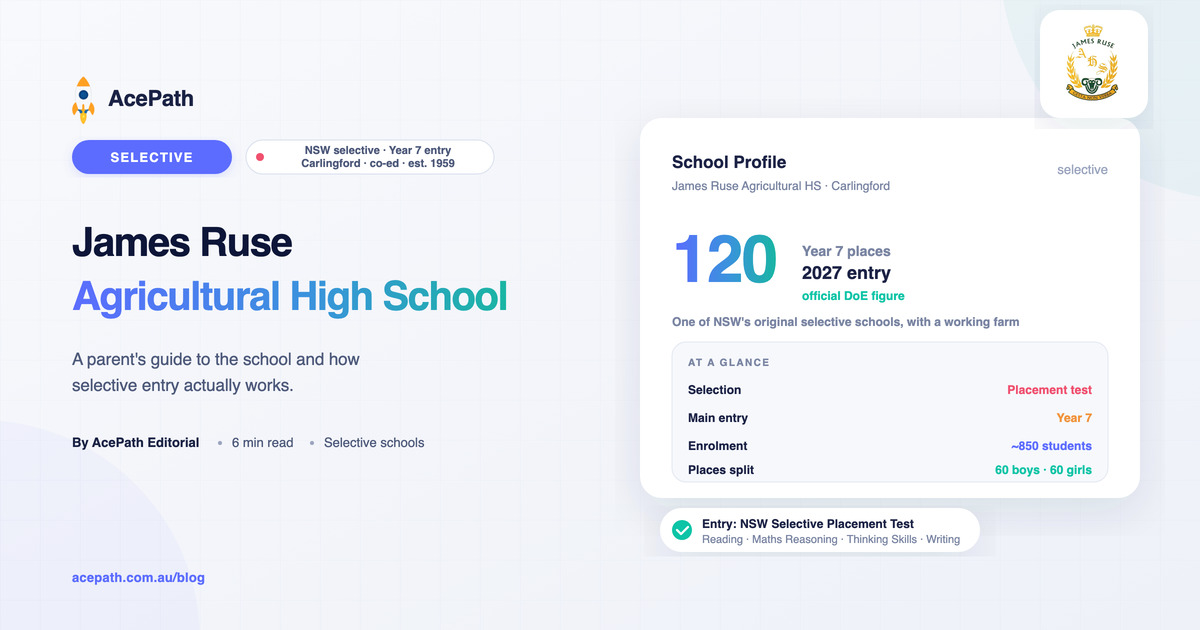
James Ruse Agricultural High School is one of the best-known names in NSW selective education — a fully selective, co-educational public school in Carlingford that has topped or sat near the top of the state's HSC results tables for decades. For many families preparing for the Selective High School Placement Test, "Ruse" is the school they most want to understand: what makes it different, how competitive it is, and what it actually takes to earn a place.
This guide gives you an honest, up-to-date profile of the school and a clear picture of how entry works — without the invented cut-off scores you'll see repeated on other sites.
School Snapshot
- Type: Fully academically selective, co-educational public high school
- Years: 7–12
- Location: Felton Road, Carlingford, in Sydney's north-west
- Enrolment: roughly 850 students
- Established: 1959, named after colonial agricultural pioneer James Ruse
- Motto: Gesta non verba — "Deeds, not words"
What Makes James Ruse Distinctive
Unlike every other academically selective school in NSW, James Ruse is an agricultural high school with a working farm on site — around ten hectares that include livestock such as Angus cattle, sheep and hens, alongside vegetable gardens, glasshouses and orchards. Agriculture is a compulsory subject in Years 7–10, so every student, regardless of where they live, spends time on practical, hands-on learning that most city schools can't offer.
That agricultural identity sits alongside a strongly academic culture. The school's stated values — acceptance, service, participation, integrity, respect and endeavour — and its focus on educating "the whole child" are reflected in a broad co-curricular program on top of its academic reputation.
Academic Reputation
James Ruse is widely regarded as one of the very top-performing schools in the state. It held the number-one position in media compilations of HSC results for many consecutive years and has remained right at the top since. It's important to be clear about what that means: the NSW Department of Education does not publish official school "rankings" or league tables. The figures you see quoted come from media and tutoring-college tables built from HSC results, not from an official source. What is fair to say is that Ruse is consistently among the most academically successful schools in NSW and is often described as the most competitive selective school to enter.
How Entry Works
Year 7 — the main entry point
James Ruse Agricultural High School offers 120 Year 7 places for 2027 entry, according to the NSW Department of Education (60 boys / 60 girls).
The overwhelming majority of students join in Year 7 through the NSW Selective High School Placement Test, which is sat in Year 6. The test is computer-based and covers four areas:
- Reading
- Mathematical Reasoning
- Thinking Skills
- Writing
When you apply, you nominate up to three selective schools in order of preference. Your preference order never changes your chances at any single school — it only decides which offer you receive if your child qualifies for more than one. Placement is based on the test result, and because demand for Ruse is so high, it typically requires one of the strongest results in the state.
The 2027 gender balance change applies here
Because James Ruse is co-educational, it is affected by the NSW gender parity model that applies from the 2027 intake. At co-ed selective schools, places are now split equally between boys and girls, with boys competing against boys and girls against girls for their halves of the places (any odd place, and any places one gender doesn't fill, go on academic merit). This does not change how your child is assessed — the placement test is identical for everyone — but it's a genuine difference between Ruse and the single-sex selective schools.
Later-year entry
A limited number of places open in Years 8–11 when vacancies arise, through a separate application and test run outside the Year 7 process. These places are few and vary year to year. There is no entry into Year 12.
Getting There
The Carlingford campus is served by school and public bus routes with connections from Epping and Parramatta, and the L4 light rail serves the surrounding area. As a selective school, Ruse draws students from across Sydney rather than a local catchment, so many families factor in a longer commute.
What a Competitive Application Looks Like
There is no published cut-off to aim at, so the only sensible target is a genuinely strong, well-rounded result across all four test sections. A child who is excellent at maths but shaky on Reading or Thinking Skills can be overtaken by a more balanced applicant. The most reliable preparation is consistent practice with realistic, exam-style questions in the same computer-based format your child will face on the day, so that timing and question style feel familiar rather than surprising.
Frequently Asked Questions
Is James Ruse co-ed or single-sex?
Co-educational. It was originally a boys' school and became co-ed from 1977.
Do I have to be interested in agriculture to go there?
No. Agriculture is a compulsory subject in Years 7–10 and part of what makes the school distinctive, but students enrol for the academic program as much as anything. You don't need a farming background.
What score do you need to get into James Ruse?
There is no officially published cut-off score, and any specific number quoted online is an unofficial estimate. Entry is by placement-test performance, and Ruse typically requires one of the highest results in the state because demand is so high.
Can you apply for James Ruse and other selective schools at the same time?
Yes. You list up to three selective schools in order of preference on the one application. Your order doesn't affect your odds at any individual school — it only decides which offer you get if you qualify for more than one.
Is there entry other than in Year 7?
A small number of Years 8–11 places open when vacancies exist, via a separate school-run process. Year 7 is by far the main entry point.
Related reading
- Selective High School Test dates 2028
- How selective placement scores are calculated
- The selective reserve list explained
- Gender parity in NSW selective schools from 2027
Prepare for the Placement Test with AcePath
Whichever selective schools you're aiming for, the placement test is what decides your child's options. Start with a free AcePath sample quiz to see where they stand in Reading, Mathematical Reasoning and Thinking Skills, then build an exam-ready routine with our OC and Selective practice test packs, which mirror the real computer-based format used on test day.
Start Practising Today
Try a free sample quiz to experience AcePath's exam-style practice tests.
Try Sample Quiz Register Free