NSW Equity Placement Model: The 20% of Places Explained
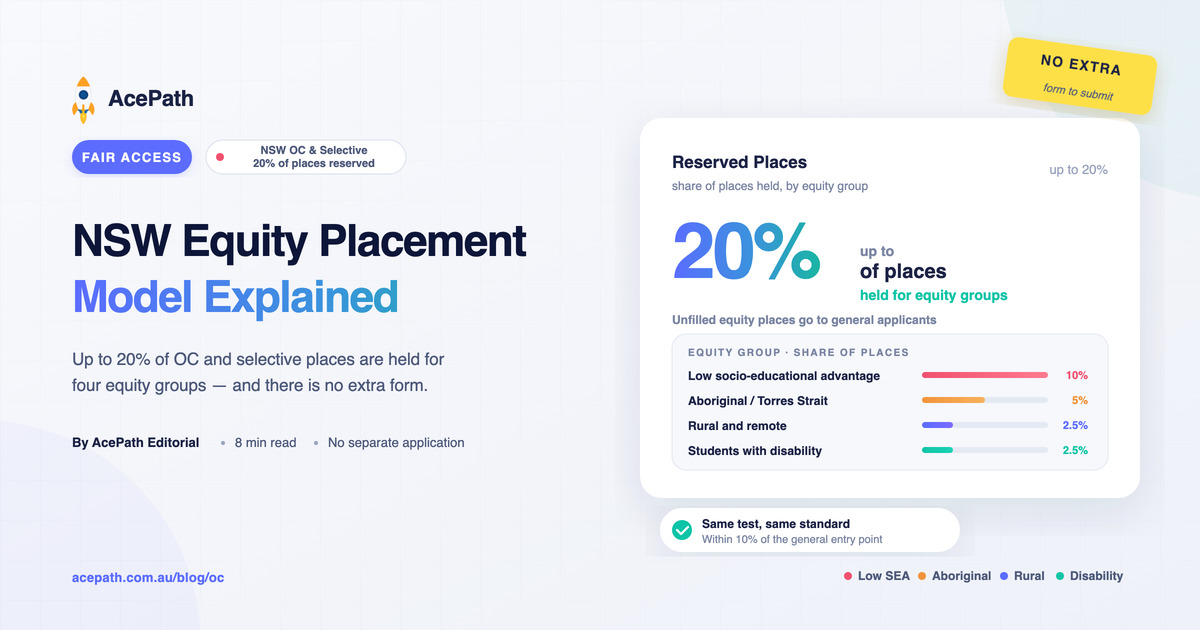
Up to 20% of places in every NSW Opportunity Class and selective high school are held for high-potential students from four under-represented equity groups — and there is no separate form to fill in, because the NSW Department of Education identifies eligible students automatically from your application.
The Equity Placement Model is the least understood part of NSW selective education. With Year 7 selective outcomes released on 19 August 2026 and Opportunity Class outcomes due on 9 September 2026, this guide answers the two questions families actually ask: does my child qualify, and what academic standard still applies?
If instead you want the seat numbers — how many equity places sit behind each individual school's intake — that is on our NSW selective high schools directory and OC schools directory, which list places school by school. This page is about eligibility and the standard.
The 20% at a Glance
The Department reserves up to 20% of places at each setting, split across four groups:
| Equity group | Share of places |
|---|---|
| Students from communities of low socio-educational advantage | 10% |
| Aboriginal and/or Torres Strait Islander students | 5% |
| Students from rural and remote areas | 2.5% |
| Students with disability | 2.5% |
The word up to matters. These are ceilings, not guarantees, and the Department describes the percentages as flexible year on year so they can respond to changes in student numbers and in the level of disadvantage experienced by under-represented students.
The model applies to both Opportunity Classes and selective high schools — it is not a selective-only rule.
Where the Model Came From
The Equity Placement Model followed the NSW Government's 2018 review of access to Opportunity Classes and selective high schools. The review found that high-potential students were missing out on places for reasons that had nothing to do with their ability: a low socio-economic background, an Aboriginal background, a disability, or simply living in a rural or remote area.
Sitting alongside it from the 2027 intake is the separate gender parity model, which gives boys and girls an equal number of places at every co-educational selective high school and Opportunity Class.
How Equity and Gender Parity Interact
Both rules apply to the same 2027 intake, and this is the question we are asked most often: does an equity place count against a school's boys' half or girls' half, or does it sit outside the gender split entirely?
The Department has not published the answer. Its fair access material describes the two models separately and does not state whether an equity-eligible student taking a reserved place counts toward their gender's share.
What is documented, and what you can plan around:
- Both models apply to the 2027 intake and to later years
- Selection under both is still decided by placement test performance
- Equity places still require performance close to the general entry point
- Places left unfilled under either rule flow to other qualifying students rather than going to waste
The practical consequence is the same under every reading: the score is what you can control.
Who Is Eligible for Each Group
Low socio-educational advantage
Students attending schools in communities with high levels of educational disadvantage are considered. This is assessed from the school your child currently attends, not from a household income figure you supply.
Aboriginal and/or Torres Strait Islander students
Students who identify as Aboriginal and/or Torres Strait Islander are eligible. A small number of schools also carry additional targeted places for this group.
Rural and remote students
Eligibility requires both the home address and the school the child currently attends to be in a rural or remote area. One or the other on its own is not enough.
Students with disability
Students recorded in the Nationally Consistent Collection of Data on School Students with Disability as receiving supplementary, substantial or extensive adjustments are eligible.
A child can be eligible under more than one group at the same time.
The Three Things Parents Most Often Get Wrong
1. There is no separate application
You do not tick an equity box, write a submission, or send evidence. The Department identifies eligibility using the data already in your application and its own records. If your child is eligible, they are considered automatically.
2. Your child still sits the same placement test
Every applicant sits the same Reading, Mathematical Reasoning and Thinking Skills papers (plus Writing for selective entry), on the same computer-based platform, under the same conditions. There is no easier paper and no separate exam.
3. It is not a lowered standard — it is a narrow band
An equity place still requires test performance within 10% of the minimum accepted for that school from a general applicant during initial offers, or as otherwise determined by the selection committee. In practice that is a tight band immediately below the general entry point, not an open door. A child a long way below the school's standard will not receive an equity offer.
What Happens to Equity Places That Are Not Filled
They are not left empty and they are not carried over. Any equity place that is not filled is offered to general applicants in the usual order of test performance. This is one of several reasons the effective entry point at a given school shifts from year to year, alongside the number of applicants, how they performed, and the number of places available.
It is also why the Department publishes no fixed cut-off scores. There is no minimum entry mark for any selective high school or Opportunity Class — the level required is an outcome of that year's applicant pool, not a published threshold. If you have seen a "cut-off list" on a coaching website, it is a reconstruction, not an official figure.
What This Means for Your Preparation
Honestly? Very little should change. The model does not alter what is tested, how it is tested, or the fact that placement is decided on test performance. Roughly one in eight applicants gains an Opportunity Class place and about one in four gains a selective high school place, and those odds are driven by the score your child produces on the day.
What the model should change is your framing. If your family falls into one of the four groups, apply with confidence: the pathway was built precisely because students like yours were being missed. If it does not, understand that equity places come out of the same performance-ranked process and are held to a standard close to the general entry point — so the practical answer is the same either way. Build the score.
Frequently Asked Questions
Does the Equity Placement Model apply to Opportunity Classes as well as selective high schools?
Yes. It applies to both.
Do I need to provide evidence of disadvantage or disability?
No. There is no separate process and no documentation to submit. Eligibility is identified from application data and departmental records.
Can my child be considered under two equity groups?
Yes. Students may be eligible for consideration in more than one group.
Does an equity place mean a lower score is enough?
Only marginally. Performance must be within 10% of the minimum accepted from a general applicant at that school during initial offers, or as determined by the selection committee.
If equity places are not used, do those places disappear?
No. Unfilled equity places are offered to general applicants.
Do equity places come out of the boys' half or the girls' half?
The Department has not published how the Equity Placement Model and the gender parity model interlock. Both apply, and both still select on test performance.
How many equity places does a particular school have?
Roughly 20% of that school's intake, so it depends on the size of the intake. Our selective high schools directory and OC schools directory list places school by school.
How does this interact with the reserve list?
Placement continues to work through offers and reserve lists in the normal way. Equity consideration affects who qualifies for an offer, not the mechanics of how offers and reserve lists move.
Where to Verify the Official Details
Percentages and eligibility rules can be adjusted year to year, so check the current rules before you rely on them:
- The "fair access" section of the selective high schools and Opportunity Classes pages at education.nsw.gov.au
- The official application dashboard and the emails sent to you after you apply
- Your child's current school, which can confirm how it is classified
The Score Is Still the Deciding Factor
Every pathway into an Opportunity Class or a selective high school runs through the same placement test. Start with a free AcePath sample quiz to see where your child stands in Reading, Mathematical Reasoning and Thinking Skills, then build a steady routine with our OC and Selective practice test packs, which mirror the real computer-based format your child will face on test day.
Start Practising Today
Try a free sample quiz to experience AcePath's exam-style practice tests.
Try Sample Quiz Register Free