Selective School Offer Rounds and How Appeals Work
Why the Offer Process Matters
The Selective High School offer process is not a single event — it unfolds over months. Many families miss opportunities because they don't understand the structure of offer rounds, the role of the reserve list, and the limited circumstances under which appeals succeed. Here's how it all works.
The Standard Offer Round
Initial Offers — Term 3
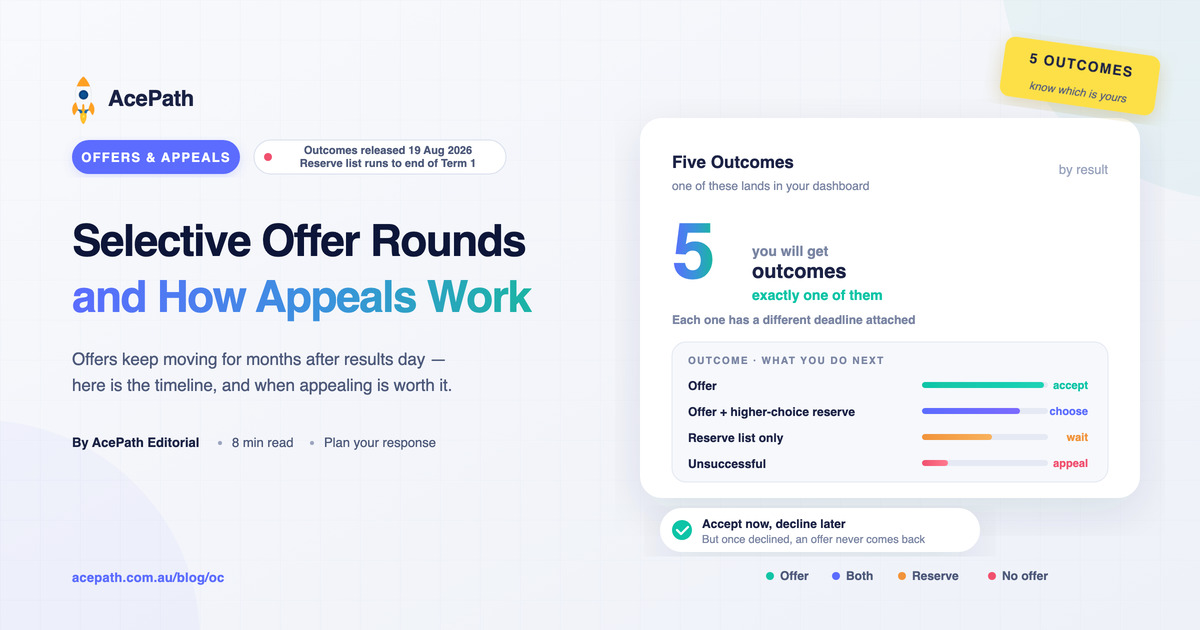
Several months after the Selective test — held on 1 or 2 May 2026 for Year 7 entry in 2027 — the Department releases initial offers. For the 2027 intake, Selective outcomes are released on 19 August 2026, with Opportunity Class outcomes following on 9 September 2026. Every ranked student receives one of five outcomes:
- Offer — a place at one of your nominated schools (up to 3 for Selective, up to 4 for OC)
- Reserve list only — no offer yet, but a ranked position that can still convert
- Offer and higher choice reserve list — an offer in hand, while still on the reserve list for a school you ranked higher
- Unsuccessful — no offer and no reserve list place
- Not applicable — the school was ranked below the offer you received
Acceptance Window
Offers must be accepted or declined through the application dashboard by the response due date shown against your outcome — check the date on your dashboard rather than relying on a rule of thumb. Missing it forfeits the offer. You can accept now and decline later if you change your mind, but once you decline an offer you cannot get it back. If you hold an offer while sitting on a higher-choice reserve list, a separate reserve decision date sets when you must choose between keeping the offer and staying on the higher reserve.
First Reserve Offers
Places declined during the acceptance window immediately become available. These are offered to the highest-ranked reserve-list student whose preferences include that school. This can happen within days of initial offers closing.
Subsequent Offer Movements
Reserve list movements continue over weeks and sometimes months:
Late Declines
Families sometimes decline after initially accepting, due to:
- Family relocation
- Change of private school plans
- Illness or other personal factors
- Late offers from other schools
Each decline creates a reserve-list opportunity for someone else.
Forfeitures
Sometimes families who accept fail to complete enrolment, or withdraw after the school year begins. Places from forfeitures may also be offered from the reserve list.
Late-Year Adjustments
Reserve offers can continue well into the following year. Families should check official communications regularly, even months after the initial offer round.
The Appeal Process
Grounds for Appeal
Appeals are considered only in limited, specific circumstances. General dissatisfaction with the result, belief that your child "should have" done better, or preference for a different school are not grounds for appeal. The Department typically considers appeals only when:
- Illness or circumstance on test day that was not formally handled through special provisions and materially affected performance (with documentation)
- Technical issues during the test that were not adequately addressed at the time
- Administrative or procedural errors by the Department that affected the outcome
- Late-arriving evidence of a genuine, documented impairment that would have qualified for special provisions
What Is Not a Ground for Appeal
- Your child was anxious or underperformed on the day
- You disagree with the school preference allocation
- The test felt harder than expected
- You believe the cutoff should be different
- You want reconsideration because of strong school reports or external awards
- External test results — NAPLAN, ICAS or IQ testing — are explicitly not considered
- Your child's young age, limited test preparation, or educational disadvantage
- Practical advantages such as travel convenience or a sibling already at the school
These situations, while emotionally significant, do not form the basis of a successful appeal.
Two hard limits are worth knowing before you invest energy in an appeal: it is not possible to have any test questions remarked, and no appeal will result in your child's test score or placement rank being released. All the performance information you will receive is already in the performance report.
How to Submit an Appeal
The window is short. Appeals are submitted through the application dashboard by the due date shown in the key dates — typically about 5 business days after outcomes are released, not a few weeks. The steps are:
- Lodge the appeal in the application dashboard before the stated due date
- Attach relevant supporting documentary evidence (for example, a medical practitioner's documentation or evidence of unforeseen circumstances)
- Wait for the panel to review — it comprises two principals of a selective high school or a school with an opportunity class, plus a Director, Educational Leadership
- Await the formal response
Three rules catch families out: no late appeals are accepted, an appeal cannot be edited or updated once submitted, and appeal decisions are final. Submit it complete the first time.
The same process and timeframe apply to Opportunity Class outcomes, lodged through the same dashboard. The Department's official outcomes page carries the current, authoritative requirements — always confirm the exact due date there.
Realistic Appeal Outcomes
The vast majority of appeals are not successful because the Department applies a strict standard. Successful appeals usually involve clear, documented procedural errors or test-day incidents — not performance concerns. Don't invest significant emotional energy into an appeal unless you have strong, documented grounds.
Out-of-Area Applications
If your child is not offered a Selective place through the standard process, some schools accept late applications for remaining places in the following years. This is rare and typically only occurs when:
- A school has unfilled places after the standard offer process
- Mid-year vacancies open due to student withdrawals
- Your family has relocated from interstate or overseas
Contact the specific school directly to enquire about out-of-area or mid-year admission policies.
Planning Through the Offer Process
Confirm Your Plan B Immediately
When initial offers are released, enrol your child in a non-Selective school as your main plan. Don't wait on reserve list hopes. If a reserve offer comes, you can switch.
Check Communications Regularly
Offers and reserve list updates come via email and portal messages. Check both weekly during the active offer period.
Make Decisions as a Family
Decisions about accepting offers, declining, or switching schools should involve your child. They are moving into adolescence — their voice matters, and they should be part of major schooling decisions.
Keep Perspective
Selective schools are a wonderful opportunity, but not the only path to strong outcomes. Many top HSC performers each year come from comprehensive public schools, private schools, and Catholic schools. The right school for your child is the one that matches their interests and supports their development — not necessarily the one with the highest rank.
Prepare Strongly, Plan Broadly
The best way to navigate the offer process is to aim for a strong score in the first place — reducing reliance on reserve lists and appeals. Our Selective practice packs help your child build skills systematically across Reading, Maths Reasoning, and Thinking Skills. Start with a free sample quiz to see where your child currently stands.
Start Practising Today
Try a free sample quiz to experience AcePath's exam-style practice tests.
Try Sample Quiz Register Free