Narrative vs Recount: 4 Selective Writing Types Explained
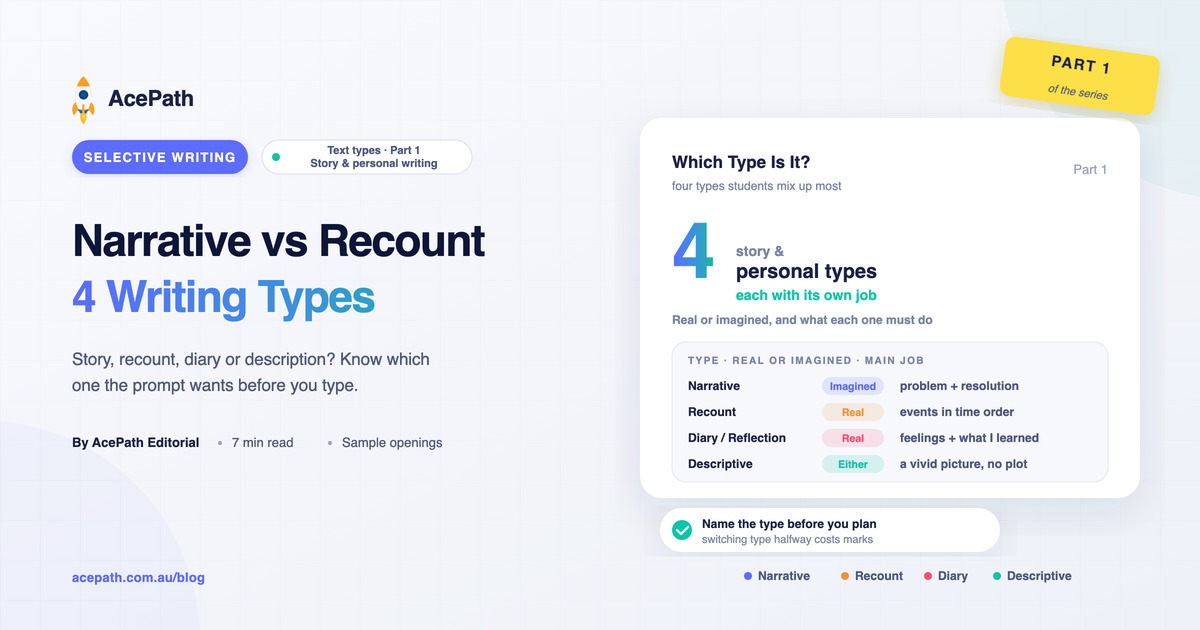
Narrative, Recount, Diary and Descriptive writing all tell the reader about something that happens or exists, but they are four different text types: a Narrative is an imagined story, a Recount retells real events in order, a Diary reflects on the writer's own experience, and Descriptive writing paints a scene without needing a plot. Students mix them up constantly, and on a timed writing task that confusion costs marks, because the marker judges whether the piece does the job its type is meant to do.
This is the first post in our series on the kinds of writing students should be ready for in the NSW Selective writing task. It covers the four "story and personal" types; Part 2 covers persuading and arguing, and Part 3 covers informative writing. For how the task works overall, how long it is and how it is weighted, start with our NSW Selective Writing Test guide.
Why the Text Type Matters
A prompt might say "write a story", "write a recount" or "write a diary entry", or it might give only a picture and leave the choice to your child. Either way, markers ask the same question first: does this piece fit its purpose? A beautifully written recount that invents a dragon halfway through is no longer a recount. A descriptive piece that turns into a rushed adventure plot has lost what made it descriptive.
Knowing the four types clearly helps in two ways. Your child reads the prompt correctly, and they pick a structure in the first few minutes instead of working it out while they type.
1. Narrative (Story)
Purpose: to entertain the reader with an imagined event or experience.
What markers look for
- A character the reader cares about, shown through actions and dialogue rather than a list of traits.
- A problem or complication: something has to go wrong, or be at stake.
- A resolution that follows from what the character does, not from luck or "it was all a dream".
- A shape: orientation, complication, rising tension, climax, resolution. In 30 minutes, one setting and one main problem is plenty.
A sample opening
The lift doors opened on the fourteenth floor, and Mia knew immediately that she was not supposed to be there. The corridor was silent. Every door was painted the same grey, and none of them had a number.
It starts in the middle of the action, gives a question straight away (why shouldn't she be there?), and uses detail that sets the mood without slowing down.
The most common mistake
Spending half the time on the set-up ("One day I woke up, brushed my teeth, ate breakfast…") and rushing the ending into one sentence. Plan the ending before starting, then begin as close to the problem as possible.
2. Recount
Purpose: to retell real events in the order they happened.
What markers look for
- An orientation that answers who, where and when in the first paragraph.
- Events in time order, linked with time connectives: first, later that morning, by the time we arrived, finally.
- Past tense, kept consistent.
- A closing comment that says what the experience meant or why it was memorable.
A sample opening
Last September, our class spent three days at a camp near the Blue Mountains. We left school at seven in the morning, and by the time the bus reached the first lookout, half of us had already eaten our lunch.
Recount or Narrative?
This is the confusion we see most. A recount is non-fiction: it tells what really happened, and its tension comes from real moments, not an invented crisis. A narrative is fiction, built around a problem the writer makes up. If a prompt says "recount a time when…", the marker expects a believable, real-feeling account. A recount can still be vivid and exciting, but it should not suddenly become a story.
The most common mistake
A list of events with no highlights ("then we did this, then we did that"). Pick two or three moments and slow them down with detail; move quickly through the rest.
3. Diary, Journal or Reflection
Purpose: to narrate and reflect on a personal experience, in the writer's own voice.
What markers look for
- First person and a natural, personal tone. It can be less formal than an essay, but not careless.
- Feelings and thoughts, not just events. The reader should know how the writer felt, and why.
- Reflection: what the writer learned, would do differently, or is still unsure about.
- Diary conventions where asked: a date, or an opening such as "Dear Diary", used once and not overdone.
A sample opening
Tuesday, 14 May. I thought today would be the worst day of the term. I had to give my speech in front of the whole year, and my hands were shaking so much that my palm cards rustled like leaves.
Diary or Recount?
Both can be about real events. The difference is the focus. A recount mainly tells what happened. A diary or reflection is mainly about what it meant to me. If the entry could have been written by someone watching from the side, it is drifting into a recount.
The most common mistake
Stopping at events and never reflecting. A strong entry spends at least a paragraph on thoughts and feelings, and usually ends with a change in how the writer sees something.
4. Descriptive Writing
Purpose: to describe a person, place, event or situation so vividly that the reader can picture it.
What markers look for
- Sensory detail beyond sight: sound, smell, touch, even temperature.
- Precise vocabulary: "the gravel crunched" rather than "it made a noise".
- Figurative language used with care: a well-chosen simile or metaphor beats a paragraph packed with them.
- An organising path: moving from far to near, from outside to inside, or through a stretch of time, so the description does not jump around.
A sample opening
The market wakes up before the sun does. Metal shutters rattle open one after another, the air fills with the sweet smoke of charcoal, and somewhere a radio is playing a song nobody is listening to.
Descriptive or Narrative?
Descriptive writing does not need a plot. Nothing has to go wrong and nobody has to solve anything. The skill being marked is the quality of the picture. A little movement is fine, such as the morning passing at the market, but if a chase scene appears, the piece has switched type.
The most common mistake
Stacking adjectives ("the big, dark, scary, old, creepy house"). One exact detail does more work than five general ones.
The Four Types Side by Side
| Type | Real or imagined? | Main job | Structure | Easy test |
|---|---|---|---|---|
| Narrative | Imagined | Entertain with a story | Orientation, problem, climax, resolution | Is there a problem the character must solve? |
| Recount | Real | Retell events in order | Orientation, events in time order, closing comment | Could this really have happened, in this order? |
| Diary / Reflection | Real (personal) | Share and reflect on an experience | Event, feelings, what it meant | Do I know how the writer felt and what they learned? |
| Descriptive | Either | Paint a vivid picture | A path through a place, person or moment | Could this work with no plot at all? |
How to Practise These Four Types
- Name the type before planning. Have your child say out loud which of the four they are writing, and why, before they type a word.
- Use the same stimulus four ways. Take one picture, such as a crowded train station, and write a short opening for each type. It is the fastest way to feel the difference.
- Practise typed and timed. The Selective writing task is typed, so practise pieces should be too, with a visible timer.
- Get feedback on one habit at a time. Rushed endings, missing reflection or adjective stacking are each fixable, but only once your child knows which one is holding them back.
Frequently Asked Questions
What is the difference between a recount and a narrative?
A recount retells real events in the order they happened; a narrative is an imagined story built around a problem and its resolution. A recount should not invent a dramatic crisis that did not happen.
Can a diary entry be about something made up?
Yes, if the prompt asks your child to write as a character. It should still read like personal writing: first person, focused on feelings and reflection, not just a sequence of events.
Does descriptive writing need a beginning, middle and end?
It needs an organised path, not a plot. Moving through a place or a moment in a clear order gives the piece its shape.
What if the prompt does not say which type to write?
Choose the type that suits the stimulus and your child's strengths, then stick with it for the whole piece. Switching type halfway is one of the clearest signs of an unplanned response.
Which other types should my child know?
Persuasive and discursive writing, speeches, reviews and advertisements (Part 2), and informative writing such as reports, articles, advice sheets and letters (Part 3).
Practise All Four With Real Feedback
AcePath's Selective practice includes writing tasks across every text type, with each response marked against seven clear criteria (ideas and detail, shape and form, flow and paragraphing, word choice and voice, sentences, spelling and grammar, and punctuation) so your child can see exactly what to improve next. Start with our free marked writing task (one per account), see the Selective practice packs, and read our Selective Writing Test guide for the full picture of how the task works.
How AcePath Marks Your Child's Writing
Every writing task on AcePath is marked against the same seven criteria. Each criterion gets a whole mark, and together they add up to a score out of 25:
| Criterion | What it looks at | Marks |
|---|---|---|
| Ideas & Detail | How well the writing answers the task, and how specific its supporting detail is | 4 |
| Shape & Form | Whether it fits the type of writing asked for, with a purposeful opening, middle and ending | 4 |
| Flow & Paragraphing | Logical order, clear paragraphs and ideas that link together | 4 |
| Word Choice & Voice | Precise, varied vocabulary and a tone that suits the reader | 3 |
| Sentences | Sentence variety, control of length and correct construction | 4 |
| Spelling / Grammar | Spelling accuracy, agreement and consistent tense | 3 |
| Punctuation | Punctuation that makes the meaning clear | 3 |
| Total | 25 | |
Our AI marker drafts the assessment: a mark with a short analysis and a suggestion for each criterion, plus corrections that quote your child's own words. A member of the AcePath team reviews the draft before it is sent, so every mark your child receives has been checked.
Your child then gets a report like the one below: an overall percentage, a skills profile across all seven criteria, the breakdown with what went well and what to change, the spelling, grammar and punctuation fixes, and a three-step improvement plan for the next piece.
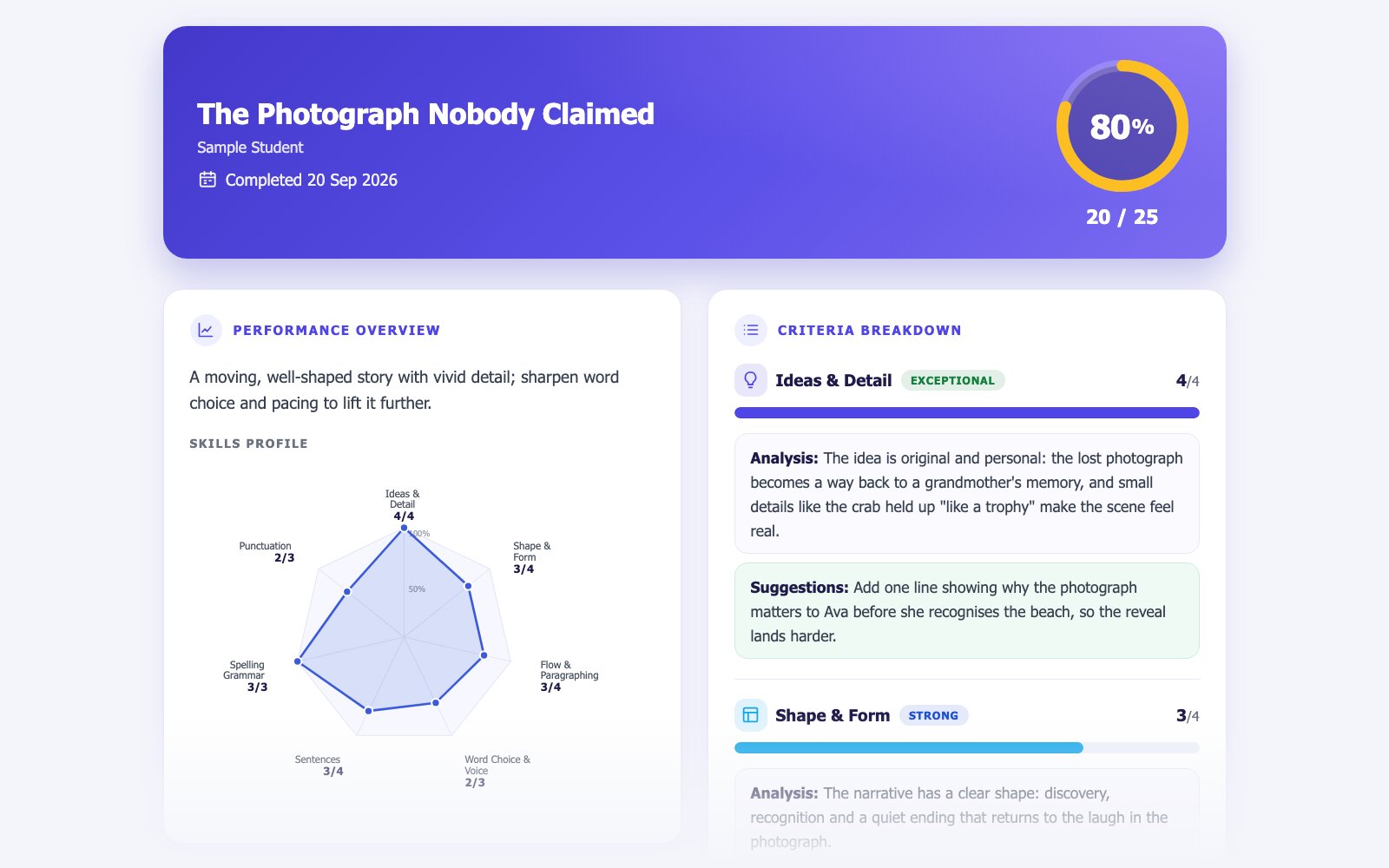
This is AcePath's own rubric, designed to give specific, useful feedback after every practice piece. It is not the official NSW Selective marking scheme.
Start Practising Today
Try a free sample quiz to experience AcePath's exam-style practice tests.
Try Sample Quiz Register Free