What Is a Selective High School in NSW? A Parent's Guide
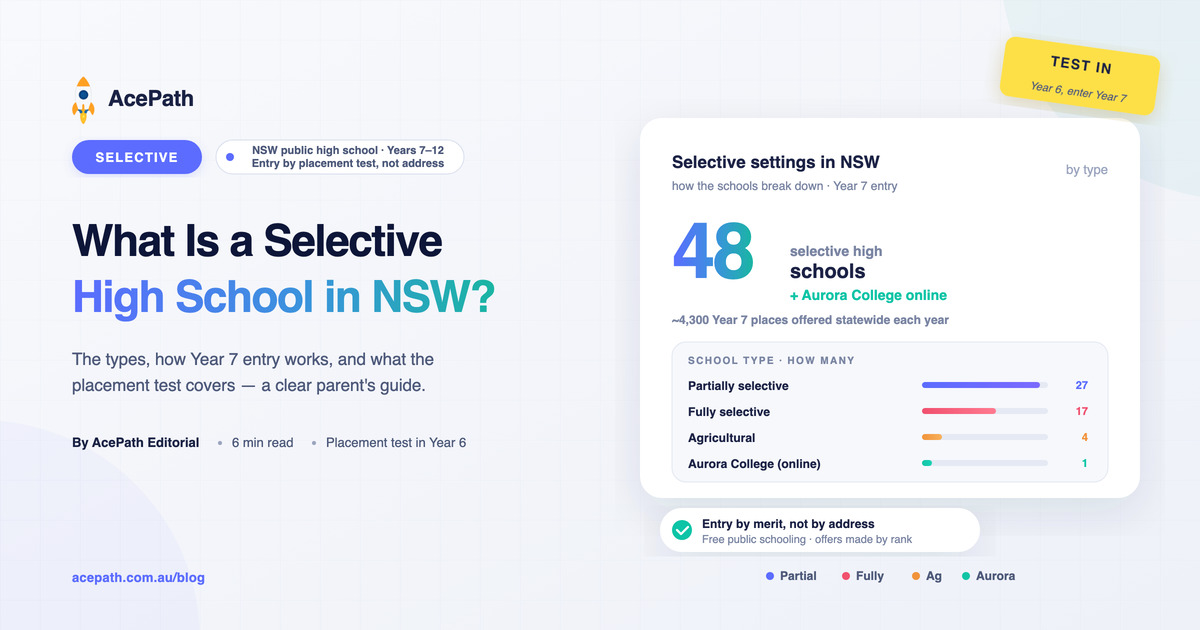
A selective high school in NSW is a government (public) high school that enrols academically high-potential and gifted students in Years 7 to 12, with entry decided by a single placement test rather than by where you live. For families weighing their options after primary school, understanding what these schools actually are — and how they differ from your local comprehensive high school — is the first step to deciding whether the selective pathway is right for your child.
This guide explains what a selective high school is, the different types across NSW, how entry works, and how to tell whether it is a good fit for your child.
What Is a Selective High School?
Selective high schools are NSW public schools designed specifically for high-potential and gifted students in Years 7 to 12. They group academically capable students together so the pace, depth, and challenge of teaching can be pitched higher than in a typical mixed-ability classroom. Because they are government schools, they charge no tuition fees — the only real "cost" of entry is performing well enough on the placement test to earn a place.
Crucially, entry is not based on your home address. A comprehensive (local) high school takes students from within its drawing area; a selective high school takes students from across NSW, purely on academic merit as measured by the Selective High School Placement Test. This is what makes places competitive — there are roughly 4,300 Year 7 selective places offered each year for many thousands of applicants.
The Types of Selective High School in NSW
"Selective high school" is an umbrella term. NSW actually offers several different settings, and knowing the difference matters when you nominate your preferences.
Fully selective high schools
There are 17 fully selective high schools in NSW. Every student in the school has gained entry through the placement test, so the entire cohort is academically selected. These are the schools most people picture when they hear "selective" — places like Sydney Boys, Sydney Girls, North Sydney, and James Ruse.
Partially selective high schools
There are 27 partially selective high schools offering Year 7 selective entry. These are comprehensive local high schools that also run one or more academically selective streams alongside their regular classes. Your child sits in a selected class within a mainstream school. Partially selective schools often widen access to the selective pathway in areas without a fully selective school — we cover them in detail in our guide to partially selective high schools.
Agricultural selective high schools
NSW has 4 agricultural selective high schools — including Farrer Memorial, Hurlstone, and James Ruse. These combine academic selection with a compulsory agriculture program, and several offer boarding, drawing students from rural and regional NSW as well as the cities.
Aurora College (online)
Aurora College is a virtual selective school for rural and remote students. Rather than relocating, students stay enrolled at their local "host" public high school and join Aurora's online classes for subjects such as English, mathematics, and science, with residential camps during the year. It extends the selective opportunity to families a long way from a bricks-and-mortar selective school.
How Is a Selective School Different from OC and a Comprehensive School?
Three settings often get confused. Here is the plain-English distinction:
- Comprehensive high school: your local public high school. Entry is by home address; classes are mixed-ability.
- Opportunity Class (OC 天才班): a selective setting for gifted students in Years 5 and 6 (primary school). Entry is via the OC Placement Test sat in Year 4. It is the primary-school equivalent of a selective high school.
- Selective high school: the Years 7 to 12 setting described above, entered via the Selective High School Placement Test sat in Year 6.
OC and selective are two separate applications with two separate tests at two different ages. Attending an OC class can be excellent preparation for the selective test, but it is not a requirement — many students enter selective high schools without ever having been in an OC class.
How Do Students Get Into a Selective High School?
Entry is decided by the Selective High School Placement Test, sat in Year 6 for entry into Year 7 the following year. The process runs on a stable annual calendar:
- Apply online through the NSW Department of Education when applications open (typically around October–November).
- Nominate up to three selective high schools in order of preference. The order does not change your child's chance at any single school — it only decides which offer you receive if your child qualifies for more than one.
- Sit the test in early May, on one allocated day.
- Receive results and offers in late August, based on a placement score that combines the test sections.
Because places are limited and offers are made strictly by rank, a strong test performance is what matters most. For the full year-by-year timeline, see our Selective test dates guide, and when you are ready to shortlist schools by distance, use our NSW selective schools directory.
What Does the Selective Test Cover?
The placement test is a computer-based assessment in the Cambridge-style format, with four sections:
- Reading — 45 minutes
- Mathematical Reasoning — 40 minutes
- Thinking Skills — 40 minutes
- Writing — 30 minutes
The writing task is the key difference from the OC test, which has no writing section. Together the sections take about 155 minutes of testing time. Because it is computer-based and uses a specific question style, familiarity with the format is a genuine advantage on the day.
Is a Selective High School Right for Your Child?
Selective schools suit students who are academically capable and who thrive on a faster pace and higher expectations. The upsides are a like-minded peer group, an accelerated curriculum, and a strong academic culture. The trade-offs can include a longer commute, a more competitive environment, and — for some children — pressure that outweighs the benefit.
The best way to gauge fit is to look at how your child responds to challenge, not just their marks. A confident, curious learner who enjoys being stretched is often well suited; a child who is doing well but already feels stretched may be happier elsewhere. There is no single right answer — a great local comprehensive school serves many students superbly.
Frequently Asked Questions
Are selective high schools free?
Yes. Selective high schools are NSW government schools and do not charge tuition fees, though the usual voluntary school contributions, uniforms, and excursion costs apply. Agricultural selective schools that offer boarding charge boarding fees.
How many selective high schools are there in NSW?
There are 17 fully selective, 27 partially selective, and 4 agricultural selective high schools offering Year 7 entry, plus Aurora College, the online option for rural and remote students.
What year does my child sit the selective test?
Year 6. Successful students start Year 7 at their selective high school the following year.
Do you have to be in an OC class to get into a selective high school?
No. Opportunity Class (OC) is a separate primary-school program with its own test. It can help, but many students enter selective high schools without any OC background.
How many schools can I list on the application?
Up to three selective high schools, in order of preference. The order affects only which offer you receive if your child qualifies for more than one — not the chance at any individual school.
What is the difference between a fully selective and a partially selective school?
In a fully selective school, every student has gained entry by test. In a partially selective school, an academically selected stream runs alongside the regular comprehensive classes within a mainstream local high school.
Start Preparing for the Selective Test
If the selective pathway sounds right for your child, the earlier you understand the test, the calmer the year before it becomes. Begin with a free AcePath sample quiz to see where your child sits across Reading, Mathematical Reasoning, and Thinking Skills, then build a steady routine with our Selective practice test packs, which mirror the real Cambridge-style format so your child knows exactly what to expect on test day.
Start Practising Today
Try a free sample quiz to experience AcePath's exam-style practice tests.
Try Sample Quiz Register Free