Cloze Questions in the OC and Selective Reading Test
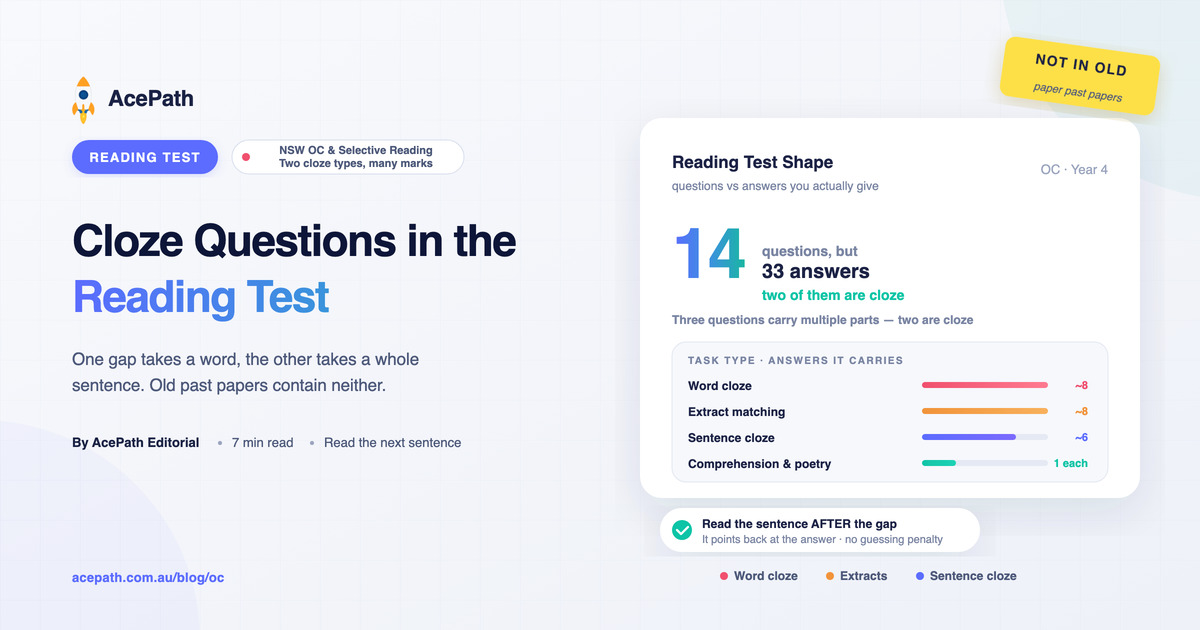
The redesigned Reading test contains two different cloze question types — one that asks for a single word and one that asks for a whole sentence — and between them they account for a large share of the answers your child has to give. Neither looks much like the comprehension questions in older paper practice papers, which is why they surprise students who have prepared on out-of-date material.
This guide explains what each type is, what it is actually testing, and how to practise for it.
Where Cloze Sits in the Test
Both the OC and the Selective Reading tests are built from a handful of tasks, each with its own text and its own question style. The official structures are:
| OC Placement Test (Year 4) | Selective Placement Test (Year 6) | |
|---|---|---|
| Time | 40 minutes | 45 minutes |
| Questions | 14 (3 have multiple parts) | 17 (3 have multiple parts) |
| Answers to give | 33 | 38 |
| Weighting | One third of the total | One of four components |
Notice the gap between "questions" and "answers to give". The three multi-part questions are what close it — and two of those three are cloze tasks. A single cloze question can be worth eight answers, which is why they matter out of proportion to how they look on a question list.
Type 1: The Word Cloze
A passage appears with roughly eight gaps in it. For each gap your child chooses a word from a drop-down list.
The trap is that the words are rarely difficult ones. In the Department's own OC practice material, the answers include springs, stands, bit, decline and measure — words a nine-year-old has known for years. What is being tested is not whether your child knows the word, but whether they can recognise a common word being used in a less common sense: "decline" as refusing rather than falling, "measure" as a step taken rather than a quantity, "springs" as a source of water or a sudden movement rather than the season.
What it is really assessing
- Vocabulary in context — the meaning is fixed by the surrounding sentence, not by the word alone
- Grammar — several options will be the wrong part of speech or the wrong tense for the slot
- Collocation — which words habitually sit together in English, which is where students who read widely have an invisible advantage
How to attack it
- Read the whole passage first, gaps and all. Later sentences frequently settle earlier gaps.
- Predict before you open the list. Deciding what kind of word belongs there — a verb? a plural noun? — makes wrong options fall away instantly.
- Read the completed sentence back. A word that is right in isolation often sounds wrong once the sentence is whole.
- Do not leave a gap because you are unsure. There is no penalty for a wrong answer.
Type 2: The Sentence Cloze
The second type gives a non-fiction passage — the Department's practice material uses the history of the escalator — with whole sentences removed. Your child picks which sentence belongs in each gap from a list of candidates.
This is a different skill entirely. Vocabulary barely matters. What matters is whether your child can track how a paragraph develops an idea.
The one technique that solves most of them
The correct sentence is almost never identifiable from the gap alone. It is identified by the sentences on either side of it. Look at how the Department explains its own answers: "The sentence before the gap explains that Ames envisioned his invention for private residences. The sentence which fits the gap expands on this idea..." Then: "The following sentence highlights that... Ames never built this version."
So the method is mechanical:
- Read the sentence before the gap. What idea is on the table?
- Read the sentence after the gap. What does it assume has just been said? Words like "this", "yet", "the following year", "here" are the giveaways — they point backwards at the missing sentence.
- Find the sentence that bridges them. The right answer makes both neighbours make sense at once.
- Do the easy gaps first. Each sentence you place removes an option from every other gap.
Students who read only the gap and pick whatever sounds most interesting get these wrong consistently. Students who read the sentence after the gap get them right.
Why These Two Types Cause Trouble
- Older practice papers do not contain them. The Department says plainly that its own PDF practice tests from the paper era "do not reflect the current test format". A child drilled on 2019 papers will meet both cloze types for the first time on test day.
- They are worth many answers each. Getting the shape of the task wrong costs far more than missing a single comprehension question.
- They punish skimming. Both types require reading complete sentences carefully, which is the opposite of the speed-reading habit many students build for comprehension passages.
- They are computer-based. Drop-down lists behave differently from circling a letter on paper — worth rehearsing on screen. See our guide to preparing for the computer-based test.
How to Practise Without Buying Anything
Cloze rewards a habit more than it rewards drilling:
- Hunt for second meanings. When your child meets an everyday word used oddly — "he declined the invitation", "a measure of protection" — stop and name the sense. Ten seconds, done often, is worth more than a vocabulary list.
- Cover-a-sentence. Take any non-fiction article, cover one sentence in the middle of a paragraph, and have your child say what must have been there. This is exactly the sentence cloze skill.
- Read non-fiction deliberately. Both cloze types in the official practice material use expository writing — history, science, explanation — not stories.
- Use the Department's own online practice tests, which simulate the real software. The PDF versions are useful for explanations but not for format.
Frequently Asked Questions
What is a cloze question?
A passage with gaps in it that the student fills by choosing from supplied options. The Reading test uses two versions: one where the gap takes a single word, and one where the gap takes an entire sentence.
How many cloze questions are in the Reading test?
Typically one word cloze task and one sentence cloze task. Each counts as a single question but carries multiple answers — the word cloze alone can be worth around eight.
Is there a penalty for guessing?
No. Every gap should be filled, even when your child is unsure.
Do OC and Selective use the same cloze types?
Both Reading tests are built the same way. The Selective test is slightly longer — 17 questions and 38 answers in 45 minutes, against 14 questions and 33 answers in 40 minutes for OC — and the passages are pitched at Year 6 rather than Year 4.
Are old past papers still useful?
For comprehension practice, yes. For format, no — the Department states its paper-era practice tests do not reflect the current test. Use the online practice tests to learn the format.
My child has a strong vocabulary but still misses these. Why?
Almost always because they are reading the gap in isolation. Both cloze types are decided by the words around the gap, not the gap itself.
Where to Confirm the Official Format
- The NSW Department of Education's placement test pages at education.nsw.gov.au, including the online practice tests
- The official practice tests with explained answers, which show exactly how each answer is reasoned
Practise Reading the Way the Test Asks
Cloze rewards students who read whole sentences and notice how ideas connect. Start with a free AcePath sample quiz to see where your child stands in Reading, Mathematical Reasoning, and Thinking Skills, then build the habit with our OC and Selective practice test packs, which mirror the computer-based format your child will face.
For the longer passages in the same section, read our reading comprehension strategies for the OC test.
Start Practising Today
Try a free sample quiz to experience AcePath's exam-style practice tests.
Try Sample Quiz Register Free