OC Results 2026: What Gender Parity Changed in the Offers
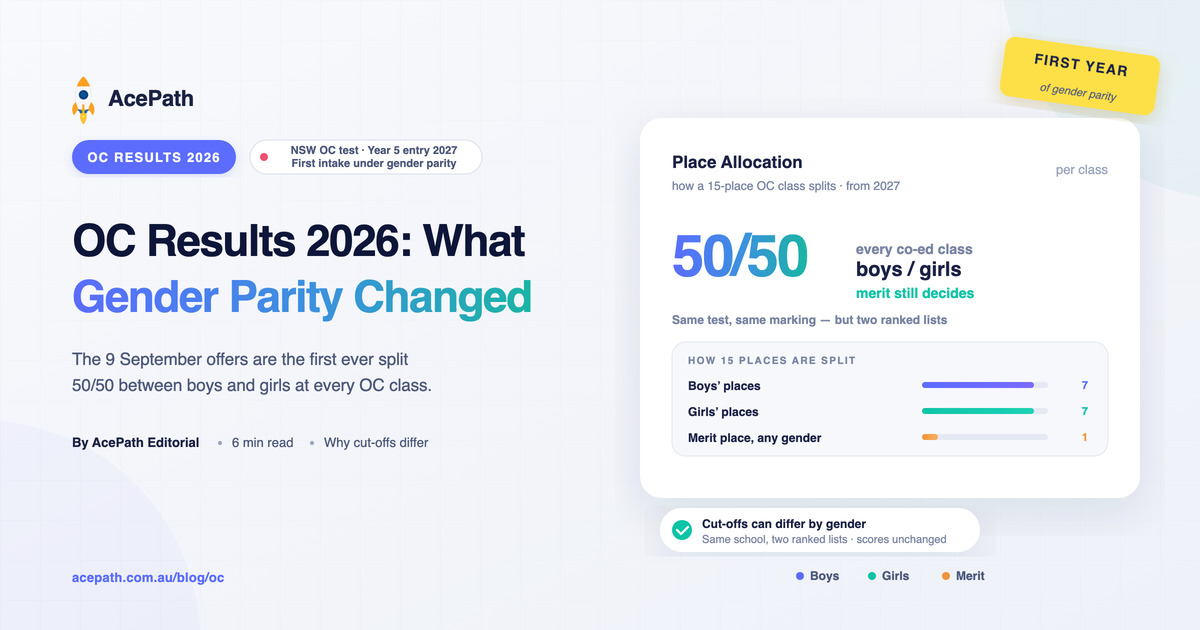
OC placement outcomes for 2027 Year 5 entry are released at 12pm on Wednesday 9 September 2026 — and they are the first ever decided under the NSW gender parity model, which means boys and girls compete for separate halves of the places at every Opportunity Class in the state. If your child's result looks different from what last year's cut-offs would have predicted, this is why.
This post is the follow-up to our explainer on how the gender parity model works. That one was written before the policy had produced a single offer. This one is about what you can and cannot see on results day, and how to read it.
A One-Paragraph Recap of the Rule
From the 2027 intake, every co-educational OC class splits its places equally between boys and girls. In a 15-place class that means 7 places to boys, 7 to girls, and the last place to the highest-scoring remaining applicant regardless of gender. Selection is still entirely based on the placement test — the model changes how many places each gender is competing for, not what the test asks. If not enough students of one gender qualify, those places flow to qualifying students of the other gender.
What You Will Actually See in Your Dashboard
Before reading anything into the gender split, it helps to know what the Department does and does not release. On 9 September you see your own child's outcome in the application dashboard, plus a performance report. You do not see cut-off scores, school rankings, or any state-wide breakdown — the Department stopped publishing minimum entry scores in 2022, deliberately, to move families away from chasing a number.
The five possible outcomes
Each of your school choices returns one of five results:
| Outcome | What it means |
|---|---|
| Offer | A place, which you must accept by the response due date |
| Reserve list only | No offer yet; an offer follows if the queue reaches your child |
| Offer and higher choice reserve list | A place at one school, still queued at a school you ranked higher |
| Unsuccessful | No offer at that school |
| Not applicable | A lower-ranked choice, not assessed because an offer came higher up |
The third outcome is the one families misread most often. An offer plus a higher-choice reserve place is not a rejection from the preferred school — it is a place in hand while you wait.
The performance report: four bands, not a score
Alongside the outcome you get a report showing how your child performed against everyone else who sat the test that year. Each component — Reading, Mathematical Reasoning, and Thinking Skills — is reported in one of four bands:
- Top 10% of candidates
- Next 15% of candidates
- Next 25% of candidates
- Lowest 50% of candidates
There is no raw mark and no rank. Two children in the same band can be a long way apart, so the report is a guide to relative strength across the three subjects, not a scoreboard. Where it is genuinely useful is spotting an uneven profile — a child in the top 10% for Reading and the lowest 50% for Thinking Skills has a clear place to work if they sit a test again.
If your child is on a reserve list, read the band letter
A reserve placement comes with a band letter. For OC the scale runs A to E, where A to D carry an estimated month by which students in a similar position received an offer last year, and E means an offer is unlikely. Note that this scale is not the same as the selective one, which runs A to F — our guide to reserve band letters sets out both tables.
What the results cannot tell you about gender parity
Because nothing is published at state or school level, no one outside the Department can say from Wednesday's release how the offers split between boys and girls, or where each gender's cut-off fell at any school. Figures circulating in parent group chats are estimates built from self-reported results in a small, self-selecting sample. Treat them as gossip, not data.
For context, the imbalance the policy was designed to address was roughly 60/40 boys to girls in opportunity classes before the change. Whether the 2027 intake lands closer to even is something the Department's own reporting may show in time — but not on results day.
Why Two Children with the Same Score Can Get Different Outcomes
This is the part families find hardest, so it is worth being direct about it.
Before 2027, a single ranked list per OC class decided the offers. Now there are effectively two ranked lists at every co-ed class — one for boys, one for girls — each competing for its own half of the places. Where more boys than girls applied and scored highly at a particular school, the boys' list is longer relative to its share of places, so the last boy offered a place will typically have a higher score than the last girl offered a place at that same school.
That gap is not evidence that the test was marked differently, or that anyone's result was adjusted. Every child's score is produced the same way. What changed is the size of the pool their score is ranked against.
It also works in reverse. At OC classes where girls historically outnumbered boys among high scorers, the boys' cut-off sits lower. The direction of the gap depends entirely on who applied where.
What the Results Do Not Tell You
- There are no published cut-off scores by gender. The Department does not release per-school, per-gender cut-offs, so any figure circulating in a parent group chat is an estimate at best.
- No place was left empty to protect a quota. If a class could not fill its girls' places with qualifying applicants, those places were offered to qualifying boys, and vice versa.
- The equity places are a separate mechanism. Up to 20% of places at each school are held under the Equity Placement Model, which operates alongside gender parity rather than inside it.
- Gender diverse applicants were placed on academic merit. A gender diverse student who outscored the lowest eligible student of either gender received an offer.
Reserve Lists Are Gendered Too
This catches people out. Because the places are split by gender, the OC reserve list at each school effectively runs by gender as well: when a girl declines her place, the next offer at that school generally goes to the next girl on the list, not to the highest-scoring child of either gender.
The practical consequence is that your child's reserve-list movement depends on how many families of the same gender decline offers at that specific school. A long reserve list is not automatically a hopeless one, and a short one is not automatically promising — it depends on the decline rate above your child.
Offers continue to be made from reserve lists as places become available. If your child is on one, keep your contact details current in the application dashboard and make a plan for their local school in the meantime.
If You Are Thinking About an Appeal
The appeal window is short — roughly five business days from the release of results. Our guide to the appeal window covers what does and does not count as grounds. The short version: an appeal is for illness, misadventure, or an administrative error on test day, not for disagreeing with the outcome. "My child scored higher than a child of the other gender who got in" is not a ground for appeal, because the model is working as designed when that happens.
What This Means If You Are Applying for 2028
Applications for 2028 OC entry are expected to open in November 2026, with the test in early May 2027. Gender parity will apply to that intake and every intake after it. Two things follow:
- For families of girls: half the places at every co-ed OC class are held for girls. If a strong local OC class has looked male-dominated and that put you off applying, the arithmetic has changed.
- For families of boys: nothing about preparation changes, but school preferences matter more than they used to. Spreading your four OC preferences across schools with different applicant profiles is worth more thought than it was under a single ranked list.
What has not changed for anyone: the placement test decides who qualifies. Reading, Mathematical Reasoning, and Thinking Skills, computer-based, no writing component.
Frequently Asked Questions
Were the September 2026 OC results affected by gender parity?
Yes. The offers released on 9 September 2026 are for 2027 Year 5 entry, the first intake the gender parity model applies to. Places at every co-educational OC class were split equally between boys and girls.
Did my child's test score get adjusted because of their gender?
No. Scores are produced identically for every student. Gender parity changes how many places each gender is ranked for, not how the test is marked.
Why did a child with a lower score get an offer when mine did not?
Most often because they were ranked in the other gender's pool at that school, where the cut-off fell at a different point. The Department does not publish per-gender cut-offs, so the exact gap is not knowable from outside.
Can I appeal on the basis of the gender split?
No. Appeals cover illness, misadventure, and administrative errors around the test itself. The gender allocation is the published policy, so an outcome produced by it is not an error.
Does gender parity apply to the reserve list?
In effect, yes. Because places are allocated by gender, later offers at a school generally go to the next student of the same gender as the family who declined.
Will the same rules apply for 2028 entry?
Yes. The model applies from the 2027 intake onwards. Confirm current details at education.nsw.gov.au before you apply.
Where to Confirm the Official Details
Policy settings can be refined from year to year, and parent group chats are not a reliable source for cut-offs or quotas. Confirm through:
- The NSW Department of Education's selective high schools and opportunity classes pages at education.nsw.gov.au
- The official outcome notice in your application dashboard
- Your child's current school
Preparing for the Next Round
Whatever the allocation model looks like, the placement test is what decides who qualifies. Start with a free AcePath sample quiz to see where your child stands in Reading, Mathematical Reasoning, and Thinking Skills, then build a steady routine with our OC practice test packs, which mirror the real computer-based format.
Start Practising Today
Try a free sample quiz to experience AcePath's exam-style practice tests.
Try Sample Quiz Register Free