NSW Reserve Bands Explained: What A to F Really Means
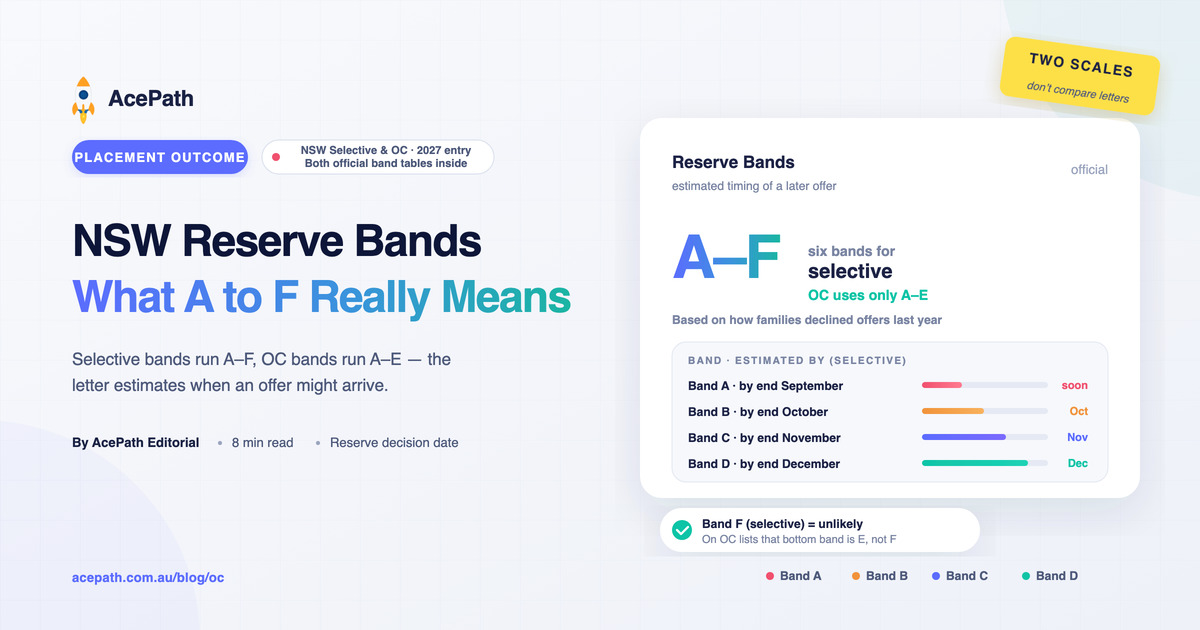
The reserve band letter on your placement outcome is the NSW Department of Education's estimate of when an offer might arrive — and the scale is not the same for selective high schools and opportunity classes. Selective reserve bands run A to F, where A to E are "likely" and F is "unlikely". OC reserve bands run A to E, where A to D are "likely" and E is "unlikely". A "Band E" means two completely different things depending on which list you are reading.
With selective outcomes for 2027 entry released on 19 August 2026 and opportunity class outcomes due on 9 September 2026, thousands of NSW families are staring at a single letter and trying to work out what it is actually telling them. This guide sets out both official band tables, explains what the letters are calculated from, and covers the one deadline that quietly ends a lot of reserve-list hopes.
What a Reserve Band Actually Is
If your child did not receive an offer in the first round but is on a school's reserve list, your application dashboard shows a reserve band alongside that placement. The band is not a rank, not a score, and not a probability. It is a timing estimate, built from a single input: how quickly families declined offers at that specific school in the previous year.
That matters because it makes the band a statement about other people's behaviour, not about your child. A Band A at a school where a third of offers were declined last year and a Band C at a school where almost nobody declines are describing two different queues, not two different students. The department is explicit that these are "estimates only", because the number and timing of declined offers is not necessarily similar from year to year.
Reserve lists themselves are ordered strictly by placement rank at each school. The band is a plain-language wrapper around your position in that queue — see our full guides to the selective reserve list and the OC reserve list for how the queue moves.
Selective High School Reserve Bands: A to F
For Year 7 selective placement, the department publishes six bands. Bands A to E carry an estimated month by which students in a similar position received an offer last year.
| Band | Estimated timing (based on the previous year) |
|---|---|
| A | By the end of September |
| B | By the end of October |
| C | By the end of November |
| D | By the end of December |
| E | By the end of January |
| F | Unlikely to receive an offer |
If your child is in band A to E, the department's wording is that you are likely to receive an offer by the date listed — with the standing caveat that there is no guarantee, because it depends entirely on other families declining places. If your child is in band F, an offer is unlikely, and if one does come it would probably arrive after the school year has already started.
Selective reserve offers do not stop at the end of January. Where vacancies keep arising, offers can be made up to the end of Term 1 of the entry year — so a Band F is a low probability, not a closed door.
Opportunity Class Reserve Bands: A to E
Opportunity class placement uses a five-band scale. The months are the same for A to D, but the final band arrives one letter earlier.
| Band | Estimated timing (based on the previous year) |
|---|---|
| A | By the end of September |
| B | By the end of October |
| C | By the end of November |
| D | By the end of December |
| E | Unlikely to receive an offer |
For OC, band E is the "unlikely" band — the equivalent of selective's band F. As with selective, an OC offer that does arrive from band E would likely come after the start of the school year, and OC reserve offers can continue up until the end of Term 1 in Year 6.
The Two-Scale Trap
This is the single most common misreading, and it is easy to see why. Parents compare notes in a school pickup line or a WeChat group, one family has an OC Band D and another has a selective Band D, and everyone assumes they are in the same boat.
| Band | On a selective list (A–F) | On an OC list (A–E) |
|---|---|---|
| D | Likely — by the end of December | Likely — by the end of December |
| E | Likely — by the end of January | Unlikely |
| F | Unlikely | Not used |
A selective Band E is a genuine "expect a call" position. An OC Band E is the bottom band. If you have one child in Year 4 and another in Year 6, or you are comparing outcomes with another family, check which list the letter belongs to before you read anything into it.
The Reserve Decision Date: The Deadline Most Families Miss
Here is the mechanic that costs families places every year, and it has nothing to do with your band.
You can receive an offer from a lower preference while still sitting on the reserve list for a higher preference. You are allowed to accept the lower-preference offer and keep the higher-choice reserve position — but only until a cut-off the department calls the reserve decision date. After that date, students holding an accepted offer are automatically removed from any higher-choice reserve lists.
To stay on the higher-choice list beyond the reserve decision date, you must decline your accepted offer. That is a real gamble — you are giving up a place in hand for a queue position — and it is exactly the kind of decision that should not be made in the last hour before a deadline.
The reserve decision date is specific to each intake year and is shown in your application dashboard and in the department's published key dates. Unofficial dates circulate on coaching sites every year; confirm yours against the dashboard rather than a forum post, and diarise it the day you receive your outcome.
What to Do With Your Band This Week
- Accept the reserve position in the portal. A reserve place still has to be accepted. Doing nothing does not hold your spot.
- Write down the reserve decision date from your dashboard, and note whether you would decline an accepted offer to chase a higher choice. Decide that in principle now, calmly, not on the day.
- Keep your contact details current and stay reachable. Reserve offers come with short response windows, and school holidays are prime declining season.
- Enrol at your backup school anyway. Enrolling locally does not remove your child from any reserve list, and it means a Band D outcome in December does not leave you scrambling.
- Do not appeal the band itself. Appeals address illness or misadventure affecting the test, supported by documentary evidence. No appeal will change a rank or a band — see our guide to the five-business-day appeal window.
- Keep the study routine running. Whatever the band, the skills tested carry straight into the year ahead.
Frequently Asked Questions
What does reserve band A mean?
Band A means students in a similar reserve-list position received an offer by the end of September in the previous year's placement round. It is the strongest band on both the selective and OC scales, but it is still an estimate — it depends on other families declining places.
Is OC band E the same as selective band E?
No. Selective reserve bands run A to F, so band E is a "likely" band with an estimate of the end of January. OC reserve bands run A to E, so band E is the final band and means an offer is unlikely. The scales are different lengths.
How is the reserve band calculated?
From how quickly families declined offers at that particular school during the previous year's placement process, mapped against your child's position on that school's reserve list. It is not a score, a rank or a published probability.
Can my reserve band change?
The band shown is a one-off estimate issued with your outcome, not a live tracker. What changes is your actual position in the queue as families ahead of you accept or decline.
What is the reserve decision date?
It is the cut-off after which students holding an accepted offer are removed from higher-choice reserve lists. To stay on a higher-choice list past that date you must decline your accepted offer. The exact date for your intake is shown in your application dashboard.
How long do reserve lists stay open?
Selective reserve offers can be made up to the end of Term 1 of the entry year. OC reserve offers can be made up until the end of Term 1 in Year 6.
Does a low band mean my child should stop preparing?
No. Selective entry is also available in Years 8 to 12 through a separate application to individual schools, and the reasoning and comprehension skills the test measures underpin the whole of high school. See selective entry in Years 8 to 11.
A Letter, Not a Verdict
A reserve band is a forecast built from last year's declines at one school. It is genuinely useful for planning — knowing whether to expect news in September or in January changes how you handle Term 4 — but it is not a measure of your child, and it is not a promise in either direction. The families who navigate reserve lists best are the ones who accept the reserve place, note the reserve decision date, enrol somewhere solid, and then get on with the year.
If you are still in the preparation stage, or you are now looking towards a future round, start with a free AcePath sample quiz to see where your child sits across Reading, Mathematical Reasoning and Thinking Skills. You can browse every school and its intake in our NSW selective schools directory and OC schools directory, and our practice test packs mirror the real Cambridge-style format.
Start Practising Today
Try a free sample quiz to experience AcePath's exam-style practice tests.
Try Sample Quiz Register Free