NSW Selective & OC Appeals: You Have About 5 Business Days
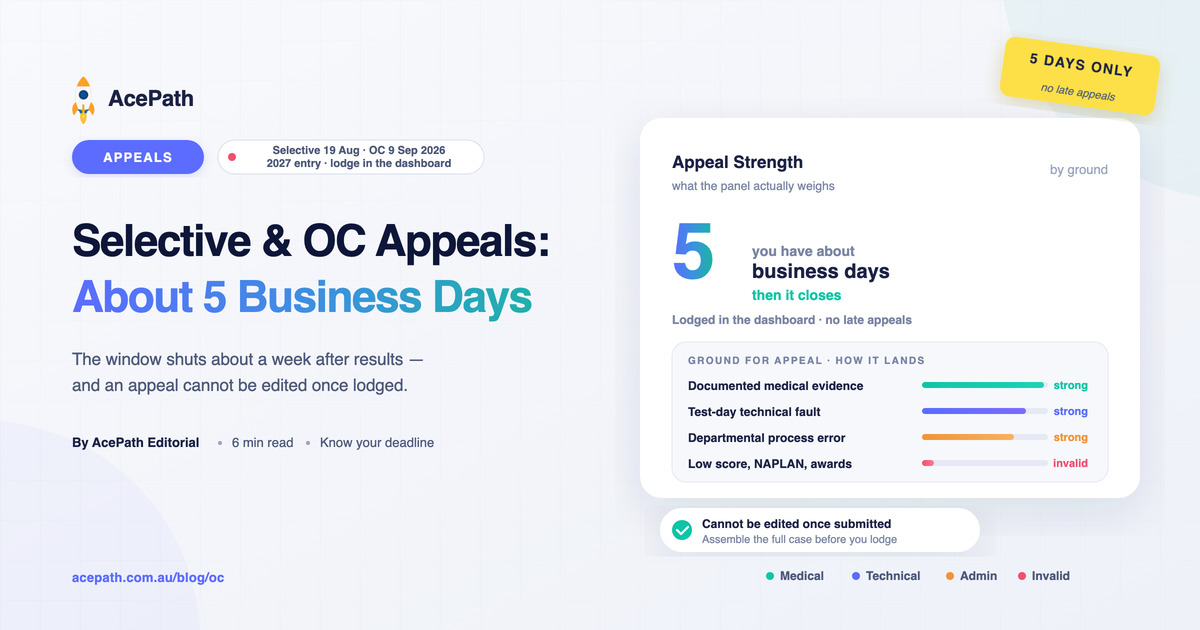
If you want to appeal a NSW Selective High School or Opportunity Class placement outcome, you have roughly 5 business days from the day results are released — and the appeal cannot be edited, extended, or reopened once that window closes. With Selective outcomes for 2027 entry released on 19 August 2026 and OC (天才班) outcomes on 9 September 2026, most families discover the deadline while they are still absorbing the result.
This guide sets out exactly how long you have, who reviews the appeal, what evidence actually counts, and — just as importantly — the three things an appeal can never do for you.
The Deadline: About 5 Business Days
Appeals are lodged through the application dashboard, the same portal you used to apply and to view the outcome. The due date is published in the key dates against your outcome, and it is typically about 5 business days after outcomes are released.
| Outcome | Released | Appeal window |
|---|---|---|
| Selective High School (Year 7, 2027 entry) | 19 August 2026 | Approx. 5 business days from release |
| Opportunity Class (Year 5, 2027 entry) | 9 September 2026 | Approx. 5 business days from release |
No late appeals are accepted. This is not a soft deadline that bends for a family in distress or for evidence that is still being gathered. If you think you may appeal, open the dashboard and find the exact due date on day one — do not spend three of your five days deciding.
One more trap: an appeal cannot be edited or updated once submitted. There is no supplementary submission and no chance to attach the medical certificate that arrives the following week. Whatever you lodge is what the panel sees, so assemble the complete case before you press submit.
Who Reviews Your Appeal
Appeals are not reviewed by an anonymous administrator. The panel comprises two principals of a selective high school or a school with an opportunity class, plus a Director, Educational Leadership.
That composition tells you a lot about how to write the appeal. These are educators who have seen thousands of placement cycles. They are assessing whether something identifiable went wrong in the process or on test day — not whether your child is bright, hard-working, or deserving. Write to the process, not to the child's merit.
Appeal decisions are final. There is no second tier, no external review, and no re-appeal.
What an Appeal Can Never Do
A great deal of family energy is spent on appeals lodged in pursuit of outcomes that are simply not available. Three limits are absolute:
- Test questions cannot be remarked. Under any circumstances. There is no re-mark pathway in this process.
- Your child's test score and placement rank will not be released. No appeal produces them. Everything you are going to receive is already in the performance report.
- A cut-off cannot be adjusted for your child. Minimum entry scores are set by where the places run out, not by a threshold that can be waived.
If what you actually want is the score or a re-mark, an appeal will not deliver it, and lodging one costs you the days you could have spent planning the next step.
Grounds That Are Worth Appealing On
Appeals must include relevant supporting documentary evidence. The grounds that succeed generally involve something that went wrong in the administration of the test or a documented circumstance that materially affected test day:
- Illness or injury on or around test day, supported by documentation from a medical practitioner
- Unforeseen circumstances affecting the test — a family emergency, an accident en route — with evidence from the time
- Technical problems during the computer-based test that were not adequately resolved on the day
- Administrative or procedural error by the Department that affected your child's outcome
- Documented disability or condition that would have qualified for special provisions had it been known and applied for
The common thread is contemporaneous evidence. A medical certificate dated the week of the test is persuasive; a letter written after the results arrive, describing how unwell your child felt in May, is much weaker.
Grounds That Will Not Succeed
The Department is explicit that these are not valid grounds, and they make up the bulk of unsuccessful appeals:
- Your child was anxious, nervous, or simply underperformed on the day
- Your child's young age within the cohort, limited preparation, or educational disadvantage
- External test results — NAPLAN, ICAS, IQ assessments or school reports
- School awards, competition results, or teacher references
- Practical considerations — travel distance, a sibling already at the school, or family circumstances
- Disagreement with the cut-off, the school preference allocation, or the difficulty of the test
None of these are trivial to a family. They are simply outside what this particular process assesses.
How to Lodge a Strong Appeal
- Find the due date first. Open the dashboard on release day and note the exact appeal deadline before doing anything else.
- Identify one clear ground. A focused appeal on a single documented issue reads far better than a list of grievances.
- Gather the evidence before writing. Medical documentation, an incident report, correspondence with the test centre, dated records.
- State what happened, when, and what effect it had. Keep it factual and chronological. The panel is looking for a process issue, not a persuasive essay.
- Check it once more, then submit. Remember it cannot be edited afterwards.
Before You Appeal, Check the Reserve List
Many families lodge an appeal when what they are really hoping for is a place — and the reserve list is the far more likely route to one. Reserve lists run until the end of Term 1 of the entry year for selective high schools, and to the end of Term 1 in Year 6 for opportunity classes, with places converting steadily as other families decline.
Your dashboard shows an estimated reserve band indicating when students in a similar position received offers in previous years — though these are estimates only, and there is no guarantee of an offer. Our guides to the Selective reserve list and the OC reserve list explain how movement actually works.
Note too that the 2027 intake is the first placed under the new 50/50 gender balance model, which changes how the ranked list converts into offers at co-educational schools — see our guide to the gender parity change.
Frequently Asked Questions
How long do I have to appeal a NSW Selective or OC outcome?
Typically about 5 business days from the release of outcomes, with the exact due date shown in the key dates in your application dashboard. No late appeals are accepted.
Where do I submit the appeal?
Through the application dashboard — the same portal used to apply and to view the outcome. There is no email or paper process.
Can I add evidence after submitting?
No. An appeal cannot be edited or updated once submitted, so it must be complete when you lodge it.
Can an appeal get my child's test score released?
No. No appeal results in the test score or placement rank being given. The performance report contains all the information you will receive.
Can the test be remarked?
No. It is not possible to have any test questions remarked, in any circumstances.
Who decides the appeal?
A panel of two principals of a selective high school or a school with an opportunity class, plus a Director, Educational Leadership. Their decision is final.
Does the same process apply to OC and Selective?
Yes — both are lodged through the same dashboard on the same kind of timeframe. Only the release dates differ: 19 August 2026 for Selective and 9 September 2026 for OC.
Is appealing worth it?
Only with clear, documented grounds of the kind listed above. Without them, your effort is better spent on the reserve list and on planning the next step.
Whatever the Outcome, Keep the Momentum
An appeal is a narrow door. The wider one is preparation — for the reserve list, for the Selective test two years after an OC result, or for a strong start wherever your child lands. See our guide to results dates and what to do next, and how offer rounds work. Then take a free AcePath sample quiz to see where your child sits across Reading, Mathematical Reasoning and Thinking Skills, and build a routine with our OC and Selective practice packs. When you are ready to compare schools, browse the NSW selective schools directory and the OC schools directory.
Start Practising Today
Try a free sample quiz to experience AcePath's exam-style practice tests.
Try Sample Quiz Register Free