Partially Selective vs Fully Selective Schools: Key Differences
Two Paths, Both Worth Considering
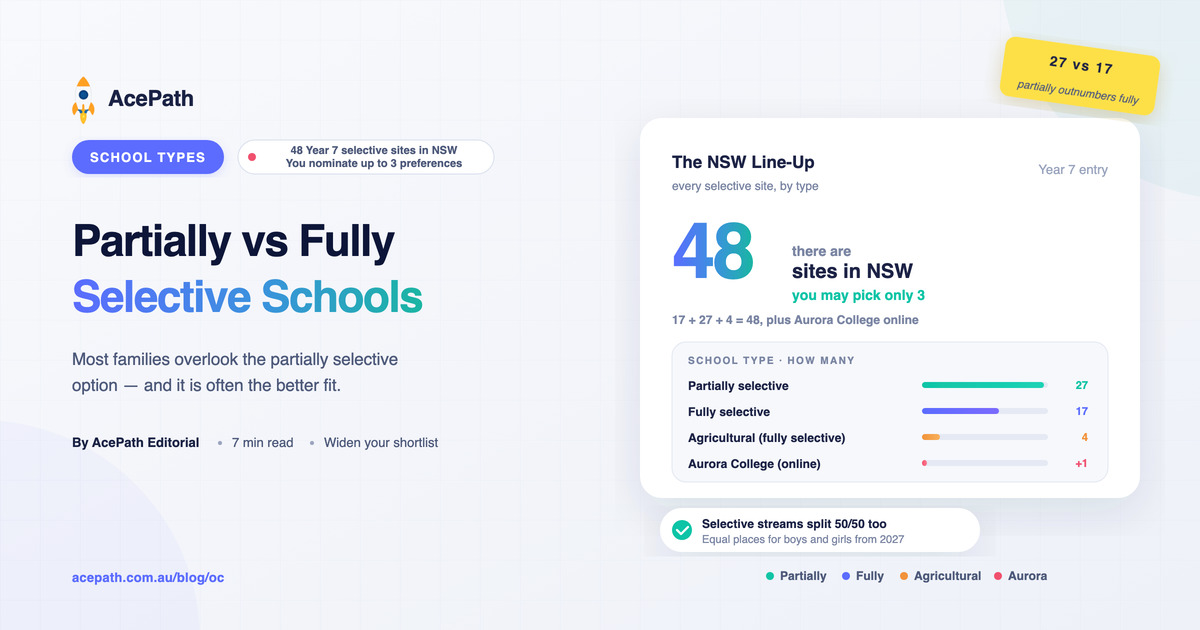
NSW offers 17 fully selective high schools, 27 partially selective high schools, and 4 fully selective agricultural high schools — 48 Year 7 sites in total. Both main types can provide excellent academic outcomes, but they differ significantly in structure, culture, and student experience. Many families don't consider partially selective options seriously — which often means missing a strong fit for their child.
How Each Type Works
Fully Selective Schools
Every student is admitted through the Selective placement test. The entire student population consists of high-achieving students selected by academic merit. Examples include James Ruse, North Sydney Boys/Girls, Sydney Boys/Girls, Baulkham Hills, and Hornsby Girls.
Partially Selective Schools
These are comprehensive high schools that include one or more selective stream classes within a broader student body. Students in selective streams usually have separate classes in most subjects but share facilities, electives, and school community with students admitted through local enrolment.
Student Body and Culture
Fully Selective
- Academically homogeneous peer group — almost every student achieved top placement scores
- Intense academic culture, often with strong competitive dynamics
- Wide socioeconomic and geographic diversity (students travel from across Sydney)
- High expectations from peers, teachers, and the school community
Partially Selective
- Mixed student body — selective stream students learn alongside general enrolment students in many contexts
- Less intense academic pressure (though selective classes themselves are demanding)
- Stronger local community ties — more students from the surrounding area
- More socially diverse peer interactions
Academic Outcomes
Fully Selective
Consistently achieves the highest HSC rankings in NSW. The concentration of top students, combined with specialised teaching, drives exceptional outcomes.
Partially Selective
Selective stream students often achieve HSC results comparable to fully selective schools, while the general student population produces results in line with other strong comprehensive schools. Outcomes vary widely from one partially selective school to the next, so compare individual school results rather than assuming the category performs uniformly.
Commute and Location
Fully Selective
Most are concentrated in metropolitan Sydney, often requiring long commutes for students outside the immediate area. Six years of daily commuting is a real factor for families in outer suburbs or regional areas.
Partially Selective
Located across a much broader geographic footprint. Regional partially selective schools include Armidale Secondary College, Grafton High, Peel High (Tamworth), Kooringal High (Wagga Wagga), Karabar High (Queanbeyan) and Gorokan High on the Central Coast. For many families, the nearest partially selective school is significantly closer than any fully selective school.
One point families often get wrong: Newcastle and Wollongong are served by fully selective schools — Merewether High and Smiths Hill High respectively — not partially selective ones. Check a school's actual status on the Department's list before assuming which category it falls into.
Social Experience
Fully Selective
Students spend six years surrounded by academically similar peers. This can be enormously beneficial for intellectual growth, but can also create limited exposure to different perspectives and backgrounds.
Partially Selective
Students navigate a more diverse social environment — selective classmates for academic intensity, general enrolment peers for broader social experiences. Many families value this as preparation for life beyond school.
Which Type Suits Which Student?
Fully Selective May Suit Students Who
- Are intensely driven academically
- Thrive in high-achievement peer environments
- Have specific interests that match school specialisations (STEM at James Ruse, agriculture at the four agricultural high schools, etc.)
- Live within reasonable commute of a fully selective school
Partially Selective May Suit Students Who
- Want academic challenge but also broader social exposure
- Prefer to stay closer to home and existing friendships
- May find the pressure of fully selective environments counterproductive
- Live in a region where the partially selective school is a leading local option
The 50/50 Gender Balance Applies to Both
From the 2027 intake, every co-educational selective high school and every partially selective stream offers an equal number of places to boys and girls. Selection is still on placement test performance — the places are split by gender first, then filled on merit within each half.
This is visible in the Department's own published place counts: a partially selective school listed with 30 Year 7 selective places now shows 15 for boys and 15 for girls. Where a class has an odd number of places, the remaining place is filled on academic merit regardless of gender, and if one gender's places cannot be filled by qualifying applicants they are offered to the other. Single-sex selective schools are unaffected. See our full guide to the gender parity change.
Entry Cutoffs
Cutoffs for selective stream places vary significantly across partially selective schools. Some sit close to fully selective levels; others are considerably more accessible, opening opportunities for students who would not qualify for a top fully selective school. Part of the reason is scale — a partially selective school may offer only 30 selective places in Year 7, while a large fully selective school offers 180.
This is one of the key strategic advantages of considering partially selective options — the range of cutoffs gives families more realistic choices across the placement score spectrum.
Preference Strategy
When nominating your 3 school preferences, consider mixing types:
- One aspirational fully selective — your stretch target
- One realistic partially selective — competitive but matched to your expected score
- One safety partially selective — where entry is likely based on expected score
This gives your child the best chance of an offer while keeping options open across the placement score spectrum.
Visit Both Types Before Deciding
The best way to understand the difference is to visit both a fully selective and a partially selective school during their open days. You will feel the cultural difference immediately — not just academically, but in how students interact, how teachers engage, and what the physical environment communicates.
Prepare Well, Then Choose Wisely
Regardless of which type of school you target, strong Selective test preparation is essential. Start with a free AcePath sample quiz to establish a baseline, then use our Selective practice packs to build skills systematically. With a realistic sense of your child's likely score, you can choose preferences that match the partially/fully selective balance that suits your family.
Start Practising Today
Try a free sample quiz to experience AcePath's exam-style practice tests.
Try Sample Quiz Register Free