Sample OC Maths Questions Walkthrough (with Full Solutions)
Learning From Worked Examples
One of the fastest ways to improve OC performance is to study how skilled problem-solvers approach questions — not just whether they get them right. Below are five sample questions in the style of the current Cambridge-based OC test, each with the thinking process laid out.
These are practice-style questions. The real OC test will have its own wording and presentation, but the question types and required reasoning are very similar.
Question 1 — Multi-Step Word Problem
A bakery makes 240 bread rolls each morning. They sell 75% of them by lunchtime, and the rest in the afternoon. If the remaining rolls are packed into bags of 12, how many bags are packed?
Walkthrough
- Identify the target: how many bags of 12 from the remaining rolls
- Calculate rolls sold by lunchtime: 75% of 240 = 180
- Calculate rolls remaining: 240 − 180 = 60
- Divide remaining rolls into bags of 12: 60 ÷ 12 = 5 bags
Answer: 5 bags
Key skill: Breaking a story into discrete calculation steps. Writing each step prevents mental errors.
Question 2 — Pattern Recognition
Find the next number in the sequence: 1, 4, 9, 16, 25, ?
Walkthrough
- Test differences between terms: 4−1 = 3, 9−4 = 5, 16−9 = 7, 25−16 = 9. The differences grow by 2 each time
- Test for square numbers: 1 = 1², 4 = 2², 9 = 3², 16 = 4², 25 = 5². These are consecutive square numbers
- Next term: 6² = 36
Answer: 36
Key skill: Trying multiple pattern-recognition approaches. Differences work for many sequences; multiplication or squared relationships work for others.
Question 3 — Fractions and Proportions
A school has 480 students. 2/5 of them study French, and 1/3 of them study Japanese. The rest study Spanish. How many students study Spanish?
Walkthrough
- Identify the target: students who study Spanish
- Calculate French students: 2/5 × 480 = 192
- Calculate Japanese students: 1/3 × 480 = 160
- Calculate Spanish students: 480 − 192 − 160 = 128
Answer: 128
Key skill: Handling fraction calculations carefully. Always convert to the same whole before subtracting.
Question 4 — Geometry
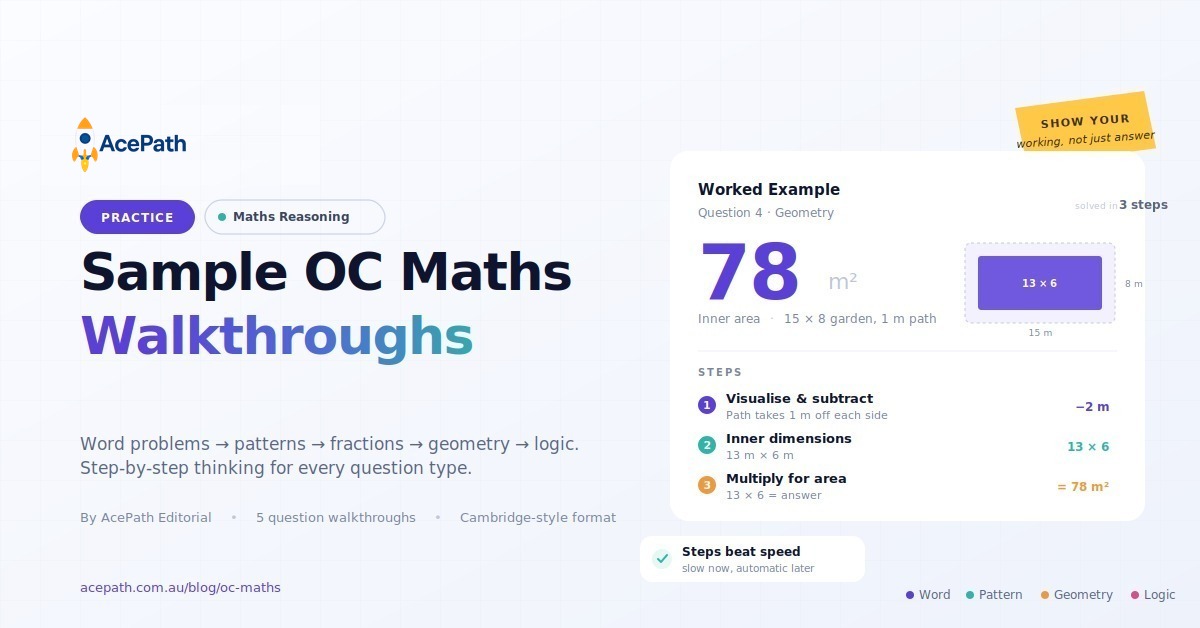
A rectangular garden has a length of 15 metres and a width of 8 metres. A path 1 metre wide runs along all four inner edges of the garden. What is the area of the garden not covered by the path?
Walkthrough
- Visualise: the path is along the inside edges, so the uncovered area is a smaller rectangle in the middle
- The path takes 1 metre off each side, so the inner rectangle dimensions are: length = 15 − 2 = 13 m, width = 8 − 2 = 6 m
- Area of inner rectangle: 13 × 6 = 78 m²
Answer: 78 square metres
Key skill: Drawing the picture. A quick sketch prevents misunderstanding the geometry.
Question 5 — Logical Reasoning with Numbers
Four students — Anna, Ben, Carlos, and Daisy — each have a different score: 72, 85, 91, and 96. Use the clues to match the students to their scores:
- Ben scored higher than Anna
- Carlos did not score the highest or the lowest
- Daisy's score is odd
Walkthrough
- List the scores: 72, 85, 91, 96. Odd scores are 85 and 91
- From clue 3: Daisy has 85 or 91
- From clue 2: Carlos is not 72 or 96. So Carlos has 85 or 91
- Both Daisy and Carlos must have 85 and 91 (in some order). So Anna and Ben have 72 and 96
- From clue 1: Ben scored higher than Anna, so Ben = 96 and Anna = 72
- Daisy and Carlos have 85 and 91. The clues don't further distinguish between them
Answer: Anna = 72, Ben = 96. Carlos and Daisy share 85 and 91 based on the given clues. The question would need one more constraint to fully resolve Carlos vs Daisy — real OC questions will always provide enough information, but this example shows how to approach the logic.
Key skill: Using elimination systematically. Write out all possibilities, then cross off based on each clue.
The Common Pattern
In every walkthrough above, the approach is:
- Identify exactly what the question is asking
- Break the problem into steps
- Carry out each step carefully, writing intermediate values
- Re-check the final answer against the question
This is slow at first but fast once it becomes habit. Students who skip these steps save time on easy questions but lose marks on harder ones.
Practising This Way Yourself
Encourage your child to follow this walkthrough format in their own practice — reading the question carefully, writing each step, checking the final answer. This pattern, repeated, becomes automatic.
For more worked examples and structured practice, try a free AcePath sample quiz and explore our Mathematical Reasoning practice packs. Every question includes a detailed solution explaining not just the answer but the reasoning process — the same walkthrough format shown above.
Start Practising Today
Try a free sample quiz to experience AcePath's exam-style practice tests.
Try Sample Quiz Register Free