Report vs Article: 4 Selective Writing Types Explained
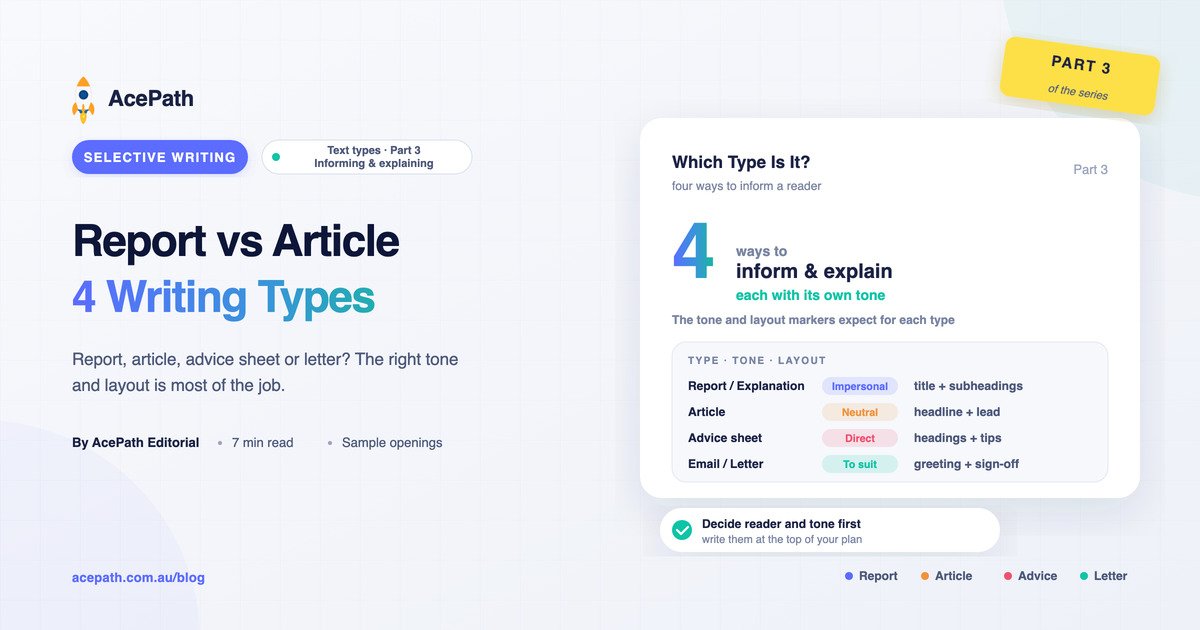
Reports, newspaper and feature articles, advice sheets and letters all give the reader information, but in different ways: a report explains a topic factually and impersonally, an article reports an event or explores a topic for a wide readership, an advice sheet gives practical tips directly to "you", and a letter or email speaks to one particular reader for a particular reason. Choosing the right tone and layout is most of the job, and it is where students most often lose marks.
This is Part 3 of our series on the kinds of writing students should be ready for in the NSW Selective writing task. Part 1 covered story and personal writing; Part 2 covered persuading and arguing. For how the task works overall, see our NSW Selective Writing Test guide.
Why Tone and Layout Matter Here
In informative writing, how something is said signals the type as much as what is said. A report that chats to the reader, a letter with no greeting or an advice sheet written as one long paragraph all tell the marker that the writer has not recognised the form. In a typed test, layout can be shown simply: a title on its own line, short headings, and clear paragraph breaks.
1. Report / Explanation
Purpose: to inform the reader about a topic, or explain how or why something happens.
What markers look for
- A clear title and an opening definition or overview of the topic.
- An impersonal, factual tone: third person, no "I think", no chatty asides.
- Logical organisation: sections by sub-topic for a report, or steps in sequence for an explanation, often with subheadings.
- Precise vocabulary and cause-and-effect connectives: as a result, this causes, because of this, consequently.
A sample opening
Honeybees are social insects that live in colonies of up to 60,000 individuals. Each colony is organised around a single queen, and every bee has a specific role that changes as it grows older.
The most common mistake
Slipping into personal opinion or story ("I love bees because…"). A report keeps the writer out of the picture.
2. Newspaper / Feature Article
Purpose: to report an event (news), or explore a topic in depth for readers (feature).
What markers look for
- A headline, and for news, a lead paragraph that answers who, what, when, where and why.
- The most important information first, with detail and background after it.
- Quotes from (invented) witnesses or experts to add authority and a human voice.
- For a feature, an engaging hook and a more personal, curious voice that keeps the reader going.
A sample opening
Students Rescue Stranded Turtle on School Excursion
A group of Year 6 students on a school excursion helped free a green sea turtle tangled in fishing line at Coogee Beach on Tuesday morning, alerting lifeguards within minutes of spotting it.
Article or Report?
A report is organised by topic and stays neutral and timeless. An article is written for readers of a publication: a news article focuses on a recent event, and a feature article explores a topic with a hook, human interest and a distinct voice.
The most common mistake
Telling a news event as a story, in time order from the beginning. News starts with the most important fact.
3. Advice / Information Sheet
Purpose: to advise and inform a reader with practical tips or facts.
What markers look for
- A title that names the audience or the problem: "Starting High School: A Survival Guide".
- A short introduction explaining who the sheet is for and why it matters.
- Headings or numbered points that make the sheet easy to scan.
- Direct, friendly instructions: second person ("you") and imperative verbs ("pack", "check", "ask").
A sample opening
Your First Week of High School: Five Things to Know
New school, new timetable, new faces. It is normal to feel nervous. These tips will help you find your way, make friends and stay on top of your work from day one.
Advice sheet or Report?
A report tells the reader about something; an advice sheet tells the reader what to do. If most sentences could start with "You should…", it is an advice sheet.
The most common mistake
Writing tips as a bare list with no explanation. Each point needs a sentence or two saying why it helps.
4. Email / Letter
Purpose: to inform, advise, request, complain or thank a particular reader.
What markers look for
- A greeting and a sign-off that match the reader: "Dear Ms Nguyen … Yours sincerely" for a formal letter; "Hi Grandma … Love" for an informal one.
- The purpose stated early. The reader should know within the first paragraph why the writer is writing.
- The right register: polite and formal for a complaint or a request, warm and relaxed for a friend.
- A clear ending that says what the writer hopes will happen next.
A sample opening
Dear Councillor Patel,
I am writing on behalf of the students of Year 6 to ask whether the council could install a pedestrian crossing outside our school gate on Station Road.
Formal or informal?
The type stays the same, but the voice changes with the reader. Before writing, your child should decide: who is reading, and how would I speak to them in person? A complaint to a company written like a text to a friend loses marks for form, however good the ideas.
The most common mistake
Burying the purpose: three paragraphs of background before the request finally appears.
The Four Types Side by Side
| Type | Written for | Tone | Layout | Easy test |
|---|---|---|---|---|
| Report / Explanation | Anyone learning the topic | Impersonal, factual | Title, overview, subheaded sections | Have I kept myself out of it? |
| Article | Readers of a publication | Neutral (news) or engaging (feature) | Headline, lead, quotes | Is the most important fact first? |
| Advice sheet | "You", the person needing help | Direct, friendly | Title, intro, headings or points | Does it tell the reader what to do? |
| Email / Letter | One particular reader | Formal or informal, to suit | Greeting, purpose, sign-off | Is my reason for writing clear in paragraph one? |
How to Practise These Four Types
- One topic, four forms. Take a single subject, such as a school fundraising day, and write a short opening as a report, a news article, an advice sheet for volunteers and a letter to parents.
- Decide reader and tone first. Have your child write "Reader:" and "Tone:" at the top of their plan.
- Practise layout in a plain text box. Headlines, headings and greetings should go on their own lines, just as they would in the test.
- Practise typed and timed, then get feedback on one habit at a time: a slip into opinion, a buried purpose or a missing headline.
Frequently Asked Questions
What is the difference between a report and an article?
A report explains a topic factually and impersonally, organised by sub-topic. An article is written for readers of a publication: news puts the most important fact first, and a feature explores a topic with a hook and a distinct voice.
Can my child use headings and bullet points in the test?
Where the form calls for it, such as an advice sheet or a report, short headings on their own lines show the marker the structure clearly. Keep full sentences under each heading so the writing quality still shows.
Is it all right to invent quotes in a news article?
Yes. The writing task is an exercise, and invented witnesses or experts are a normal part of a practice news article. They should sound believable and add information.
How formal should a letter be?
As formal as the reader requires. A letter to a principal, a council or a company should be polite and formal; a letter to a friend or relative can be warm and relaxed, but still well written.
Which other types should my child know?
Story and personal writing (Part 1) and persuading and arguing (Part 2).
Practise All Four With Real Feedback
AcePath's Selective practice includes writing tasks across every text type, with each response marked against seven clear criteria (ideas and detail, shape and form, flow and paragraphing, word choice and voice, sentences, spelling and grammar, and punctuation) so your child can see exactly what to improve next. Try the free sample quiz, see the Selective practice packs, and read our Selective Writing Test guide for the full picture of how the task works.
How AcePath Marks Your Child's Writing
Every writing task on AcePath is marked against the same seven criteria. Each criterion gets a whole mark, and together they add up to a score out of 25:
| Criterion | What it looks at | Marks |
|---|---|---|
| Ideas & Detail | How well the writing answers the task, and how specific its supporting detail is | 4 |
| Shape & Form | Whether it fits the type of writing asked for, with a purposeful opening, middle and ending | 4 |
| Flow & Paragraphing | Logical order, clear paragraphs and ideas that link together | 4 |
| Word Choice & Voice | Precise, varied vocabulary and a tone that suits the reader | 3 |
| Sentences | Sentence variety, control of length and correct construction | 4 |
| Spelling / Grammar | Spelling accuracy, agreement and consistent tense | 3 |
| Punctuation | Punctuation that makes the meaning clear | 3 |
| Total | 25 | |
Our AI marker drafts the assessment: a mark with a short analysis and a suggestion for each criterion, plus corrections that quote your child's own words. A member of the AcePath team reviews the draft before it is sent, so every mark your child receives has been checked.
Your child then gets a report like the one below: an overall percentage, a skills profile across all seven criteria, the breakdown with what went well and what to change, the spelling, grammar and punctuation fixes, and a three-step improvement plan for the next piece.
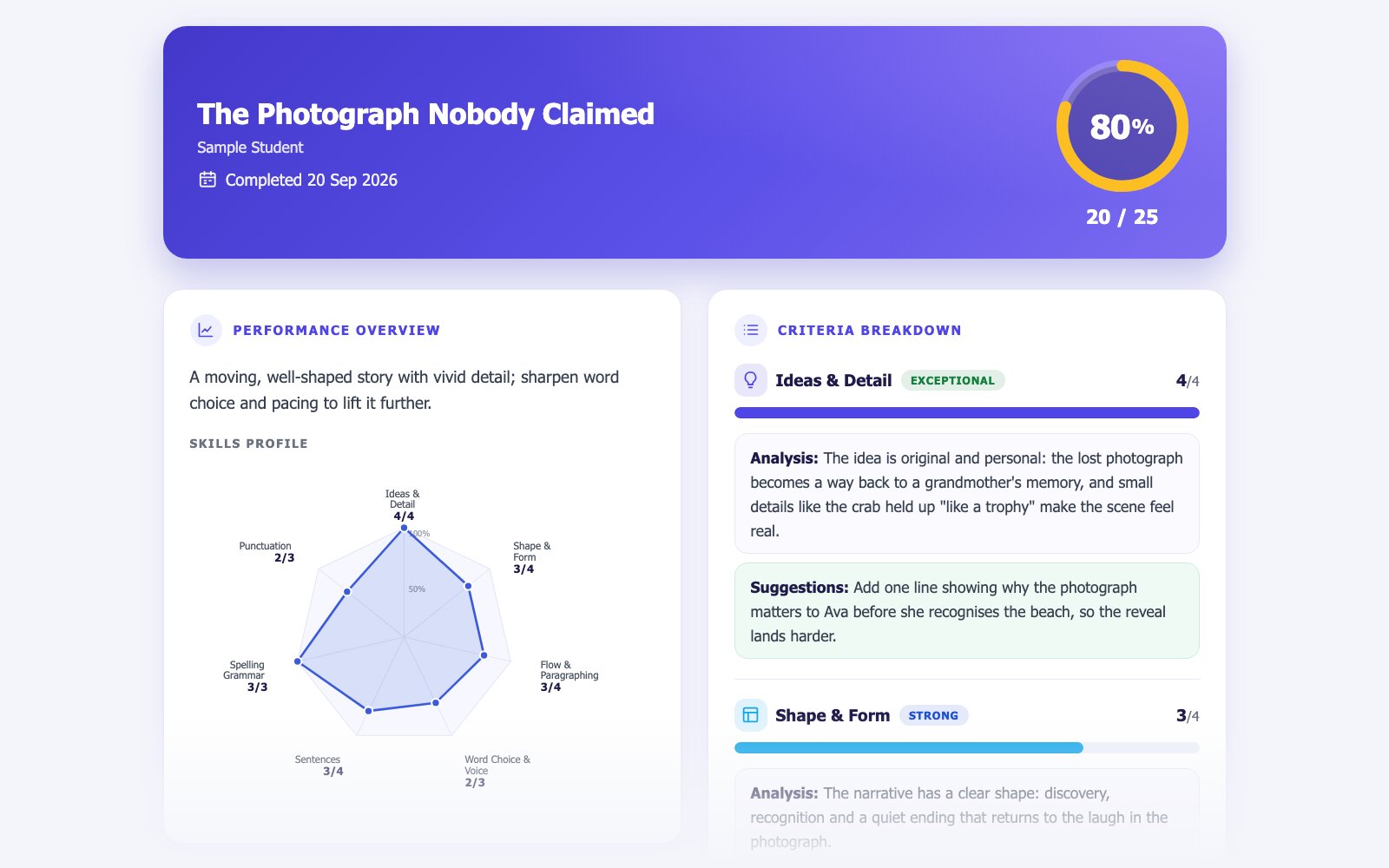
This is AcePath's own rubric, designed to give specific, useful feedback after every practice piece. It is not the official NSW Selective marking scheme.
Start Practising Today
Try a free sample quiz to experience AcePath's exam-style practice tests.
Try Sample Quiz Register Free