Persuasive vs Discursive: 5 Selective Writing Types
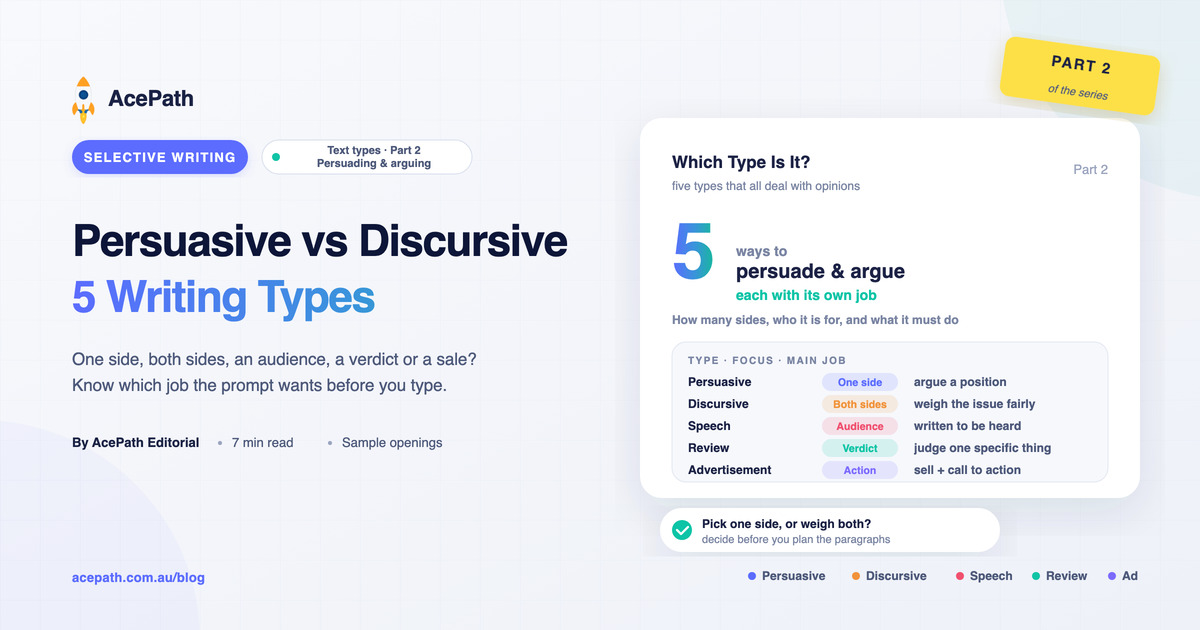
Persuasive, Discursive, Speech, Review and Advertisement writing all deal with opinions, but each has a different job: a persuasive piece argues one side, a discursive piece weighs both sides before concluding, a speech is written to be heard by an audience, a review judges one specific thing, and an advertisement sells something and asks the reader to act. Mixing them up is common, and the result is a piece that does not do what the prompt asked.
This is Part 2 of our series on the kinds of writing students should be ready for in the NSW Selective writing task. Part 1 covered story and personal writing; Part 3 covers informative writing. For how the task works overall, see our NSW Selective Writing Test guide.
Why These Five Get Confused
All five ask your child to take a position on something. The differences are in how many sides they present, who they are written for and what the reader should do next. Markers notice straight away when a "discursive" piece is really a one-sided argument, or when a "speech" reads like an essay nobody could say out loud.
1. Persuasive / Opinion
Purpose: to argue for one point of view and convince the reader to agree.
What markers look for
- A clear position in the first paragraph. The reader should know which side the writer is on within two or three sentences.
- Two or three strong reasons, each in its own paragraph with a topic sentence, an explanation and an example.
- Persuasive devices used with purpose: a rhetorical question, a statistic-style claim, an appeal to fairness or safety, the rule of three.
- A conclusion that restates the position more strongly, without simply repeating the introduction word for word.
A sample opening
Every afternoon, thousands of students sit in traffic while their school's bike racks stand empty. It is time every primary school in NSW had a safe cycling route, and here is why.
The most common mistake
Listing many weak reasons instead of developing a few strong ones. Three well-explained paragraphs beat six one-line claims.
2. Discursive
Purpose: to explore both sides of an issue before reaching a balanced conclusion.
What markers look for
- An introduction that frames the issue as a question with more than one reasonable answer.
- Fair treatment of each side: arguments for, then arguments against (or point and counterpoint in turn), with similar effort on both.
- Balancing connectives: on the other hand, however, some people argue, critics point out.
- A considered conclusion, which may lean one way, but only after weighing both.
A sample opening
Should children under twelve have their own mobile phones? For some families, a phone means safety and independence; for others, it means distraction and screen time that is hard to control. Both views deserve a closer look.
Discursive or Persuasive?
This is the pair students confuse most. A persuasive piece picks a side from the first line. A discursive piece keeps an open mind until the end. If one side gets three paragraphs and the other gets one sentence, a discursive piece has turned persuasive, and it has not done what the prompt asked.
The most common mistake
Giving the "other side" only to knock it down straight away. In a discursive piece, each view should be put at its strongest before the writer weighs it.
3. Speech
Purpose: to persuade or inform an audience, in words written to be spoken aloud.
What markers look for
- A clear audience and occasion: a school assembly, a council meeting, a class captain election.
- A greeting and direct address: "Good morning, Principal, teachers and fellow students", and "you" throughout.
- Spoken devices: rhetorical questions, repetition, short punchy sentences, and signposting such as "my first point is".
- A memorable ending: a call to action, a callback to the opening, or a final line the audience will remember.
A sample opening
Good morning, everyone. Close your eyes for a moment and picture our playground at lunchtime. Now picture it with no bins, no shade and no rules. Would you want to play there? I wouldn't. That is why I'm asking you to vote for a Green Team.
Speech or Persuasive essay?
Many speeches are persuasive, but the form is different. A speech talks to an audience in the room; an essay addresses a reader on the page. Read it aloud: if it sounds like a textbook, add the spoken features.
The most common mistake
Writing an essay and adding "Thank you for listening" at the end. The audience needs to be present from the first line.
4. Review
Purpose: to judge a book, film, product or place, and recommend it or not.
What markers look for
- What is being reviewed, named clearly with a little context: title, type, who it suits.
- A short summary with no spoilers. Enough to understand the review, not a retelling.
- Judgements backed by specific evidence: a scene, a feature, a moment, not just "it was good".
- A clear verdict: a recommendation, a rating, or who would and would not enjoy it.
A sample opening
If you have ever wondered what it would be like to live on a lighthouse island with no internet, The Keeper's Year will answer that question and leave you wanting one more chapter.
Review or Persuasive?
A review judges one specific thing the writer has experienced. A persuasive piece argues about an issue. "This film is worth seeing" is a review; "schools should show more films" is persuasive.
The most common mistake
Spending most of the piece retelling the plot. Keep the summary to a short paragraph and spend the rest on judgement.
5. Advertisement
Purpose: to persuade a reader to buy, join or attend something.
What markers look for
- A headline or slogan that grabs attention in a few words.
- Benefits, not just features: not "the bottle holds one litre" but "stay cold and energised all day".
- Persuasive language aimed at a clear target audience: parents, teens, sports fans.
- A call to action with practical details: what to do, where and by when.
A sample opening
Rain or shine, the fun goes on! This school holidays, Riverbend Library turns into a maker space, with robots to build, stories to write and a mystery to solve every Friday.
Advertisement or Persuasive?
Both persuade, but an advertisement is short, punchy and laid out for skimming, and it always ends with an action. A persuasive essay develops reasons in full paragraphs. In a typed test, your child can show an advertisement's layout with a headline on its own line and short sections.
The most common mistake
Forgetting the call to action, or writing a whole persuasive essay under a headline.
The Five Types Side by Side
| Type | Sides shown | Written for | Main job | Easy test |
|---|---|---|---|---|
| Persuasive | One | A reader | Argue a position | Is my side clear by the second sentence? |
| Discursive | Both | A reader | Weigh an issue fairly | Does each side get a fair hearing? |
| Speech | Usually one | A live audience | Persuade or inform listeners | Does it sound right read aloud? |
| Review | A verdict | Someone deciding | Judge one specific thing | Have I named it, judged it and recommended it? |
| Advertisement | One | A target audience | Sell and prompt action | Is there a headline and a call to action? |
How to Practise These Five Types
- One topic, five ways. Take a single idea, such as a new school canteen, and write a short opening as an argument, a balanced discussion, a speech, a review and an ad.
- Plan reasons before writing. For persuasive and discursive pieces, list the paragraphs' main points before typing the introduction.
- Read speeches aloud. Anything that is hard to say should be rewritten.
- Practise typed and timed, then get feedback on one habit at a time: a missing position, a lopsided discussion or a missing call to action.
Frequently Asked Questions
What is the difference between persuasive and discursive writing?
Persuasive writing argues one side from the start; discursive writing explores both sides fairly and reaches a conclusion only after weighing them.
Can a discursive piece have an opinion?
Yes, in the conclusion. The writer may lean one way after weighing both sides, but the body should treat each side fairly.
Does a speech need a greeting?
It should. A greeting and direct address to the audience are the quickest ways to show the marker that the piece is written to be spoken.
Is an advertisement too short for the writing task?
It can be brief, but it still has to be crafted: a strong headline, well-chosen benefits aimed at a clear audience, and a clear call to action. Every line needs to earn its place.
Which other types should my child know?
Story and personal writing (Part 1) and informative writing such as reports, articles, advice sheets and letters (Part 3).
Practise All Five With Real Feedback
AcePath's Selective practice includes writing tasks across every text type, with each response marked against seven clear criteria (ideas and detail, shape and form, flow and paragraphing, word choice and voice, sentences, spelling and grammar, and punctuation) so your child can see exactly what to improve next. Start with our free marked writing task (one per account), see the Selective practice packs, and read our Selective Writing Test guide for the full picture of how the task works.
How AcePath Marks Your Child's Writing
Every writing task on AcePath is marked against the same seven criteria. Each criterion gets a whole mark, and together they add up to a score out of 25:
| Criterion | What it looks at | Marks |
|---|---|---|
| Ideas & Detail | How well the writing answers the task, and how specific its supporting detail is | 4 |
| Shape & Form | Whether it fits the type of writing asked for, with a purposeful opening, middle and ending | 4 |
| Flow & Paragraphing | Logical order, clear paragraphs and ideas that link together | 4 |
| Word Choice & Voice | Precise, varied vocabulary and a tone that suits the reader | 3 |
| Sentences | Sentence variety, control of length and correct construction | 4 |
| Spelling / Grammar | Spelling accuracy, agreement and consistent tense | 3 |
| Punctuation | Punctuation that makes the meaning clear | 3 |
| Total | 25 | |
Our AI marker drafts the assessment: a mark with a short analysis and a suggestion for each criterion, plus corrections that quote your child's own words. A member of the AcePath team reviews the draft before it is sent, so every mark your child receives has been checked.
Your child then gets a report like the one below: an overall percentage, a skills profile across all seven criteria, the breakdown with what went well and what to change, the spelling, grammar and punctuation fixes, and a three-step improvement plan for the next piece.
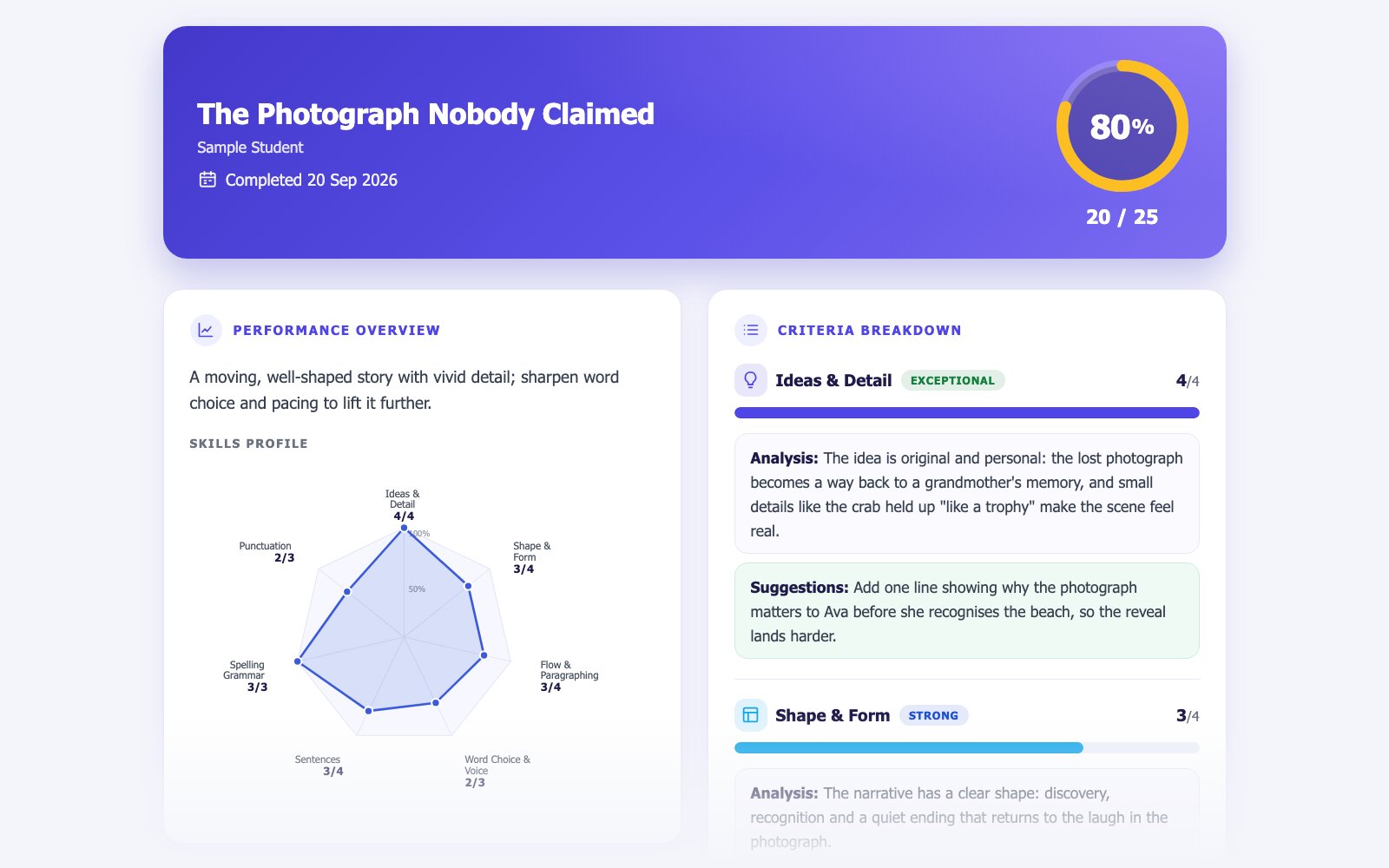
This is AcePath's own rubric, designed to give specific, useful feedback after every practice piece. It is not the official NSW Selective marking scheme.
Start Practising Today
Try a free sample quiz to experience AcePath's exam-style practice tests.
Try Sample Quiz Register Free