No OC Offer? The Year 6 Selective Path Explained
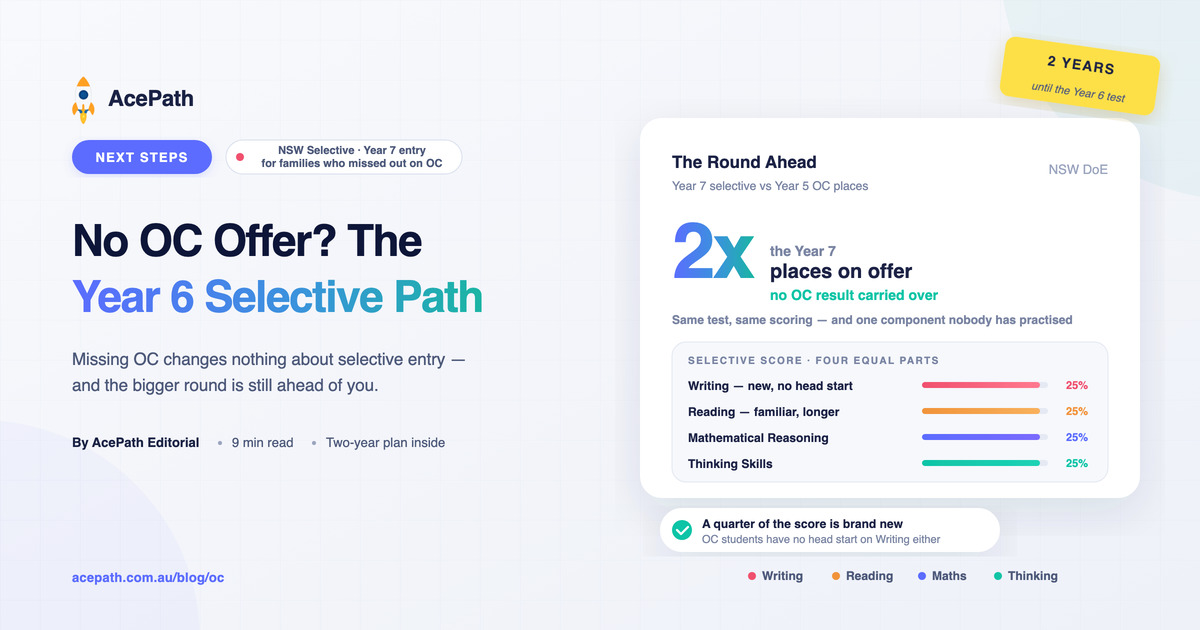
Missing out on an OC place has no effect whatsoever on your child's chances of a selective high school place. Every Year 6 student in NSW can apply for Year 7 selective entry, OC or not, and the Department offers more than twice as many Year 7 selective places as there are Year 5 OC places. The door most families are worried about closing is, statistically, the narrower of the two.
This guide sets out what the OC outcome does and does not mean, and how to use the two years between now and the selective test.
The OC Result Carries No Weight in Selective Placement
Selective placement is decided on performance in the Selective High School Placement Test. There is no carry-over from the OC test — no bonus for children who were placed in an opportunity class, and no penalty for children who were not. Your child's OC outcome is not part of the selective application and is not seen by the selection process.
This matters because the two cohorts start Year 7 together on the same basis. A child who spent Years 5 and 6 in a mainstream class sits exactly the same test, scored exactly the same way, as a child who spent them in an OC.
The Numbers Move in Your Favour
Opportunity classes are the tighter bottleneck. The Department's own comparison is blunt: there are more than twice as many Year 7 places in selective high schools as there are Year 5 places in opportunity classes. That is before accounting for the fact that selective places are spread across 17 fully selective schools, 27 partially selective schools, 4 agricultural high schools and Aurora College — a much wider set of destinations than the OC map offers.
So the honest framing for your child is not "you missed your chance." It is "the bigger round is still ahead, and it is the one that decides which high school you attend."
Read the OC Performance Report as a Free Diagnostic
The report you received does not give a score or a rank, but it does give a band for each component — top 10%, next 15%, next 25%, or lowest 50% — and that is genuinely useful planning information, provided you read it correctly.
- A band is a position, not a percentage. "Next 15% in Mathematical Reasoning" does not mean 15% correct; it means your child was between the 10th and 25th percentile of everyone who sat the test.
- Compare the three components against each other. The gap between your child's strongest and weakest band is the single most actionable thing in the report. Two bands' difference between Reading and Thinking Skills tells you where the next two years should go.
- Do not read a single weak band as a verdict. These are four-year-old skills measured in one 30 to 40 minute sitting against the most competitive cohort in the state.
Our guide to the changes parents still miss explains the banding system in full.
What Actually Changes Between OC and Selective
Three of the four selective components will be familiar: Reading, Mathematical Reasoning and Thinking Skills all appeared in the OC test. Two things are new.
Writing — a quarter of the score, and completely new
The Selective test adds a 30-minute Writing task that the OC test does not have, and it carries equal weight with each of the other three components — a quarter of the total. For a family coming from an OC near-miss, this is the most important sentence in this article: a quarter of the selective score sits in a component where nobody has a head start. OC students have had no more exposure to it than your child has.
Writing is also the component that responds fastest to structured practice, because much of what is being marked — structure, paragraphing, sentence variety, precise vocabulary — is teachable in a way that reasoning speed is not. See our guide to the Selective Writing test.
Everything else gets harder
The questions are calibrated for Year 6, not Year 4. Reading passages are longer and demand stamina; Mathematical Reasoning introduces pre-algebraic thinking, negative numbers and more complex geometry; Thinking Skills questions combine several reasoning types in one item. Reading time also rises to 45 minutes and Thinking Skills to 40.
The Two-Year Runway
You have more time than most families realise. Applications open in Term 4 of Year 5, the test is sat in Term 2 of Year 6, and the result decides Year 7. That is roughly two years from an OC result — a genuinely long runway, and long enough that intensity now is counterproductive.
Year 5: widen, don't drill
Spend this year on the things that compound. Harder independent reading — young adult fiction, quality non-fiction, news written for children — builds the vocabulary and stamina that the Reading test rewards and that cannot be crammed. Extension maths beyond the Year 5 curriculum. Thinking Skills puzzles treated as recreation rather than homework. Two or three focused sessions a week is plenty.
Start writing this year too, informally: a paragraph or two a week, on anything. Building the habit early removes the panic that hits families who discover the Writing component in Year 6.
Year 6, Terms 1–2: structure and format
Move to structured preparation across all four components, with a diagnostic first so you are working on the real weaknesses rather than the assumed ones. Practise on screen, not on paper — the test is computer-based, and reading a long passage by scrolling is its own skill. Introduce full-length timed papers every three or four weeks, then weekly in the final six to eight weeks. Our OC-to-Selective preparation guide sets out the arc in detail.
Widen the School List While You Are At It
Families who focused on a single local OC often carry the same narrow lens into the selective application, and it costs them. You can nominate up to three selective high schools, and the list includes partially selective schools, whose selective streams are frequently overlooked and whose entry scores are usually lower than the fully selective schools nearby. Start with the difference between partially and fully selective schools, then browse the full directory of NSW selective schools.
Frequently Asked Questions
Does missing out on OC reduce my child's chance of getting into a selective high school?
No. Selective placement is based solely on performance in the Selective High School Placement Test. The OC outcome is not part of the selective application and does not affect the result in either direction.
Are OC students at an advantage in the selective test?
They have two years of practice at an accelerated pace, which helps, but they sit the same test scored the same way — and they have no more preparation than your child for the Writing component, which is a quarter of the score.
When do we apply for selective high school?
Applications open in Term 4 of Year 5 — November — and close in February. The test is sat in Term 2 of Year 6. See our application guide for the current cycle's dates.
Can my child sit the OC test again?
No. The OC placement test is sat once, in Year 4, for entry to Year 5. There is no repeat sitting, which is why the selective test in Year 6 is the next opportunity.
Should we start intensive preparation straight away?
No. With two years available, Year 5 is better spent widening reading, extending maths and building a light writing habit. Structured test preparation belongs in Year 6, and burning a child out in Year 5 is the most common avoidable mistake.
Start with Where Your Child Actually Stands
The most useful next step is a current picture rather than a plan built on the OC result. Take a free AcePath sample quiz to see where your child sits across Reading, Mathematical Reasoning and Thinking Skills today, then build the two-year runway with our Selective practice packs, which cover all four components — Writing included — in the computer-based format your child will face in Year 6.
Start Practising Today
Try a free sample quiz to experience AcePath's exam-style practice tests.
Try Sample Quiz Register Free