Reserve List Timeline: From Results Day to Term 1
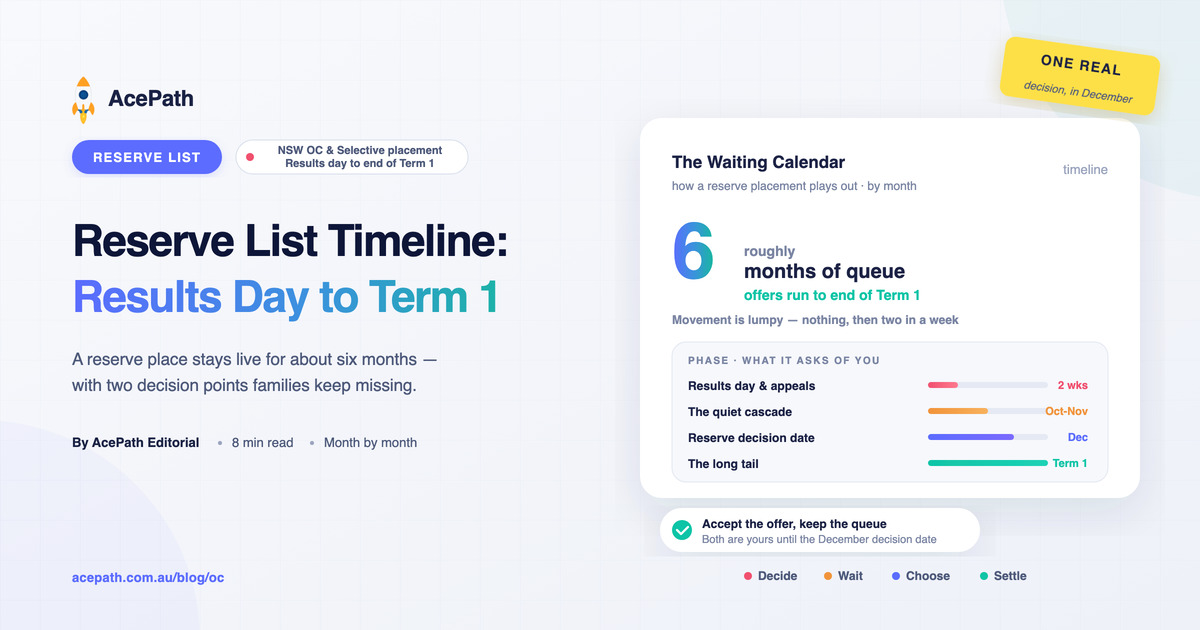
A reserve placement is not a rejection with extra steps — it is a queue position that stays live until the end of Term 1 of the entry year. For OC that means offers can arrive right up to the end of Term 1 in Year 6; for selective high schools, up to the end of Term 1 of Year 7. That is roughly six months of waiting, with two decision points that catch families out.
Our guides to the OC reserve list and the selective reserve list explain what the list is. This one walks the calendar: what happens each month, what you have to decide, and what to do while you wait.
The Whole Timeline on One Screen
| When | What happens | What you do |
|---|---|---|
| Outcome day | Offer, reserve placement, or no offer appears in your dashboard, with a reserve band letter | Read the band; diarise your response due date |
| ~5 business days later | Appeal window closes | Appeal only on illness, misadventure, or administrative error |
| Response due date | Any offer you hold must be accepted or declined | Accept, unless you are declining to chase a higher choice |
| October to November | The cascade: declined places move down each school's list | Keep contact details current; enrol locally as a backstop |
| Early December | Reserve decision date — accepted-offer holders drop off higher-choice lists | The one real decision of the whole process (below) |
| December to January | Offers continue as families move, change plans, or go private | Nothing — stay reachable over the holidays |
| Term 1 of the entry year | Final window; offers stop at the end of Term 1 | Settle your child into their current school properly |
Exact dates shift each intake year. The ones in your dashboard are the only ones that count.
Outcome Day: Read the Band Before Anything Else
A reserve placement comes with a band letter estimating when an offer might arrive, based on how quickly families declined at that school last year. The scales differ: selective runs A to F, OC runs A to E, and the last letter means "unlikely" in both cases — so a Band E is encouraging on one list and discouraging on the other. Our reserve bands guide has both tables.
The band is a statement about other families' behaviour, not about your child. It is not a rank and not a probability.
The First Two Weeks: Appeals, Then Your Response
The appeal window is about five business days
Appeals cover illness, misadventure, and administrative problems on test day. They are not a route for disagreeing with an outcome or arguing that your child should have scored higher. See our guide to the appeal window before you spend an evening on one.
Accepting an offer does not remove you from higher-choice lists — yet
This is the single most misunderstood mechanic in the process. If you receive an offer from a lower preference while sitting on the reserve list for a higher preference, you can accept the lower offer and keep the higher-choice queue position. You are not choosing between them in September. You are choosing between them in December.
So accept the offer. Declining a place in September to "keep your options open" gives up something real for something speculative.
October and November: The Quiet Months
Very little visible happens, but the cascade is running underneath. Each time a family declines a place, the offer passes to the next eligible student on that school's list, which frees a place at whatever school that family was holding, which cascades again. Movement is lumpy — nothing for three weeks, then two offers in a week.
Two things to do:
- Keep your contact details current in the application dashboard. Offers are notified by email, and they come with a response deadline. A missed email is a missed place.
- Enrol at your local school as though the reserve list does not exist. Local enrolment periods run on their own calendar and will not wait for your queue position. Enrolling is reversible; missing the window is not.
Early December: The Reserve Decision Date
This is the only genuinely hard decision in the six months, and it arrives when everyone has stopped paying attention.
After the reserve decision date, students holding an accepted offer are automatically removed from any higher-choice reserve lists. To stay on a higher-choice list past that date, you must decline the offer you hold.
That is a real trade: a confirmed place for a queue position with no guarantee attached. Worth weighing honestly:
- What does the band say? A Band A or B at the higher choice is a different proposition from a Band E or F.
- How different are the two schools, really? Travel time, friendship groups, and whether your child actually wants the change usually matter more than a ranking table.
- What is the fallback if neither lands? Your local school — which you should already be enrolled at.
The date is specific to each intake year and appears in your dashboard and the Department's published key dates. Unofficial dates circulate on coaching sites every year; confirm yours against the dashboard and diarise it the day your outcome arrives.
December to Term 1: The Long Tail
Offers keep coming through the holidays and into the new school year as families relocate, take private-school places, or change their minds late. Reserve offers stop at the end of Term 1 of the entry year — end of Term 1 in Year 6 for OC, end of Term 1 in Year 7 for selective.
A late offer is disruptive by definition: your child has started somewhere else and made friends. It is entirely reasonable to decline one. Deciding in advance where your cut-off sits — "after week 4 of Term 1 we stay put" — spares you an anxious conversation in February.
OC and Selective: Where the Two Differ
- Band scales differ — selective A to F, OC A to E.
- Enrolment contact differs — OC principals contact families directly about enrolment; selective families receive an online enrolment email.
- Aurora College has no reserve list at all.
- Gender parity now shapes both queues. Because places are split equally between boys and girls at co-ed settings, movement on a list depends on how many families of the same gender decline at that school — see what gender parity changed in the offers.
What Not to Do While You Wait
- Do not contact the school to ask about your position. Schools do not control the list and cannot move anyone up it.
- Do not treat group-chat estimates as data. Cut-offs and movement rates reported in parent chats come from small, self-selecting samples.
- Do not let the wait become the family's main topic. Six months is a long time for a ten- or twelve-year-old to feel provisional.
Frequently Asked Questions
How long does a reserve list last?
Until the end of Term 1 of the entry year — Term 1 of Year 6 for opportunity classes, Term 1 of Year 7 for selective high schools. After that, no further offers are made from it.
Can I accept an offer and stay on a higher-choice reserve list?
Yes, until the reserve decision date in early December. After that date, holding an accepted offer removes you from higher-choice lists automatically. To stay on, you must decline the offer you hold.
Does my position on the list move up over time?
Yes, as families ahead of you decline. The list is ordered by placement rank at that school and does not reshuffle — you only move up, never down.
Should I enrol at my local school while waiting?
Yes. Local enrolment runs on its own timetable and will not wait for a reserve outcome. Enrolling is reversible; missing the enrolment window is not.
Is a low band worth waiting for?
A last-letter band (F for selective, E for OC) means an offer is unlikely, and any offer would probably arrive after the school year has started. It is not impossible — but plan as though it will not happen.
Do reserve lists work the same for boys and girls?
Since the 2027 intake, places at co-educational settings are split equally by gender, so later offers at a school generally go to the next student of the same gender as the family who declined.
Where to Confirm the Official Dates
- Your application dashboard — the only source for your own dates and band
- The NSW Department of Education's selective high schools and opportunity classes pages at education.nsw.gov.au
- Official email notifications, which carry their own response deadlines
If the Answer Turns Out to Be No
Plenty of students sit a placement test again, and Year 8 to 11 selective entry exists for later years. Whatever the reserve list does, the next test is decided the same way this one was. Start with a free AcePath sample quiz to see where your child stands in Reading, Mathematical Reasoning, and Thinking Skills, then build a routine with our OC and Selective practice test packs.
Start Practising Today
Try a free sample quiz to experience AcePath's exam-style practice tests.
Try Sample Quiz Register Free