Selective Gender Parity: What It Means for Boys
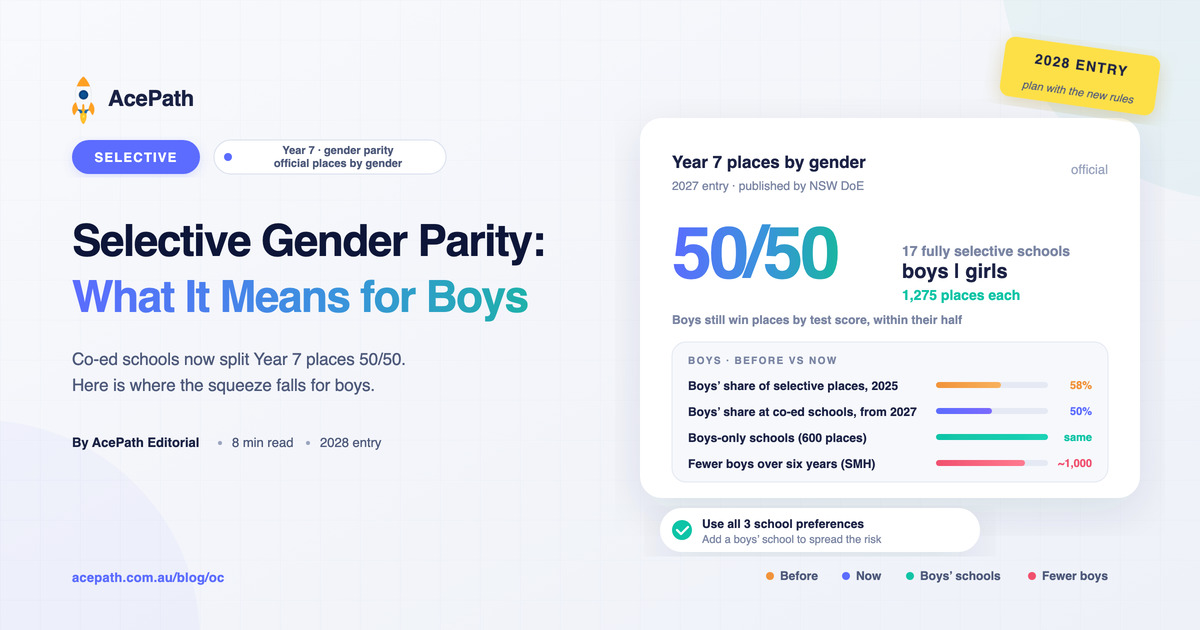
Under NSW's gender parity model, boys applying to a co-educational selective high school now compete only against other boys for exactly half of that school's Year 7 places. Boys have recently held about 58% of selective places, so the boys' share at co-ed schools shrinks, and a Sydney Morning Herald analysis of enrolment data expects about 1,000 fewer boys in fully selective schools over the next six years. The test itself hasn't changed, boys-only selective schools haven't changed, and any girls' places left unfilled still go to qualifying boys.
The first offers under the new model went out on 19 August 2026 for Year 7 entry in 2027. Families of boys now preparing for the May 2027 test (Year 7 entry in 2028) are the first to plan knowing the rules in advance. This guide sets out the official numbers, shows where the pressure falls, and covers what you can still control.
The Rule in One Paragraph
From the 2027 intake, every co-educational selective and partially selective high school offers an equal number of places to girls and boys. Selection is still based on placement test performance, but boys are ranked against boys and girls against girls. If one gender can't fill its half with qualifying applicants, those places go to qualifying students of the other gender. Single-sex schools keep all their places for their own gender. Our full explainer on gender parity covers the mechanics in detail, including how it works for Opportunity Classes.
The Official Numbers: Year 7 Places by Gender
The NSW Department of Education now publishes separate boys' and girls' place numbers for every selective school. These are the fully selective and co-ed agricultural high schools for 2027 entry:
| School | Type | Boys' places | Girls' places |
|---|---|---|---|
| Baulkham Hills High School | Co-ed, fully selective | 90 | 90 |
| Gosford High School | Co-ed, fully selective | 90 | 90 |
| Merewether High School | Co-ed, fully selective | 90 | 90 |
| Caringbah High School | Co-ed, fully selective | 75 | 75 |
| Fort Street High School | Co-ed, fully selective | 75 | 75 |
| Penrith High School | Co-ed, fully selective | 75 | 75 |
| Girraween High School | Co-ed, fully selective | 60 | 60 |
| Northern Beaches Secondary College Manly Campus | Co-ed, fully selective | 60 | 60 |
| Smiths Hill High School | Co-ed, fully selective | 60 | 60 |
| Hurlstone Agricultural High School | Co-ed, agricultural | 90 (75 day, 15 boarding) | 90 (75 day, 15 boarding) |
| James Ruse Agricultural High School | Co-ed, agricultural | 60 | 60 |
| Sydney Boys High School | Boys, fully selective | 180 | — |
| North Sydney Boys High School | Boys, fully selective | 150 | — |
| Sydney Technical High School | Boys, fully selective | 150 | — |
| Normanhurst Boys High School | Boys, fully selective | 120 | — |
| Sydney Girls High School | Girls, fully selective | — | 180 |
| North Sydney Girls High School | Girls, fully selective | — | 150 |
| St George Girls High School | Girls, fully selective | — | 150 |
| Hornsby Girls High School | Girls, fully selective | — | 120 |
Source: NSW Department of Education, selective high schools list for Year 7 entry. Always check the Department's page for the current figures before you apply.
Across the 17 fully selective schools the split is now exactly even: 1,275 places for boys and 1,275 for girls. The four boys' schools (600 places) and the four girls' schools (600 places) balance each other, and the nine co-ed fully selective schools add 675 places for each gender.
Where the Squeeze Actually Falls
Gender parity changes nothing at a boys' school. Sydney Boys, North Sydney Boys, Sydney Technical and Normanhurst Boys offer the same boys-only places they always have. The change is felt at the co-ed schools, where boys used to win more than half of the places on merit and are now capped at half.
The official numbers show how big that gap was. The Department reported in October 2025 that selective high schools were about 58% boys and 42% girls, and that girls took only 41% of Year 7 selective places in 2025, down from 45% in 2019. Media coverage of the change reported that some co-ed cohorts were more than 75% boys.
How "about 1,000 fewer boys" adds up
The Herald didn't publish its full method, but a rough calculation shows how a number that size comes about. It's an illustration, not an official forecast:
- The nine co-ed fully selective schools plus James Ruse and Hurlstone offer 1,650 Year 7 places a year.
- Every percentage point that boys used to hold above 50% of those places works out to about 16 or 17 places a year.
- If boys had held about 58% of those places (the statewide figure), parity moves roughly 130 places a year from boys to girls.
- A selective school has six year groups (Years 7 to 12). As each parity cohort replaces an older one, the gap builds up to roughly 800 boys by the time all six year groups were placed under parity. Schools where boys held well above 58% push the total higher.
In other words, the "1,000 fewer boys" is the total across all six year groups by the early 2030s. It is not 1,000 fewer offers in a single year. In any one Year 7 intake, the change at the co-ed fully selective schools is in the low hundreds of places statewide.
What Happens to the Entry Bar for Boys
With boys and girls ranked separately, each co-ed school effectively has two entry thresholds: one for boys and one for girls. At schools where many strong boys apply, the boys' threshold is likely to be higher than the single cut-off it replaced, and higher than the girls' threshold.
How much higher is unknown, and it will stay that way. The Department no longer publishes cut-off scores and doesn't give families their test scores or placement ranks. Families receive performance bands instead. Be wary of anyone quoting a precise "boys' cut-off" for a school. No official figure exists to back it up.
The Safety Valves That Still Work for Boys
- Unfilled girls' places go to boys. If a co-ed school can't fill its girls' half with qualifying applicants, the leftover places are offered to qualifying boys on merit. This matters most at schools that attract fewer applications.
- Boys-only schools are untouched. 600 fully selective places, plus the selective streams at Blacktown Boys and Granville Boys (30 each) and Farrer Memorial Agricultural High School, remain open only to boys.
- The reserve list keeps moving. When a boy declines an offer, the next boy on that school's boys' reserve list moves up. Reserve offers continue into Term 1.
- Partially selective schools are a real option. They follow the same 50/50 rule, but they are a separate set of selective classes inside comprehensive schools across NSW, from 15 to 45 places per gender.
- Year 7 isn't the only entry point. Places that open up in later years are filled through Years 8 to 11 entry.
What Families of Boys Can Do for 2028 Entry
1. Use all three preferences, and think about including a boys' school
You can list up to three selective schools. Your preference order doesn't lower your child's chance at any single school. It only decides which offer you get if your child qualifies for more than one. Filling all three spots costs nothing. For many families, putting a realistic boys' school alongside co-ed choices is the simplest way to spread the risk. Our school guides for Sydney Boys, North Sydney Boys, Sydney Technical and Normanhurst Boys can help you judge fit.
2. Don't guess from last year's gossip
Old cut-off tables circulating online come from the single-ranking era and don't carry over. Under parity, the useful questions are how many places for boys a school offers (see the table above) and how many strong boys are likely to apply there. A large, popular co-ed school with 90 places for boys may be harder or easier to get into than a smaller, less-known one. Nobody outside the Department can say precisely.
3. Aim for margin, especially in Writing
If the boys' bar at popular co-ed schools rises, the practical answer is a stronger score, not a different strategy. The selective test weights Reading, Mathematical Reasoning, Thinking Skills and Writing. Writing is often the weakest section for otherwise strong boys, so it's usually where extra marks are easiest to find. See our Selective Writing test guide.
4. Put the dates in your calendar now
Based on past cycles, applications for Year 7 entry in 2028 are expected to open in early November 2026 and close in late February 2027, with the test in May 2027. See our 2028 selective test dates and step-by-step application guide, and confirm the official dates when the Department publishes them.
A Note on Opportunity Classes
The same 50/50 rule applies to OC. In a class of 15 Year 5 places, 7 go to boys, 7 go to girls, and the last place goes to the highest-scoring remaining applicant regardless of gender. Opportunity classes were about 60% boys before the change, so boys applying for OC face a similar squeeze. There are no boys-only OC classes, so every OC setting is affected.
Frequently Asked Questions
Is it harder for boys to get into a selective school now?
At co-ed selective schools, very likely yes. Boys now compete for exactly half the places, down from the roughly 58% share boys held before. At boys-only schools, nothing has changed. Overall, the fully selective system now offers 1,275 Year 7 places to boys and 1,275 to girls.
Are there separate cut-off scores for boys and girls?
In effect, yes. Ranking boys and girls separately creates a different threshold for each gender at every co-ed school. The Department doesn't publish either one, and families receive performance bands instead of scores or ranks.
Where does the "1,000 fewer boys" figure come from?
It comes from a Sydney Morning Herald analysis of enrolment data. It describes the expected total fall in boys across all year groups at fully selective schools over about six years. It is not the number of offers lost in any single year.
Do boys' selective schools benefit from the change?
Their number of places hasn't changed. Some families of boys may put boys' schools higher on their preference lists, which could make those schools more competitive, but no official data on that exists yet.
Is the test different for boys and girls?
No. Every applicant sits the same computer-based test. Gender parity only changes how the ranked results turn into offers.
Can girls' places end up going to boys?
Yes. If a school can't fill its girls' places with qualifying applicants, those places are offered to qualifying boys based on test performance.
Build the Score That Gives Your Son Options
Parity changes how places are shared out, but a strong result still gives your child the most choice. Try a free AcePath sample quiz to see where your child stands across Reading, Mathematical Reasoning and Thinking Skills. Then build up to test day with our Selective practice test packs, which use the same computer-based format as the real test. You can also browse every school's details in our selective schools directory.
Start Practising Today
Try a free sample quiz to experience AcePath's exam-style practice tests.
Try Sample Quiz Register Free