NSW Selective Results 2026: What Your Outcome Actually Means
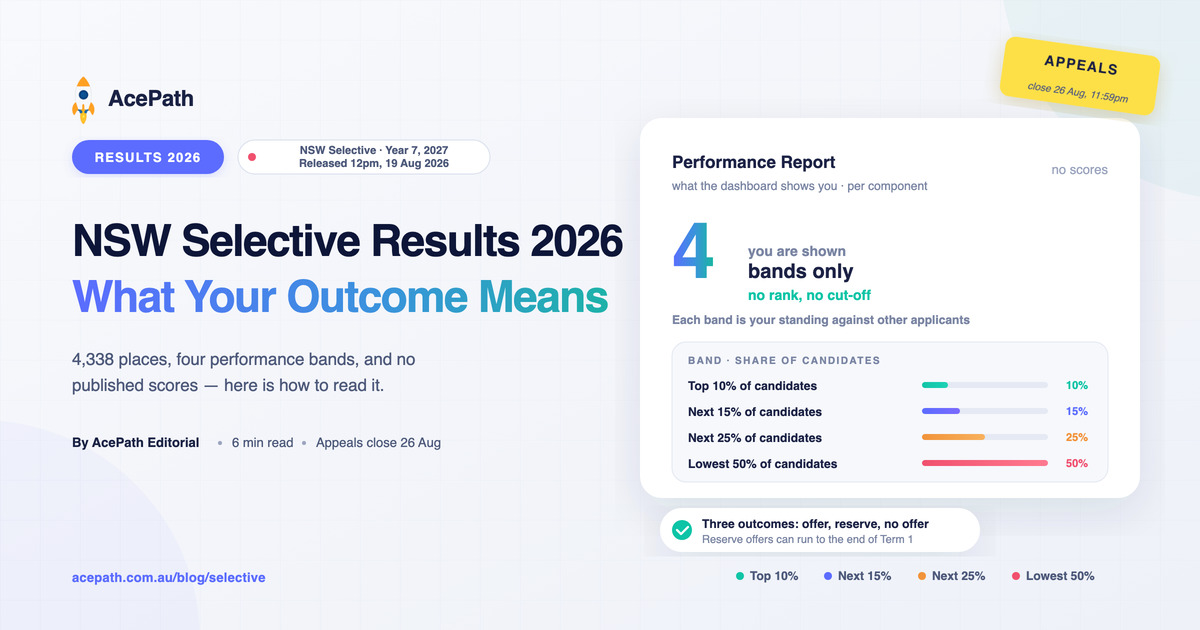
NSW Selective High School placement outcomes for Year 7 entry in 2027 were released from 12pm on Wednesday 19 August 2026, online only, through the application dashboard you used to apply. There are 4,338 Year 7 places across NSW selective settings, and every applicant receives one of three outcomes: an offer, a place on a school's reserve list, or no offer in this round.
If you have just opened your dashboard and are trying to work out what the report in front of you actually means, this guide walks through the performance bands, the three outcomes, the deadlines that now matter, and what changed this year.
Where to Find Your Child's Outcome
Nothing is posted to your home and your child's current school is not told first. To see the outcome:
- Log in to the application dashboard at the NSW Department of Education's selective and OC placement portal, using the same account you applied with.
- Open the Action menu and select "View outcomes".
- Check your email — including spam and junk. The department sends an email alert on release day, and it is easy to miss.
- Reset a forgotten password immediately. Being locked out on results day is the single most common avoidable panic.
Reading the Performance Report: Four Bands, No Scores
Alongside the outcome you receive a performance report. This is the part that surprises most families: the department does not publish your child's individual score, their rank, or any school's cut-off. Instead, each test component is reported as one of four bands showing where your child sat relative to all other candidates.
| Band | What it means |
|---|---|
| Top 10% of candidates | Your child was in the strongest tenth of the state-wide applicant pool for that component. |
| Next 15% of candidates | Roughly the 75th–90th percentile of applicants. |
| Next 25% of candidates | Roughly the 50th–75th percentile of applicants. |
| Lowest 50% of candidates | The bottom half of the applicant pool for that component. |
Two things are worth holding on to. First, the bands describe relative standing among applicants, not the percentage of questions answered correctly — and the applicant pool is already a self-selected, high-performing group, so "lowest 50%" of this cohort is a very different thing from "bottom half of Year 6". Second, the bands are not the placement score itself. The actual placement score combines test components with school assessment moderation; we explain that in detail in how selective placement scores are calculated.
The Three Possible Outcomes
1. An offer
Your child has a place. You accept or decline through the dashboard by the stated deadline — an offer not responded to in time can be withdrawn, so diarise that date before you do anything else. Because you nominated up to 3 selective schools in order of preference, the offer is for the highest preference your child qualified for. The order never changed their odds at any individual school; it only decided which offer arrived if they qualified for more than one.
2. A place on the reserve list
No offer in the first round, but your child is on a school's reserve list, grouped into a band that estimates the likelihood and timing of a later offer. Places genuinely do move as families decline, and for selective high schools offers can continue up to the end of Term 1 of the entry year. Keep your contact details current and respond quickly. Our guide to the selective reserve list explains how the bands move.
3. No offer this round
Your child was not offered a place and is not on a reserve list. It is a hard morning, but it closes one door, not the pathway. Entry to selective high schools is also available in Years 8 to 12 through a separate application process, and a strong partially selective or comprehensive school serves an enormous number of high-achieving students superbly.
The Deadlines That Matter Now
| What | When |
|---|---|
| Selective outcomes released | From 12pm, 19 August 2026 |
| Appeals close | Approximately 5 business days after release — 26 August 2026, 11:59pm |
| Accept or decline an offer | By the date shown in your dashboard |
| Reserve list offers can continue | Until the end of Term 1, 2027 |
| OC (天才班) placement outcomes | 9 September 2026 |
Confirm every one of these against your own dashboard and the department's official outcomes page — a third-party website, including this one, should never be your only source for a deadline.
Should You Appeal?
Appeals are submitted through the dashboard, with a maximum of three supporting documents, and are reviewed by a panel that includes school principals and an educational director. Late appeals are not accepted at all.
The critical thing to understand is what an appeal is for. A valid appeal generally rests on illness or misadventure that affected your child on test day and was documented at the time, or on an administrative error. A score that is simply lower than you hoped is not grounds for an appeal, and an appeal is not a re-mark. Read the five-business-day appeal window and how offer rounds and appeals work before you spend the week writing one.
What Changed for This Cohort
Two changes make the 2027 intake different from previous years.
- Equal places for boys and girls. From 2027 entry, every co-educational selective high school and opportunity class has a set number of places for girls and for boys. The department introduced this after the selective cohort drifted to roughly 58% boys and 42% girls, with girls' share of Year 7 selective placements falling from 45% in 2019 to 41% in 2025. Entry remains based on performance in the placement test. We covered the policy in full in gender parity in NSW selective and OC placement from 2027.
- Testing at local public schools. From 2026 the placement test has been sat in local public school settings rather than large centralised venues.
Up to 20% of places at each school are also held for students from equity groups, which is a long-standing provision rather than a new one.
Frequently Asked Questions
When were NSW selective results released in 2026?
From 12pm on 19 August 2026, for Year 7 entry in 2027, through the online application dashboard with an email alert on the day.
Why can't I see my child's test score or rank?
Because the NSW Department of Education does not publish individual scores, ranks, or school cut-offs. You receive a performance report showing four relative bands per component. Any "cut-off score" list you find online is an unofficial estimate.
How many selective places were available?
4,338 Year 7 places across 48 selective high schools — 17 fully selective, 27 partially selective and 4 agricultural — plus Aurora College, which offers 100 places (50 for boys, 50 for girls) for rural and remote students.
Does a reserve list place mean my child will get in?
Not guaranteed, but it is a live prospect. Offers move through reserve lists as families decline, and can continue up to the end of Term 1 of the entry year. Stay reachable and respond fast.
When do OC results come out?
9 September 2026, about three weeks after the selective outcomes. See our 2026 selective and OC results date guide.
Can my child try again for a selective school?
Yes. Entry is available in Years 8 to 12 through a separate application to individual schools, based on school reports, assessments and available vacancies rather than the Year 6 placement test.
Whatever Today's Outcome, the Next Step Is the Same
For families with an offer, the work now is settling in. For families on a reserve list or without an offer this round — and for the Year 4 families waiting on OC outcomes on 9 September — the most useful thing you can do this week is keep the study routine intact rather than stopping it cold. Start with a free AcePath sample quiz to see exactly where your child sits across Reading, Mathematical Reasoning and Thinking Skills, and browse every school and its intake on our NSW selective schools directory. When you are ready for structured practice, our practice test packs mirror the real Cambridge-style format.
Start Practising Today
Try a free sample quiz to experience AcePath's exam-style practice tests.
Try Sample Quiz Register Free